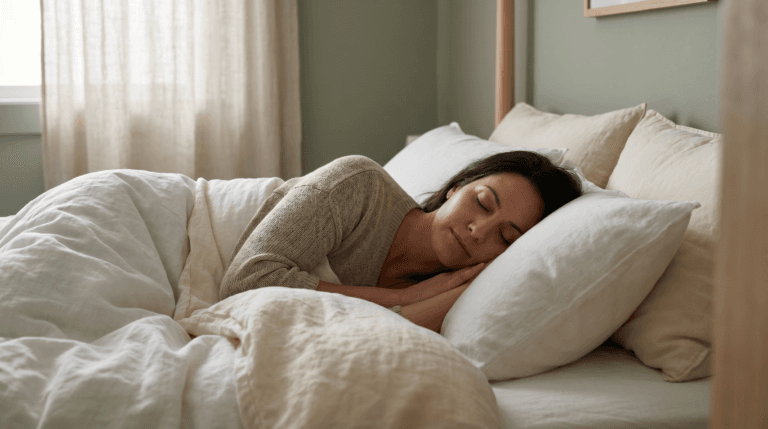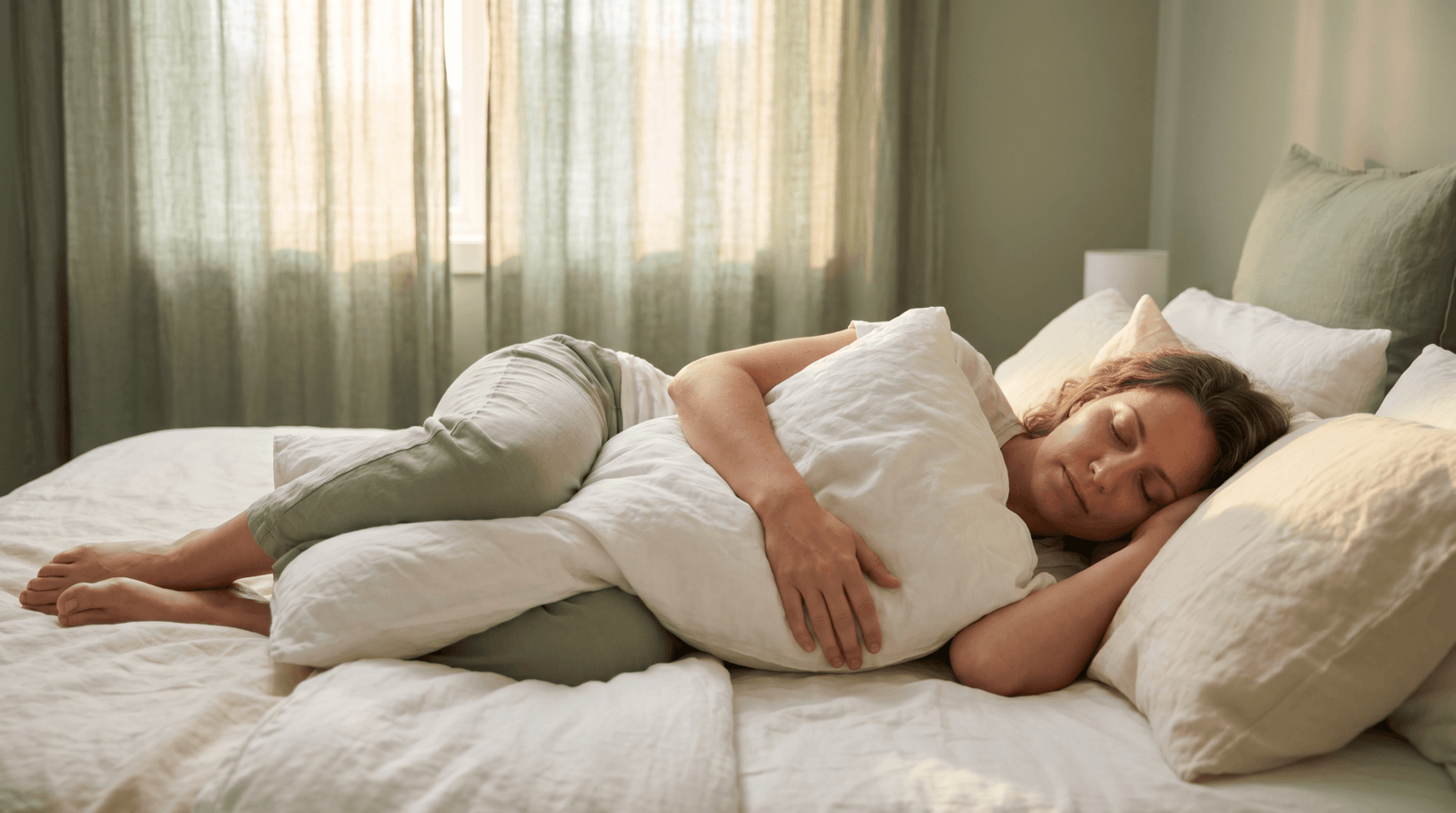
If you’re a side sleeper, you’re in the majority. A 2024 SSRS Opinion Panel survey of 3,364 nationally representative US adults found that 69% of US adults usually sleep on their side, compared to 19% on their back and 12% on their stomach (SSRS, 2024). When sleep researchers track actual movement during sleep with accelerometers, the time-in-bed numbers are slightly different, about 54% on the side, 38% on the back, 7% prone, but the side is still the dominant position by a clear margin (Skarpsno et al., 2017).
This article covers what the research actually says about side sleeping benefits, where the famous brain-clearance research comes from (and what its limitations are), how the fetal position fits in, and the real downsides side sleepers run into and how to address them. As always, we’re a research curator, not a doctor, so we cite, summarize, and stop short of any “you should sleep this way” framing.
Key Takeaways
- About 69% of US adults are side sleepers, the majority position by a clear margin.
- Side sleeping benefits include reduced snoring, better acid clearance on the left side, possibly improved brain waste clearance, and fewer musculoskeletal issues than stomach sleeping.
- Most side sleepers naturally curl into some version of the fetal position with at least one knee bent, this is normal and fine for most people.
- The real downsides are manageable: shoulder pressure, hip pressure, and facial creasing on the side you sleep on.
- The right setup (medium-firm mattress, supportive pillow, pillow between the knees) addresses most of the downsides.
Why Most Researchers Recommend Side Sleeping
The case for side sleeping isn’t one big study, it’s the consistency of the research across multiple outcomes. Side sleeping doesn’t have a single dramatic advantage; it has small-to-moderate advantages across most things sleep position affects, with fewer downsides than the alternatives.
Snoring and Sleep Apnea
Side sleeping reduces airway obstruction. About 50-60% of obstructive sleep apnea patients have what’s called positional sleep apnea, where breathing events more than double when supine compared to lateral (Ravesloot et al., 2013). For non-apnea snoring, the same gravity-on-soft-tissue mechanism applies, supine collapses the airway, lateral keeps it open. We covered this in detail in Best Sleeping Position for Snoring & Sleep Apnea.
Acid Reflux (Left Side Specifically)
The left side has the strongest research evidence for nighttime reflux. The 2022 Schuitenmaker study found median acid exposure time of 0.0% on the left side compared to 1.2% on the right and 0.6% supine, with acid clearance about 2.5 times faster on the left (Schuitenmaker et al., 2022). The 2022 American College of Gastroenterology guidelines specifically recommend left-side sleeping as a GERD lifestyle modification. Full deep-dive at Best Sleeping Position for Acid Reflux & GERD.
Brain Waste Clearance (the Glymphatic Research)
The 2015 Stony Brook study by Lee, Xie, Iliff, Nedergaard, and Benveniste is the most-cited research on side sleeping and brain health. Researchers measured glymphatic transport, how the brain clears metabolic waste during sleep, across three sleeping positions in mice. Lateral position was the most efficient, supine was second, and prone was the least (Lee et al., J. Neuroscience, 2015).
The honest caveat: this was a rodent study. The mechanism, gravity-assisted cerebrospinal fluid movement through the brain’s perivascular spaces, is plausible in humans but hasn’t been directly confirmed by human RCTs. Side sleeping likely has some glymphatic advantage in humans too, but we don’t have proof.
Spinal Posture
A 2019 scoping review of spinal posture during sleep concluded that supported side-lying is associated with fewer musculoskeletal symptoms than three-quarter side-lying or prone positions (Cary et al., 2019). The “supported” qualifier matters, side sleeping with proper pillow support and a knee pillow is meaningfully different from collapsed-into-the-mattress side sleeping.
Side Sleeping Benefits and Risks at a Glance
Side sleeping has the most consistent research support across the most outcomes, but it isn’t free of trade-offs. The table below summarizes the major effect domains with the strength of evidence and the practical implication for an average adult.
| Domain | Effect | Evidence strength |
|---|---|---|
| Snoring / sleep apnea | Reduced events on side vs back | Strong (clinical RCTs) |
| Acid reflux (left side) | 2.5x faster acid clearance vs right | Strong (2022 ACG guideline) |
| Brain waste clearance | Lateral most efficient (rodent) | Mechanistic (mouse only) |
| Spinal alignment | Fewer symptoms vs prone | Moderate (scoping review) |
| Shoulder pressure | Increased; rotator cuff risk | Clinical observation |
| Facial creasing | Real but minor vs sun/genetics | Dermatologic consensus |
Fetal Position vs Straight Side
“Fetal position sleeping” is the term most people use for tightly curled side sleeping with the knees drawn up toward the chest. It’s by far the most common variant, most side sleepers are partial fetal sleepers without thinking about it, and the research treats it as a subset of side sleeping rather than a distinct category.
The mechanical differences between tightly curled fetal and straight side sleeping are small. The curl can compress the diaphragm slightly, which may matter for people with breathing-related conditions (the 2015 glymphatic research used lateral with relatively neutral leg position, not extreme fetal). For most adults, fetal vs straight side is a comfort preference, not a clinical issue. If you’ve been sleeping in a fetal position your whole life and feel fine, no reason to change.
One thing worth noting: the deepest fetal positions can put the spine into a sustained mild flexion that some people find aggravates lower back pain over years. If you’re a fetal sleeper with chronic low back stiffness in the morning, opening up the curl slightly and adding a pillow between the knees often helps without requiring a full position change. We covered the broader low-back-pain question in Best Sleeping Position for Back Pain.
Left Side or Right Side?
For most people without specific conditions, left and right are roughly equivalent. The differences only matter when one of two specific conditions is in play.
- Acid reflux/GERD: left side is clearly better.
- Late pregnancy: side sleeping (left preferred) is recommended after about 28 weeks because the gravid uterus can compress the inferior vena cava when supine. We covered this in Best Sleeping Position During Pregnancy.
For everything else, snoring, brain clearance, general spinal posture, left and right are essentially the same. If you have a strong side preference, sleep on whichever feels natural. If you don’t, defaulting to the left is a reasonable insurance policy in case reflux develops later (it does for many adults as they age).
The Real Downsides of Side Sleeping
Side sleeping isn’t free of issues. Honest version of the trade-offs:
Shoulder Pressure and Pain
The shoulder you sleep on bears most of your upper body weight for hours at a time. Over years, this can contribute to rotator cuff issues, shoulder impingement, and morning shoulder stiffness. The interventions that help: a thicker pillow (so you’re not crushing the shoulder forward), sleeping with the bottom arm extended forward and out from under your body, switching shoulders periodically, and a mattress with enough give at the shoulder zone to avoid hard pressure points.
Hip Pressure
Same idea, different joint. Side sleeping puts most of your lower body weight on the hip you’re lying on. A medium-firm to firm mattress prevents your hips from sinking too deep and twisting your lower back. A pillow between the knees keeps your top hip aligned with your bottom hip rather than rolling forward and torquing the lower back.
Facial Creasing
Pressing one side of your face into a pillow for 6-9 hours per night, every night, mechanically creases the skin in repeatable patterns. Dermatologists note this as a real but minor factor compared to sun exposure, hydration, and genetics. If you’re young and side-sleeping is otherwise working for you, this isn’t a reason to change. If you’re noticing one-sided facial lines and it bothers you, silk or satin pillowcases reduce the friction component, and switching sides periodically distributes the load.
Numbness in the Arm or Hand
The bottom arm sometimes goes numb from compression of nerves running through the shoulder and upper arm. The fix is usually pillow-based: you want the bottom arm out from under your torso, either extended forward or tucked under the pillow rather than directly compressed by your body weight.
Setting Up for Side Sleeping
If you’ve decided to commit to side sleeping (or already sleep this way and want to optimize), the setup matters as much as the position itself.
The Pillow
You want the cervical spine neutral, the line from your shoulders through your neck to your head should be roughly straight when you’re lying on your side. Side sleepers generally need a thicker pillow than back sleepers. 4-6 inches of fill height is typical. Too thin and your head drops down, kinking your neck toward the bed. Too thick and your head tilts up, kinking your neck the other way.
The Knee Pillow
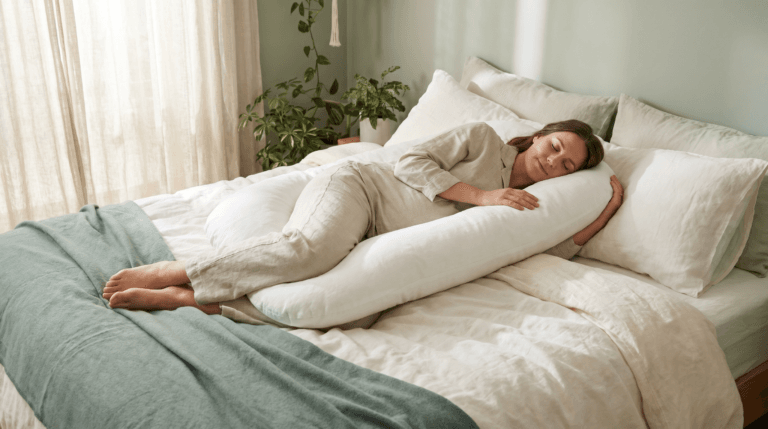
A pillow between the knees keeps your top hip stacked over your bottom hip. A full body pillow does both jobs at once. See our curated body pillow picks for side sleepers across budget, mid, and premium tiers. Without one, the top hip rolls forward, the lower spine twists, and you wake up with lower back stiffness. A small pillow, folded blanket, or dedicated leg pillow all work. The size is less important than the principle of keeping the hips aligned.
The Mattress
Side sleepers need a mattress that gives at the shoulder and hip but supports the waist. Too firm: pressure points at the shoulder and hip, and the waist sags into a curve. Too soft: the whole side sinks, the spine bends, you wake up with low back pain. Medium-firm is the typical recommendation, but the right firmness depends on body weight, heavier sleepers need firmer mattresses to avoid sinking too deep.
The Bedroom Climate
Side sleepers tend to run a bit warmer than back sleepers because the body has more contact with the mattress and bedding, reducing airflow. If you’re a side sleeper who runs hot, the climate matters as much as the position. We covered the sleep-temperature research in How to Stay Cool Sleeping: 7 Ways for Hot Summer Nights and the cooling-bedding question in Best Weighted Blankets for Hot Sleepers.
When Side Sleeping Isn’t Right for You
Side sleeping is the best default for most adults, but it isn’t universally optimal. The conditions where it’s contraindicated or specifically problematic:
- Acute shoulder injury or rotator cuff surgery recovery: the affected shoulder shouldn’t be the bottom shoulder. Switch sides.
- Acute hip pain or hip replacement recovery: follow your physical therapist’s guidance. Often back sleeping with a pillow under the knees is recommended in the early recovery weeks.
- Severe respiratory conditions where elevation matters more than position: follow your physician’s guidance.
None of this is medical advice, it’s a list of contexts where the general “side sleeping is good” guidance doesn’t apply uniformly. If you have a specific condition, the answer is “talk to your doctor,” not “follow this blog.”
Frequently Asked Questions
What are the main benefits of side sleeping?
Side sleeping has the most consistent research support across multiple outcomes, reduced snoring and sleep apnea events (9% to 60% of OSA patients have positional apnea where supine events more than double lateral events), better acid clearance on the left side specifically (acid clearance about 2.5 times faster than on the right), possibly better brain waste clearance during sleep based on rodent research, and fewer musculoskeletal symptoms than stomach sleeping per a 2019 scoping review. About 69% of US adults are already side sleepers, and most sleep researchers consider it the best default for most adults.
Is fetal position sleeping bad for you?
For most people, no. The fetal position is a tightly curled side variant, and it’s the most common way side sleepers actually sleep. Mechanical differences between tightly curled fetal and straight side sleeping are small. Notably, the deepest fetal positions can put the spine into sustained mild flexion that some people find aggravates lower back pain over years. If you’re a fetal sleeper with chronic morning back stiffness, opening up the curl slightly and adding a pillow between the knees often helps without requiring a full position change.
Should side sleepers sleep on their left or right?
For most people without specific conditions, left and right are roughly equivalent. The left side has stronger evidence for two specific conditions: acid reflux and late pregnancy. If you have nighttime reflux, left-side sleeping reduces acid exposure time substantially. In late pregnancy, side sleeping (left preferred) keeps the gravid uterus from compressing the inferior vena cava. For everything else, snoring, brain clearance, general spinal posture, left and right are essentially the same.
Why does my shoulder hurt from side sleeping?
The shoulder you sleep on bears most of your upper body weight for hours at a time, which can contribute to rotator cuff issues, shoulder impingement, and morning stiffness over years. The interventions that help: a thicker pillow so you’re not crushing the shoulder forward, sleeping with the bottom arm extended out from under your body, switching shoulders periodically, and a mattress with enough give at the shoulder zone. Persistent shoulder pain that doesn’t respond to setup changes warrants medical evaluation.
Does side sleeping cause facial wrinkles?
It can contribute. Pressing one side of your face into a pillow for 6-9 hours per night mechanically creases the skin in repeatable patterns. Dermatologists note this as a real but minor factor compared to sun exposure, hydration, and genetics. If facial-wrinkle prevention is the only reason you’re considering changing sleeping position, the impact is small. Silk or satin pillowcases reduce the friction component, and switching sides periodically distributes the load.
What kind of pillow do side sleepers need?
Side sleepers generally need a thicker pillow than back sleepers, typically 4-6 inches of fill height, to keep the cervical spine neutral. The line from your shoulders through your neck to your head should be roughly straight when you’re lying on your side. Too thin and your head drops, kinking your neck toward the bed. Too thick and your head tilts up, kinking your neck the other way. A separate pillow between the knees keeps your top hip aligned with your bottom hip and reduces lower back twisting.
References
- SSRS Opinion Panel. (2024). How the American Public Sleeps. SSRS
- Skarpsno, E.S. et al. (2017). Sleep positions and nocturnal body movements based on free-living accelerometer recordings. Nature & Science of Sleep. PMC5677378
- Lee, H., Xie, L., Iliff, J.J., Nedergaard, M., Benveniste, H. (2015). The effect of body posture on brain glymphatic transport. Journal of Neuroscience. jneurosci.org
- Stony Brook University. (2015). Press release: lateral sleep position and brain clearance. Stony Brook
- Reddy, O.C. & van der Werf, Y.D. (2020). The sleeping brain: harnessing the power of the glymphatic system through lifestyle choices. Brain Sciences. PMC7698404
- Cary, S.J. et al. (2019). Spinal posture during sleep: a scoping review. PMC6609073
- Ravesloot, M.J.L. et al. (2013). Positional therapy in position-dependent snoring and OSA. PMC3817704
- Schuitenmaker, J.M. et al. (2022). The effect of sleep position on gastroesophageal reflux. PubMed 34928874