You’re exhausted. You’ve tried deep breathing, white noise, and counting sheep. Nothing works — your brain just won’t shut off. What if the problem isn’t that you can’t sleep, but that you haven’t found the right bridge between waking and sleeping?
Yoga nidra for sleep might be that bridge. Sometimes called “yogic sleep,” it’s a guided relaxation technique that walks your body and mind through a structured wind-down. And unlike most sleep meditation techniques, yoga nidra doesn’t ask you to clear your mind. It gives your mind something specific to do — and that’s exactly why it works for overthinkers.
A 2023 sleep lab study found that 78% of insomnia patients fell asleep during a single yoga nidra session, with an average sleep onset time of just 9 minutes (Journal of Psychosomatic Research, 2023). In comparison, most sleep aids don’t come close to that.
Key Takeaways
- Yoga nidra for sleep helped 78% of insomnia patients fall asleep during practice, averaging 9 minutes to sleep onset (Journal of Psychosomatic Research, 2023).
- A single session reduced self-reported anxiety by 18% — a key barrier to falling asleep.
- Yoga nidra works by systematically relaxing the body while keeping awareness in a hypnagogic state between waking and sleeping.
- Sessions as short as 12 minutes improve sleep quality when practiced daily.
What Is Yoga Nidra and How Does It Help You Sleep?
A 2026 systematic review of 15 randomized controlled trials found that yoga nidra significantly improves sleep quality across populations with insomnia, anxiety, and chronic stress (Dutta et al., Journal of Primary Care & Community Health, 2026). Unlike progressive muscle relaxation or standard meditation, yoga nidra keeps you in a specific in-between state — not fully awake, not fully asleep.
Here’s why that matters for sleep. Your brain moves through stages: beta (alert), alpha (relaxed), theta (drowsy), delta (deep sleep). Most people try to jump straight from beta to delta. However, that rarely works when you’re stressed. Yoga nidra guides you through alpha and theta gradually. You’re aware but deeply relaxed.
What makes this unique is a phenomenon researchers call “local sleep.” A 2022 EEG study found that during yoga nidra, delta power increased by 1.95 dB in the central brain regions (p = 0.033) while participants remained electrophysiologically awake (PMC, 2022). Parts of your brain enter deep-sleep-like states while you’re still conscious. Consequently, no other relaxation technique produces this pattern.
The technique follows a predictable structure: intention setting, body scan, breath awareness, visualization, and return. Each step shifts your nervous system further from sympathetic (fight-or-flight) to parasympathetic (rest-and-digest) mode.
A 2022 review in Sleep and Vigilance reported that yoga nidra practice produces significant increases in alpha EEG activity (p < 0.01), indicating the relaxation response engages within minutes of beginning the practice — before most participants even feel drowsy (Sleep and Vigilance, 2022).
Does Yoga Nidra Actually Work for Insomnia?
The strongest evidence comes from a 2023 randomized sleep lab study by Sharpe et al. Twenty-two adults with self-reported insomnia practiced yoga nidra under polysomnographic monitoring. The results were clear: 78% of participants fell asleep during the 30-minute practice, averaging just 9 minutes to sleep onset (Journal of Psychosomatic Research, 2023).
For context, that’s worth comparing. The average adult with insomnia takes 25-45 minutes to fall asleep. Yoga nidra cut that to 9 minutes in most participants — without medication. A separate feasibility study found that people with sleep onset latency of 30-120 minutes experienced a 34-minute reduction after consistent practice (p = 0.017), and state anxiety dropped 41% (PMC, 2021).
What about longer-term effects? In a 2023 study of COVID-19 healthcare workers, 30 minutes of daily yoga nidra for just two weeks halved their Insomnia Severity Index scores — from 6.10 to 3.03 (p < 0.001). The music-listening control group showed no change (PubMed, 2023). Anxiety scores dropped from 4.93 to 2.33 in the same period.
A 2026 meta-analysis — the largest ever — pooled 73 studies with 5,201 participants and confirmed large effect sizes for anxiety reduction (Hedges’ g = -1.35) and stress reduction (g = -0.80) compared to active controls (Annals of the New York Academy of Sciences, 2026).
Worth noting: 70% of participants in the sleep lab study reported perceived benefit after a single session. When something feels like it works on night one, you’re more likely to do it on night two.

How Is Yoga Nidra Different from Regular Sleep Meditation?
You might be wondering: isn’t this just sleep meditation with a different name? Not quite. A 2023 PLoS ONE study comparing yoga nidra practitioners with non-practitioners found that yoga nidra improved not just sleep quality but also cognitive processing speed and memory accuracy — benefits that standard sleep meditations don’t typically produce (PLoS ONE, 2023).
Here’s the core difference. Regular sleep meditation usually focuses on one thing — breath, a mantra, or a body scan. Yoga nidra moves through multiple stages in a specific sequence. Each stage targets a different layer of tension:
Physical tension
Specifically, the body scan portion systematically releases muscle groups. It’s similar to progressive muscle relaxation but without the active tensing. You simply bring awareness to each area and let it soften.
Mental tension
Meanwhile, the visualization and intention-setting stages give your analytical mind something constructive to do. Instead of fighting thoughts, you channel them.
Emotional tension
On an emotional level, the practice includes stages for observing sensations and emotions without reacting. This is particularly helpful if anxiety is what’s keeping you awake. The Sharpe et al. study measured an 18% reduction in self-reported anxiety after a single session.
If breathing exercises help you calm down but don’t bridge you to actual sleep, yoga nidra picks up where breathing leaves off.
How to Practice Yoga Nidra for Sleep (Step-by-Step)
Generally, a guided audio recording is the most practical way to practice. But understanding the structure helps you know what to expect — and why each step matters. Here’s a typical 20-minute yoga nidra for sleep sequence.
If you want to see what a full yoga nidra for sleep session looks like before trying it yourself, this guided practice by Ally Boothroyd is one of the best available:
Step 1: Get Into Position (2 minutes)
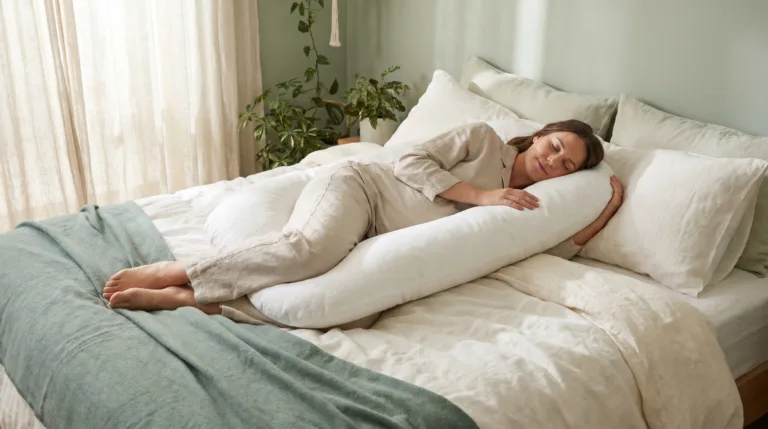
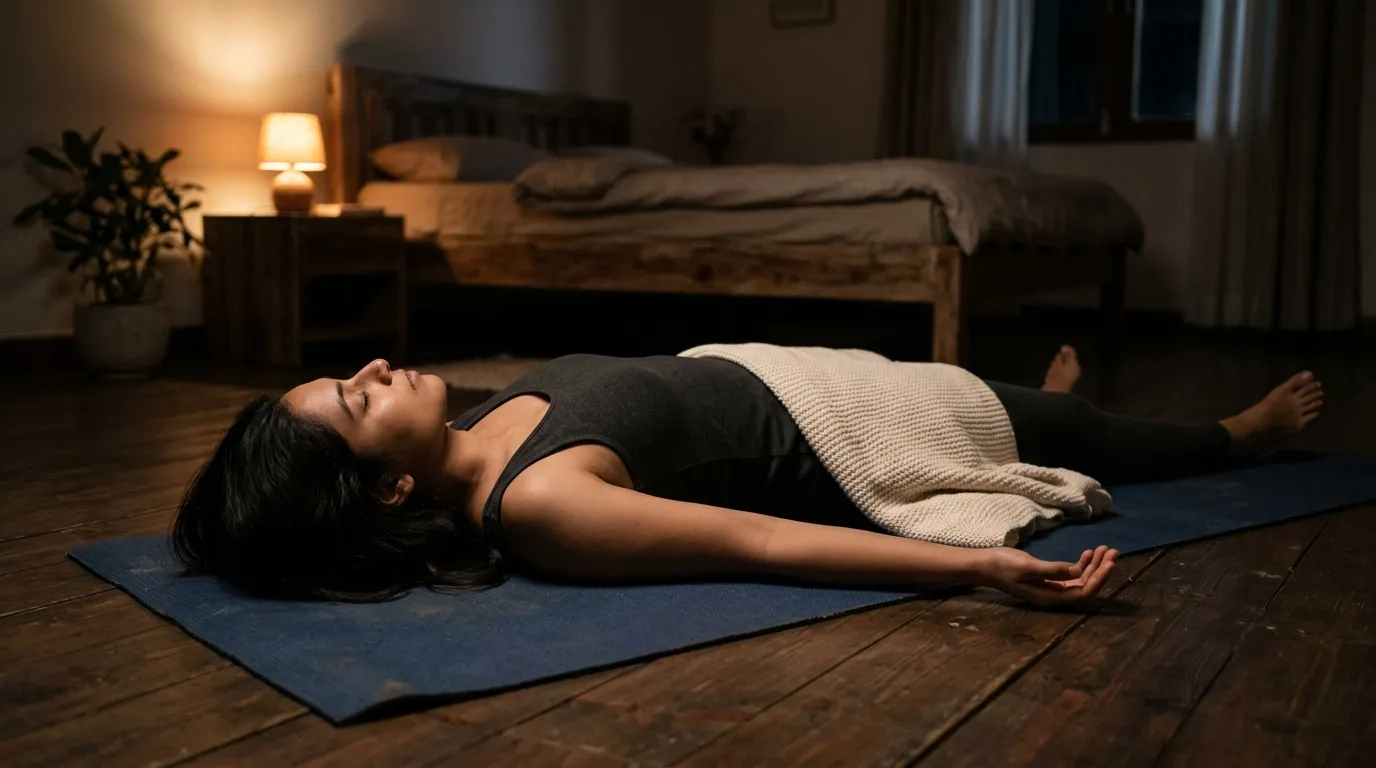
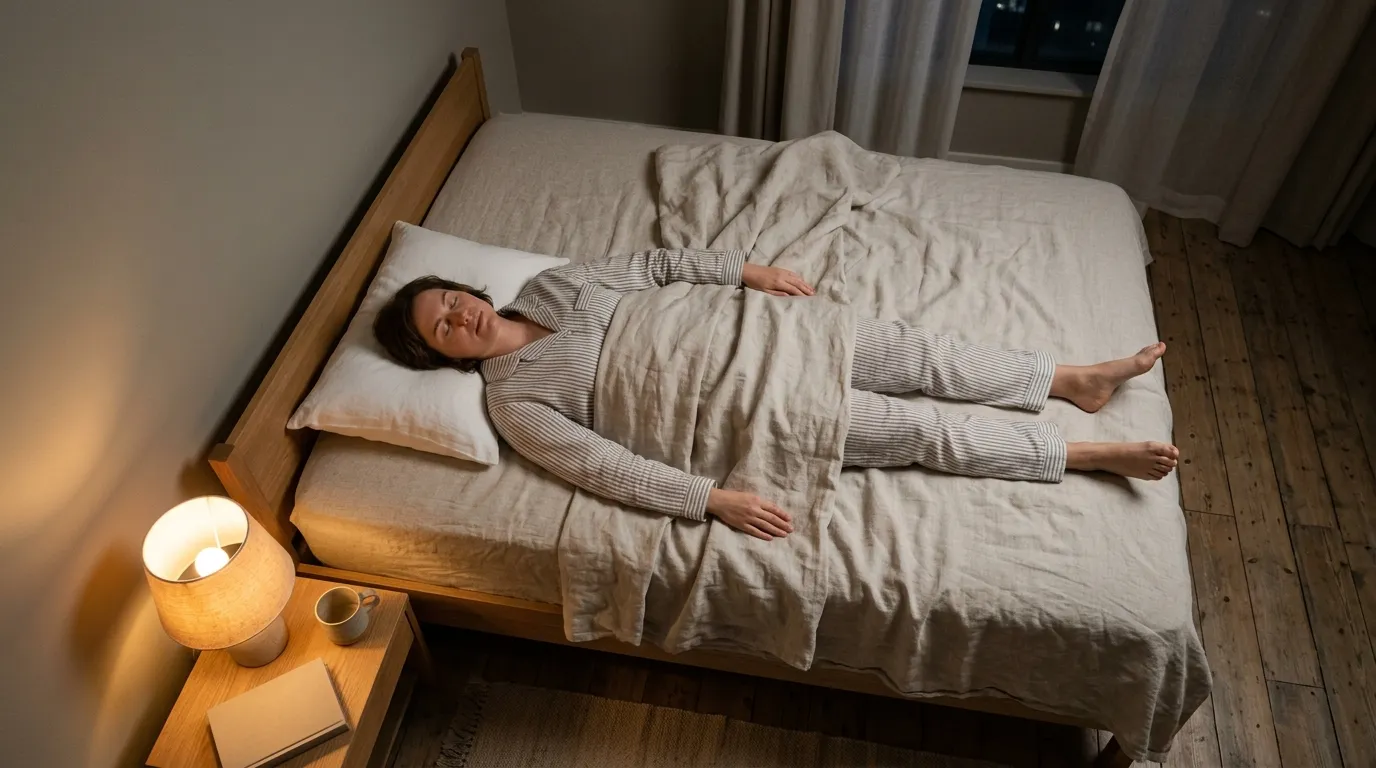
Lie on your back in savasana. Arms at your sides, palms facing up. Additionally, a pillow under your knees takes pressure off your lower back. Cover yourself with a blanket — your body temperature drops during deep relaxation. For the broader question of which sleeping position is best for daily sleep, see our research roundup.
You can do this in bed. Unlike seated meditation, yoga nidra is designed for the lying-down position. If you tend to fall asleep — that’s the point.
Step 2: Set a Sankalpa (1 minute)
A sankalpa is a short intention or resolve. Keep it simple and present-tense: “I fall asleep easily” or “I release the day.” Repeat it mentally three times. In effect, this gives your subconscious a direction before the conscious mind fades.
Step 3: Body Scan (5-7 minutes)
During this phase, the guide will move your awareness through body parts in rapid succession: right thumb, index finger, middle finger… right palm, wrist, forearm… Each area gets just 2-3 seconds of attention before moving on.
This rapid rotation prevents your mind from wandering because it’s constantly being redirected. It’s the mechanism that makes yoga nidra work for people who can’t focus during meditation.
Step 4: Breath Awareness (3-4 minutes)
Simply observe your natural breath. Don’t change it. Some guides add counting — breathing in for 4, out for 6. The slightly extended exhale activates your vagus nerve, the same mechanism that makes 4-7-8 breathing effective for sleep.
Step 5: Visualization (3-4 minutes)
Next, the guide will describe images: a quiet lake, stars, a warm light spreading through your body. These visualizations engage the right hemisphere and reduce left-brain analytical chatter. This stage is where most people drift off.
Step 6: Return (2 minutes)
Finally, the guide slowly brings you back — or doesn’t, if you’ve fallen asleep. If you’re using yoga nidra specifically for sleep, there’s no need to “complete” the practice. Falling asleep during it is success, not failure.
How Long Should a Yoga Nidra for Sleep Session Be?
A 2022 RCT found that just 11 minutes of daily yoga nidra for 30 days significantly reduced stress and improved sleep quality in 341 participants compared to controls (Moszeik et al., Current Psychology, 2022). A follow-up study by the same team confirmed biological changes: 11 minutes daily reduced total salivary cortisol (p < 0.001) after two months (Stress and Health, 2025). In other words, that’s shorter than most people expect.
Here’s a practical breakdown by experience level:
For a body-scan focused approach from the largest sleep meditation channel on YouTube, try this one from Jason Stephenson:
If you’re just starting (week 1-2): Start with a 15-20 minute guided recording. You need enough time for the full body scan. Shorter sessions skip stages and feel rushed.
After a few weeks (week 3-4): 20-30 minutes is the sweet spot used in most clinical studies. The Sharpe et al. sleep lab study used 30-minute sessions.
Once you’re comfortable (month 2+): Some practitioners condense the technique to 10-12 minutes by moving through the body scan faster. Research suggests this still works if the structure remains intact.
The consistency rule from meditation research applies here too. Frequency matters more than duration. A 2025 study found that daily practice frequency is roughly 2.5 times more important than session length for long-term wellbeing (Applied Psychology: Health and Well-Being, 2025). Twelve minutes every night beats 45 minutes twice a week.
What If You Can’t Stop Thinking During Yoga Nidra?
You don’t need to stop thinking. That’s the whole point. Yoga nidra gives your mind tasks — scanning, counting, visualizing. Your job isn’t to be thought-free. It’s to follow the instructions.
Still struggle? Three things help:
Try headphones. For one, external noise pulls you out. Headphones create a sealed environment. Sleep-friendly headband headphones work better than earbuds if you’re lying down.
Pick a consistent time and place. As a result, your brain builds associations. If you practice yoga nidra in bed at 10 PM every night, your body starts anticipating relaxation at 10 PM. This is the same habit-stacking principle behind any effective wind-down routine.
Let go of expectations. Some nights you’ll fall asleep in 5 minutes. Some nights you’ll lie there for 20 minutes and feel nothing happened. But even sessions where you stay awake show measurable reductions in stress hormones and respiratory rate (p = 0.03). Still, the relaxation happens whether you notice it or not.
How Does Yoga Nidra for Sleep Compare to Other Techniques?
How does yoga nidra for sleep compare to other methods? Here’s an honest look:
Versus 4-7-8 breathing: Breathing techniques work fast for acute stress. Yoga nidra works better for people whose insomnia is driven by racing thoughts, because it occupies the mind rather than just calming the body.Yoga nidra vs progressive muscle relaxation: PMR targets physical tension. The practice includes a body scan similar to PMR but adds the visualization and intention stages that address mental and emotional tension.Yoga nidra vs sleep meditation: Overlap exists, but yoga nidra follows a rigid structure with specific stages. Generic sleep meditation is more freeform. For overthinkers, structure works better.
Versus medication: Admittedly, sleep medication works faster on night one. Yoga nidra takes a few sessions to build effectiveness. But yoga nidra has zero side effects, no dependency risk, and the 2023 sleep lab data shows it can get you to sleep in 9 minutes once you’re practiced.
Frequently Asked Questions
Is yoga nidra for sleep safe for everyone?
Yes, for most people. Unlike intensive breathwork techniques such as the Wim Hof method, yoga nidra involves no breath manipulation or physical movement. People with PTSD should use trauma-informed recordings that skip surprise elements in the visualization stage. Pregnant people can practice safely with a bolster for side-lying position.
Can I practice yoga nidra for sleep every night?
Absolutely. Daily practice is encouraged. Research shows daily frequency matters roughly 2.5 times more than session length for building lasting benefits (Applied Psychology: Health and Well-Being, 2025). There’s no upper limit — practicing yoga nidra nightly is like having a bedtime routine, not a medication.
How quickly will yoga nidra for sleep work?
Many people notice effects in the first session. In the 2023 sleep lab study, 78% of insomnia patients fell asleep during their first monitored yoga nidra session, and 70% reported perceivable benefit immediately. Consistent improvements in sleep quality typically appear after 2-4 weeks of daily practice.
What’s the best yoga nidra for sleep app or recording?
Specifically, look for recordings labeled “yoga nidra for sleep” specifically — not general yoga nidra. Good recordings run 20-30 minutes, use a calm monotone voice, and include the full structure (body scan, breath awareness, visualization). Insight Timer offers several free options. The iRest protocol is a well-researched clinical adaptation.
Can yoga nidra for sleep replace medication?
For some people, yes — over time. The American Academy of Sleep Medicine recommends non-pharmaceutical approaches like relaxation training as first-line treatment for chronic insomnia. However, don’t stop prescribed medication without consulting your doctor. Yoga nidra works best as a complement, and some practitioners use both during a transition period.
Ready to Try Yoga Nidra for Sleep Tonight?
In short, you don’t need a yoga mat, a quiet room, or any experience. Just lie in bed, put on a 20-minute yoga nidra for sleep recording through headphones, and follow the instructions. That’s the entire commitment for night one.
If the racing thoughts are your main barrier to sleep, yoga nidra was built for exactly that problem. It gives your mind a job — scanning, counting, imagining — so it stops defaulting to tomorrow’s to-do list.
The science supports it. The practice is free. And unlike sleep medication, there’s nothing to taper off.
For more sleep techniques, see our complete guide to better sleep. If you want to start with something simpler first, try the 4-7-8 breathing technique for sleep — it takes under a minute.
References
- Sharpe, E. et al. (2023). A Closer Look at Yoga Nidra: Early Randomized Sleep Lab Investigations. Journal of Psychosomatic Research. PMC9973252
- Ghai, S. et al. (2026). Meta-Analysis of Yoga Nidra on Stress, Anxiety, and Depression (73 studies, N=5,201). Annals of the New York Academy of Sciences. Wiley
- Moszeik, E. et al. (2025). Yoga Nidra and Salivary Cortisol: An RCT. Stress and Health. PMC12080877
- Moszeik, E. et al. (2022). Short Yoga Nidra Meditation (11 min): Effects on Stress, Sleep, and Well-Being. Current Psychology. Springer
- Datta, K. et al. (2023). Improved Sleep, Cognitive Processing and Enhanced Learning with Yoga Nidra. PLoS ONE. PMC10688709
- EEG Delta Power During Yoga Nidra: Local Sleep Phenomenon (2022). PMC9315270
- COVID-19 Healthcare Workers Yoga Nidra Pilot RCT (2023). PubMed
- Feasibility Study: Yoga Nidra for Insomnia and Sleep Onset Latency (2021). PMC8135531
- Pandi-Perumal, S.R. et al. (2022). The Origin and Clinical Relevance of Yoga Nidra. Sleep and Vigilance. PMC9033521
- Bowles, D. & Van Dam, N. (2025). Meditation Frequency vs Duration. Applied Psychology: Health and Well-Being. PMC12336962