You wake up with a stiff neck. Again. You read somewhere that stomach sleeping is “the worst position you can choose.” So now you’re lying awake at 1 AM, flipped onto your back, certain you’ll never fall asleep this way, and quietly wondering whether you’ve spent two decades wrecking your spine.
The honest answer: stomach sleeping isn’t great, but the panic around it is overstated. Roughly 7-17% of adults sleep this way (the range varies by survey), and most of them function fine. The mechanics are real, sustained neck rotation, flattened lumbar curve, restricted breathing, but those mechanics produce measurable problems mostly in people who already have neck or back pain, or who get less than five hours of sleep on their back when they try to switch.
This piece pulls together what sleep research actually says about stomach sleeping, who should care, and the one practical workaround Mayo Clinic recommends if you can’t change. We synthesized 8 studies and clinical guidelines from Sleep Foundation, Mayo Clinic, Keck Medicine, and peer-reviewed literature on sleep posture and waking symptoms.
Key Takeaways
- Only about 7-17% of US adults sleep on their stomach as their primary position (varies by survey methodology).
- Stomach sleeping forces sustained cervical rotation to one side for hours, which correlates with higher waking neck pain (PLOS One, 2021).
- The Mayo Clinic workaround: a thin pillow under the pelvis, which restores partial lumbar curve and reduces lower-back strain.
- Switching positions takes roughly 2-4 weeks of consistent practice for the new position to feel less alien, with full automaticity taking longer (median 66 days per Lally et al., 2010). Trying to white-knuckle it in one night usually fails.

How Many People Actually Sleep on Their Stomach?
About 7-17% of US adults sleep on their stomach as their primary position, depending on the survey. A widely cited figure puts side sleepers at 54-74% of adults, back sleepers at 10-37%, and stomach sleepers at the bottom, making prone sleeping the least common adult position by a clear margin (Sleep Foundation, 2025).
Among US adults, roughly 7-17% sleep on their stomach as their primary position, while side sleepers make up 54-74% and back sleepers 10-37%. The wide range across surveys reflects different methodologies, but stomach sleeping is consistently the least common adult position.
The split matters because stomach sleeping is heavily over-represented in people who report waking spinal symptoms. A 2021 cross-sectional study published in PLOS One found that participants who reported prone as their dominant sleep posture also reported the highest percentage of waking cervical symptoms, meaning if you wake with neck pain, your sleeping position is statistically likely to be part of the cause (Cary et al., PLOS One, 2021).
If you sleep on your stomach and have no pain, you’re in a smaller subgroup, and the urgency to change is lower. If you sleep on your stomach and wake with neck or lower-back pain, the position is the cheapest variable to change before you start spending money on pillows, mattresses, or PT.
Why Sleep Researchers Flag Stomach Sleeping
Researchers consistently flag stomach sleeping for three independent mechanical reasons, not because it’s “wrong” in some abstract sense. Each mechanism has its own evidence base, and not all three apply equally to every person.
Sustained Cervical Rotation
To breathe while prone, you have to rotate your neck sustained cervical rotation to one side to one side for the duration of sleep. EMG and MRI studies show this sustained rotation significantly elevates muscle strain and morning pain compared to neutral spine positions (Yamada et al., PMC, 2017).
The mechanism is straightforward: muscles aren’t designed to hold a rotated position for 6-9 hours. They cramp. The cramp is what you feel as morning stiffness.
Lumbar Curve Flattening
The natural lumbar spine has a slight inward curve. When you lie face-down, gravity pulls your abdomen toward the mattress, which flattens that curve and over-extends the lower back. Dr. Raymond Hah, a spine surgeon at the USC Spine Center, describes this as putting “the most pressure on your spine’s muscles and joints” of any sleep position (Keck Medicine USC, 2024).
According to spine specialists at the USC Spine Center, stomach sleeping flattens the natural curve of the lumbar spine and forces the lower-back muscles into sustained over-extension. This mechanism is the primary reason stomach sleeping is associated with higher rates of waking lumbar pain in adult cohort studies.
Younger sleepers can usually absorb this load. After 35-40, accumulated wear amplifies it, which is why people who slept fine on their stomach for decades sometimes start waking with lower-back pain in their 40s.
Restricted Diaphragmatic Breathing
Stomach sleeping compresses the chest and abdomen against the mattress, which restricts the downward movement of the diaphragm. The result is shallower, more chest-driven breathing for the entire sleep period. For people with no respiratory issues, this is mostly cosmetic. For people with mild sleep-disordered breathing or congestion, it makes things measurably worse.

The One Workaround Sleep Researchers Recommend
If you can’t switch positions, place a thin pillow or folded towel under your pelvis. This single change restores some of the lumbar curve, reduces over-extension, and is the only practical workaround that has consistent backing from clinical references including Mayo Clinic’s sleep position guide (2025).
The pillow shouldn’t be thick. The goal is to lift the pelvis just enough to neutralize the lumbar arch, not enough to feel propped up. A folded bath towel works as well as a dedicated pillow. If you sleep with a head pillow, swap it for a thinner one, a thick pillow under your head while prone forces even more cervical rotation.
What this workaround does not fix: the cervical rotation problem. Your neck is still turned. So if your primary stomach-sleeping symptom is morning neck pain, the pelvis pillow won’t solve it. It only addresses the lower-back component.
For the broader set of habits that compound (or relieve) sleep posture issues, bedroom temperature, pre-bed timing, mattress firmness, see our complete guide to sleep, which covers the environmental side that interacts with whatever position you end up in.
Should You Actually Bother to Switch?
The decision depends on three honest questions, not on internet advice that treats stomach sleeping as universally bad.
Question 1: Do you wake with pain? If you wake stiff or sore in the neck or lower back several days per week, your sleep position is one of the cheapest variables to change. Try switching for 4 weeks. If pain reduces, the position was a contributor.
Question 2: Are you over 40? Cumulative load compounds. People who slept on their stomach for decades without issue sometimes start having problems in their 40s and 50s. Pre-emptively switching before pain starts is reasonable, even though it’s harder to motivate without a clear pain signal.
Question 3: Do you have sleep apnea or breathing issues? Stomach sleeping isn’t ideal for snoring or apnea, though it’s actually slightly better than back sleeping for most untreated apnea cases, because it keeps the tongue forward. If you have diagnosed apnea, follow your sleep doctor’s position guidance, not blog advice.
If your answers to all three are “no”, no pain, under 40, no breathing issues, the urgency to switch is low. The mechanical concerns are still real, but they aren’t producing measurable problems for you yet. You might still want to switch eventually for long-term spine health, but it’s a preference call, not an emergency.
Sleep position is a contributor to morning pain, not the sole cause. People with no waking symptoms and no diagnosed conditions are unlikely to gain measurable benefit from switching positions, and forcing the change can disrupt sleep quality during the 2-4 week adaptation window. The trade-off matters.
This article is for general information only and isn’t medical advice. If you have chronic pain, suspected apnea, or any sleep disorder, talk to a healthcare provider before making changes, they can rule out causes that have nothing to do with how you’re lying.
How to Train Yourself Out of Stomach Sleeping
Sleep position is a habit, and habits don’t respond well to willpower at 2 AM. The methods that actually work are the ones that make stomach sleeping physically uncomfortable enough that you stop drifting back into it during the night.
The most reliable approach is the tennis ball trick: pin a tennis ball or two into the front of a fitted t-shirt, near the navel. When you roll prone, the pressure wakes you just enough to readjust. After 2-4 weeks, most people stop ending up on their stomach because the new position has become the new default. Specialty “anti-snore” shirts with sewn-in pouches do the same thing without DIY.
Backup methods if the tennis ball is too uncomfortable:
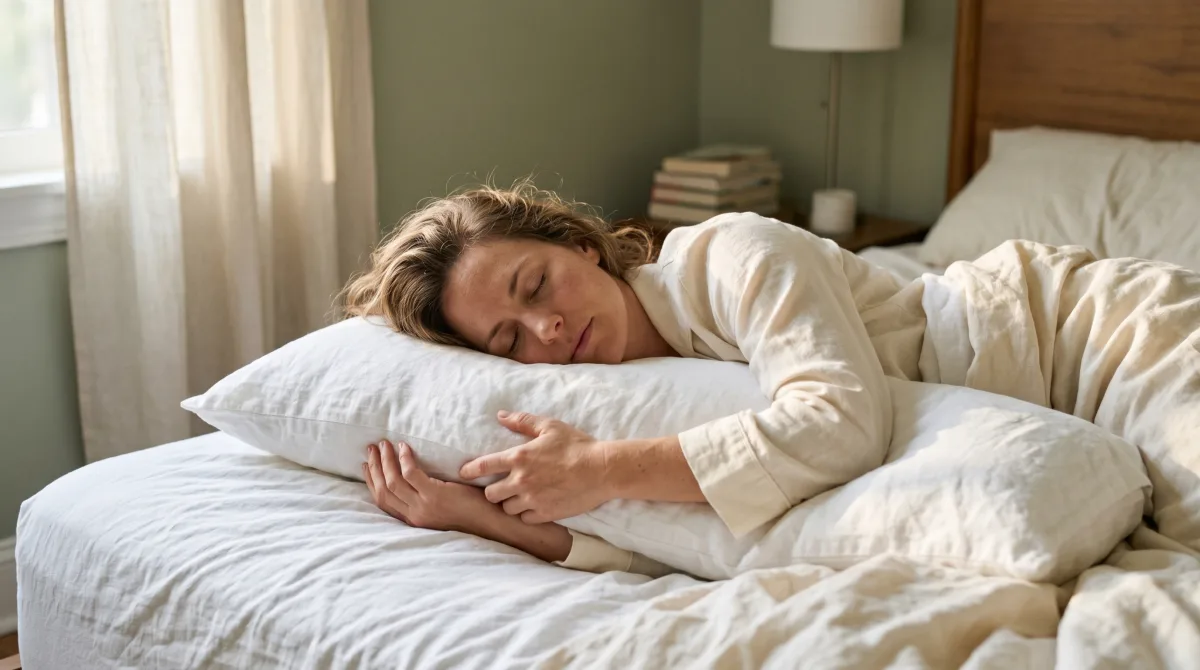
- Hug a pillow to the side. A long body pillow pressed against your front, while you lie on your side, gives stomach sleepers the chest-pressure feeling they’re used to without the rotation cost.
- Sleep on a slightly inclined wedge. A wedge under the head and shoulders makes the prone position physically awkward, encouraging back or side as defaults.
- Address what makes you flip prone. Many people end up on their stomach because they’re cold or uncomfortable. A heavier blanket fixes the cold issue, see our review of weighted blankets that actually work in summer for picks that add weight without overheating.
The other variable that derails position-change attempts is lying awake too long while trying. If switching to your back means you stare at the ceiling for 40 minutes, the next night you’ll subconsciously revert to what worked before. That’s why the techniques in our how to fall asleep fast guide matter for position changes, falling asleep faster on your back makes the new position stick.
Expect 2-4 weeks for the new position to feel natural. Trying to force it in one night fails most of the time. Pair the position change with a consistent wind-down routine so the rest of your sleep cues stay stable while you change one variable.
Frequently Asked Questions
Is stomach sleeping really that bad if I have no pain?
Probably not, in the short term. The mechanical concerns about stomach sleeping, sustained neck rotation, flattened lumbar curve, restricted breathing, are real, but they translate to measurable problems mostly in people who already have symptoms or who are over 40. If you’re under 40 and pain-free, the urgency to switch is low. Long-term, the cumulative load can show up later.
Can I just put a pillow under my pelvis and stay on my stomach?
You can, and it helps with the lower-back component. A thin pillow or folded towel under the pelvis restores some of the lumbar curve and reduces over-extension, this is the workaround Mayo Clinic explicitly recommends. It does not fix the neck rotation problem, so if morning neck pain is your main symptom, the pelvis pillow alone won’t be enough. Pair it with a thinner head pillow.
How long does it take to change sleeping positions?
Most people need 2-4 weeks of deliberate practice for a new sleep position to feel natural. The tennis-ball-in-shirt method or a body pillow accelerates this by making the old position physically uncomfortable. Trying to white-knuckle it through willpower alone usually fails because you don’t make decisions at 2 AM, your sleeping body does, and it defaults to whatever felt comfortable before.
Why do I always end up on my stomach even when I start on my back?
Three common reasons: you’re cold (stomach sleeping with a thin blanket feels warmer because of the surface contact), the mattress is too soft and your hips sink which feels uncomfortable on the back, or you have unconscious habit reversion from years of stomach sleeping. The first two have material fixes (warmer blanket, firmer mattress). The third needs the tennis-ball method or body pillow to override.
Does stomach sleeping cause facial wrinkles?
It can contribute. Pressing one side of your face into a pillow for 6-9 hours per night, every night, mechanically creases the skin in repeatable patterns. Dermatologists note this as a real but minor factor compared to sun exposure, hydration, and genetics. If facial-wrinkle prevention is the only reason you’re considering switching, the impact is small. If you’re switching for spine reasons anyway, the skin benefit is a side effect.
Is it OK for kids to sleep on their stomach?
For infants under 1 year, no, stomach sleeping is associated with significantly higher SIDS risk, and the AAP recommends back sleeping until age 1 (NICHD). For older children and teenagers, stomach sleeping is generally safe, though the same neck-rotation and lumbar concerns apply at smaller scale. Most kids self-correct as they grow. Talk to a pediatrician for any specific concerns.
What to Do Next
If you wake with pain and you sleep on your stomach, pick one change and try it for 4 weeks: either the pelvis-pillow workaround (easiest, partial fix) or the tennis-ball method (harder, full position switch). Track morning pain on a 1-10 scale. If pain drops by 30% or more, the position was a contributor and the switch is worth keeping.
If you don’t wake with pain, the urgency is low. The position isn’t ideal, but it isn’t the emergency the internet suggests. Spend the energy on the variables that have larger effect sizes, sleep duration, bedroom temperature, screen use before bed, and revisit the position question if symptoms appear later.
For the rest of the sleep variables that interact with position, environment, timing, technique, start with our complete guide to sleep, which covers the full picture. If lower-back pain is your main morning symptom, our progressive muscle relaxation guide covers a 12-minute pre-bed practice that complements the position changes covered here.
About the author: Ulrich Baldauf is the founder of wuusaa.com. He works in sales and curates peer-reviewed research on sleep, breathwork, and nervous-system regulation, translating the science into practical techniques anyone can use. He is not a clinician. Read the full story.
References
- Sleep Foundation. “Sleeping Positions.” 2025. https://www.sleepfoundation.org/sleeping-positions
- Mayo Clinic. “Sleeping positions that reduce back pain.” 2025. https://www.mayoclinic.org/diseases-conditions/back-pain/in-depth/sleeping-positions/art-20546852
- Keck Medicine of USC. “The Best, and Worst, Sleep Positions for Back Pain.” 2024. https://www.keckmedicine.org/blog/the-best-and-worst-sleep-positions-for-back-pain/
- Cary et al. “Examining relationships between sleep posture, waking spinal symptoms and quality of sleep.” PLOS One, 2021. https://pmc.ncbi.nlm.nih.gov/articles/PMC8631621/
- Yamada et al. “Effect of sleep posture on neck muscle activity.” PMC, 2017. https://pmc.ncbi.nlm.nih.gov/articles/PMC5468189/
- Harvard Health Publishing. “Is your sleep position helping or hurting you?” Harvard Medical School. https://www.health.harvard.edu/staying-healthy/is-your-sleep-position-helping-or-hurting-you
- Johns Hopkins Medicine. “Choosing the Best Sleep Position.” https://www.hopkinsmedicine.org/health/wellness-and-prevention/choosing-the-best-sleep-position
- NICHD. “Most Definitive Study of Its Kind Shows That Sleeping on the Stomach Increases Infant SIDS Risk.” https://www.nichd.nih.gov/newsroom/releases/infant_sids