If your partner has been gently elbowing you in the ribs at 3 AM, or if you’ve been waking yourself up with your own snoring, the question you’re probably Googling is some version of “best sleeping position for snoring.”
The short answer is side. The long answer involves how much side actually helps, why back sleeping makes snoring and sleep apnea so much worse, and the honest research on what behavioral changes actually stick. We’re a research curator, not a doctor, so we’ll cover what the evidence says and stop short of any “you should do X” framing. If your snoring is loud, witnessed apneas are happening, or you’re exhausted during the day, talk to a sleep physician. Positional changes alone don’t replace medical evaluation.
Key Takeaways
- 9% to 60% of obstructive sleep apnea patients have positional sleep apnea, meaning their breathing events more than double when supine compared to lateral.
- The best sleeping position for snoring and apnea is on the side. Switching from back to side is the highest-lever intervention that doesn’t require CPAP, a dental device, or surgery.
- Staying on your side all night is the hard part. The tennis-ball method works while used, but only about 6% of users still use it after 30 months.
- Modern vibrating sleep position trainers have substantially better long-term adherence at about 52% daily use vs 15% for tennis ball.
- If snoring is loud, witnessed apneas occur, or you’re exhausted during the day, see a sleep physician. Position alone isn’t a substitute for diagnosis.
For a clinical primer on what obstructive sleep apnea actually is, this Mayo Clinic explainer covers the airway mechanics that make positional therapy work:
Why Back Sleeping Makes Snoring So Much Worse
The mechanism is gravity. When you sleep supine, your tongue and the soft tissues at the back of your throat (soft palate, uvula) fall toward the back of your airway. The airway narrows. Air moving through that narrowed passage vibrates the soft tissue, and that vibration is the sound of snoring. If the airway narrows enough to actually block airflow, you’ve moved from snoring into obstructive sleep apnea territory.
The size of this effect is substantial. A systematic review by Ravesloot and colleagues found that positional obstructive sleep apnea (POSA), defined as having at least twice as many breathing events when supine compared to lateral, affects roughly 50-60% of all OSA patients (Ravesloot et al., 2013). In the underlying data, mean supine apnea-hypopnea index (AHI) was about 34.2 events per hour, compared to about 15.1 events per hour in non-supine positions. That’s not a small difference. That’s a dramatically different night of sleep.
The prevalence varies by severity. A 2019 study found POSA in 50% of mild OSA cases, 19% of moderate cases, and 27% overall (Frank et al., 2019). The takeaway: positional therapy has the biggest impact on people whose apnea is on the milder end of the spectrum. For severe OSA, position helps but isn’t a substitute for CPAP or other definitive treatment.
Why Side Sleeping Helps
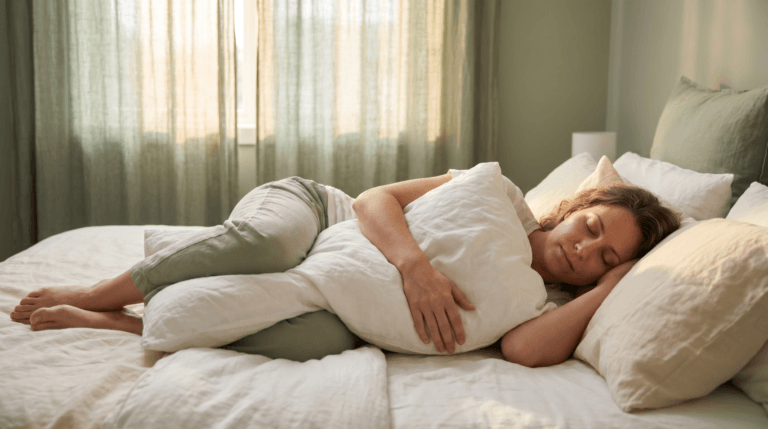
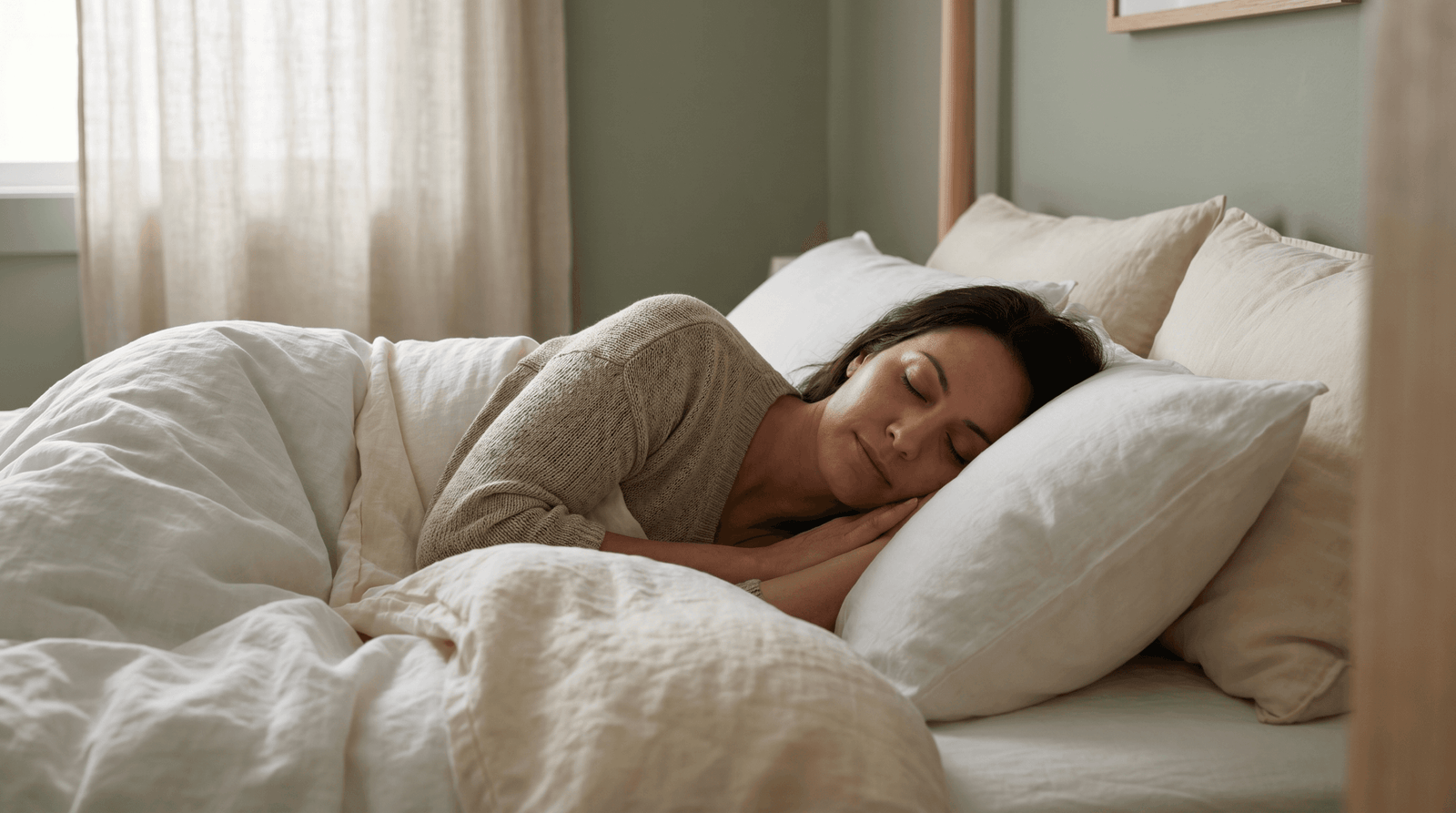
When you’re on your side, gravity pulls the tongue and soft tissues sideways instead of backward. The airway stays more open. The amount of soft-tissue collapse is reduced, so the vibration is reduced, so the snoring is reduced.
For snoring specifically (without diagnosed apnea), the research uses a slightly different definition. Snoring is considered “position-dependent” if there’s at least a 50% reduction in snoring time when lateral compared to supine (Ravesloot, Sleep & Breathing, 2013). For people whose snoring is position-dependent, which is a large fraction of all snorers, switching from back to side cuts snoring time roughly in half. That’s a meaningful change for the partner who’s trying to sleep next to you.
A 2024 systematic review of positional therapy for snoring summarized data from multiple positional interventions. One head-positioning pillow reduced median snoring severity by 33.3% and snoring index by 34.4%. Notably, a vest with inflatable chambers, which prevents back sleeping, reduced snoring rate from 36.7% of total sleep time down to 15.7% (J. Personalized Medicine, 2024). The numbers vary across interventions, but the direction is consistent: less time on the back means less time snoring.
Left Side or Right Side?
For snoring and sleep apnea specifically, left and right are roughly equivalent. Both are dramatically better than back. There’s no strong evidence that one side reduces apnea events more than the other.
If you have other conditions that interact with side selection, acid reflux is the big one, where left side has clear advantages, that can break the tie. We covered the why in Best Sleeping Position for Acid Reflux & GERD. For snoring without reflux, sleep on whichever side you find comfortable.
The Hard Part: Staying on Your Side All Night
This is where the research gets interesting and a bit depressing. Switching to side sleeping is easy in principle. Staying there for eight hours, every night, is hard.
Most people roll onto their back at some point during the night without realizing it. That’s why positional therapy interventions, devices that physically prevent or discourage supine sleeping, exist. The classic version is the tennis ball method.
The Tennis Ball Method (and Why Compliance Is Low)
You sew or tape a tennis ball into the back of a t-shirt. When you roll onto your back during the night, the ball pokes you uncomfortably and you roll back onto your side. Eventually, the theory goes, you train yourself out of supine sleeping entirely.
The treatment effect is real. In OSA patients using the tennis ball method, treatment success (defined as AHI dropping below 5) was 42.9% (Eijsvogel et al., JCSM, 2015). That’s meaningful, nearly half of people who actually used it had their apnea drop into the normal range.
The compliance is the problem. A 2009 study tracked tennis-ball-method users and found that only 6.0% were still using it about 30 months after prescription (Bignold et al., 2009). The reasons for stopping, in order of frequency: discomfort (63%), the ball moved out of position (33%), no perceived improvement in sleep (26%), it didn’t seem to be working (24%), and backache (13%). Most people abandoned it within months.
Sleep Position Trainers (Better Compliance)
Modern alternatives are vibrating devices worn around the neck or chest. When you roll onto your back, a small vibration prompts you to roll back onto your side. The vibration is uncomfortable enough to register but not so uncomfortable that it wakes you up.
The compliance numbers are dramatically better. In a head-to-head trial, daily use after follow-up was 51.7% with a sleep position trainer vs 15.4% with the tennis ball method. Treatment success (AHI under 5) was 68.0% with the trainer vs 42.9% with the tennis ball (Eijsvogel et al., 2015). Both work when used; the trainer is used more often and longer.
We’re not in a position to recommend specific products, we don’t test devices, and sleep apnea treatment should be coordinated with a sleep physician. But the research is clear that the trainer category has better adherence than the DIY tennis-ball approach.
Body Pillows and Wedge Pillows
The lower-tech approach is a body pillow you hug while lying on your side, which makes rolling onto your back physically harder. Wedge pillows that elevate the upper body also help, by raising the head about 30 degrees, you reduce gravitational soft-tissue collapse even when supine.
Body pillows have the advantage of doubling as comfort props. Wedge pillows have the advantage of working without requiring a behavioral change. Neither has the published RCT evidence base of the formal positional therapy devices, but both are low-cost and worth trying before more aggressive interventions.
How Snoring Interventions Compare
Three positional interventions for snoring and apnea show meaningfully different long-term success and adherence. Tennis ball, body pillow, and vibrating sleep position trainer have all been studied; only one of them shows substantial daily use after the first year.
| Intervention | Treatment success (AHI<5) | Daily use at follow-up | Cost |
|---|---|---|---|
| Tennis ball method | 42.9% (Eijsvogel 2015) | 15.4% at 12 mo, 6% at 30 mo (Bignold 2009) | $1-5 |
| Body pillow / pillow wedge | Modest, varies by sleeper | Higher (no published RCT figure) | $30-80 |
| Vibrating sleep position trainer | 68.0% (Eijsvogel 2015) | 51.7% at 12 mo | $200-300 |
What If You Already Have a Sleep Apnea Diagnosis?
If you’ve been diagnosed with obstructive sleep apnea and you’ve been prescribed CPAP, positional therapy isn’t a substitute. It’s a potential adjunct. People with mild positional OSA sometimes successfully treat their apnea with positional therapy alone, but that decision needs to involve a sleep physician, ideally with a follow-up sleep study to confirm the AHI is actually under control.
For people who hate CPAP and have stopped using it, positional therapy is sometimes a reasonable middle ground. For people with moderate-to-severe OSA, it isn’t enough. The 2019 prevalence data showed that POSA was much more common in mild OSA (50%) than in moderate OSA (19%), meaning the more severe your apnea, the less likely position alone will fix it.
How to Stop Snoring While Sleeping: A Realistic Plan
If snoring is your main concern (witnessed apneas and daytime sleepiness change the picture, see a doctor), here’s the realistic order of operations.
- Identify whether you’re a back sleeper. Ask your partner, or set up a phone camera with a long-record sleep tracking app to verify. Most snorers are surprised to learn how much of the night they spend supine.
- Try the body pillow approach first. Cheap, no real downside, immediate test. (See our research-curated body pillow picks for the actual products.) If a week of body-pillow side sleeping reduces or eliminates snoring, you have your answer.
- If body pillow alone isn’t enough, consider a wedge pillow. Elevation reduces snoring even when supine. Stacking interventions (wedge plus side) often outperforms either alone.
- If snoring persists, escalate to a positional sleep trainer. The compliance research strongly favors vibrating devices over the tennis ball method.
- If snoring is loud, you have witnessed pauses in breathing, or you’re exhausted during the day, get a sleep study. Positional therapy doesn’t substitute for medical evaluation when there’s a real possibility of moderate or severe apnea.
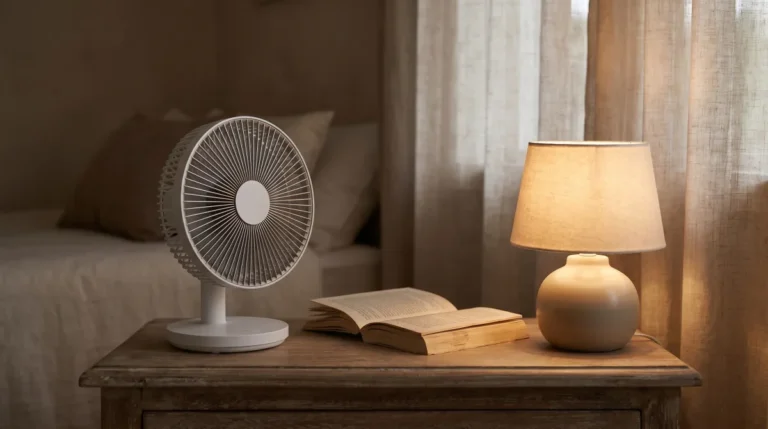
If your snoring is partner-facing rather than safety-facing, you can also help by addressing acoustic masking on the listener’s side. We covered the research on this in Fan for Sleep: 5 Best Picks for 2026 and Best Sound Machines for Sleep. White noise doesn’t reduce your snoring, but it makes a partner’s experience of it dramatically better.
Frequently Asked Questions
What is the best sleeping position for snoring?
Side sleeping is the position with the strongest evidence for reducing snoring. 9% to 60% of obstructive sleep apnea patients have positional sleep apnea, meaning their breathing events more than double when supine compared to lateral. For non-apnea snoring, the effect is similar, when you sleep on your back, gravity pulls the tongue and soft palate toward the airway, narrowing it and creating the vibration that makes snoring noise. Switching to side sleeping is the single highest-lever intervention that doesn’t require a CPAP machine.
Does side sleeping really reduce sleep apnea events?
For people with positional sleep apnea, yes, substantially. The defining criterion for positional OSA is that the supine apnea-hypopnea index is at least twice the non-supine index. In the published data, mean supine AHI was about 34 events per hour vs about 15 events per hour in non-supine positions. For people with mild positional OSA (around 50% of all mild apnea cases), positional therapy alone can sometimes bring the AHI into the normal range. For moderate or severe OSA, position helps but isn’t sufficient on its own.
Is the tennis ball method effective for snoring?
It works while you use it, but compliance is poor. Treatment success in OSA patients (AHI dropping below 5) was 42.9%, meaningful when used. But long-term adherence is the problem: only about 6% of people who started the tennis ball method were still using it 30 months later. The most common reasons for stopping were discomfort (63%) and the ball moving out of position (33%). Modern vibrating sleep position trainers have substantially better compliance.
What’s the difference between snoring and sleep apnea?
Snoring is the sound of air vibrating soft tissue in a partially obstructed airway. Sleep apnea is when the airway becomes blocked enough that breathing actually stops or becomes severely reduced for at least 10 seconds at a time. All people with obstructive sleep apnea snore, but not all snorers have apnea. The signs that snoring may be apnea: witnessed pauses in breathing, gasping or choking on waking, daytime exhaustion despite a full night in bed, morning headaches. If any of those apply, get a sleep study, positional therapy alone isn’t enough.
Can a body pillow help with snoring?
Yes, indirectly. A body pillow doesn’t reduce snoring through any direct airway effect, it works by making rolling onto your back physically harder. If your snoring is position-dependent (which it is for a large fraction of snorers), keeping yourself on your side using a body pillow is a low-cost, no-downside test. A week of body-pillow side sleeping is enough to tell you whether positional therapy might be the answer for you.
Will sleeping with my head elevated reduce snoring?
Often, yes. A wedge pillow that elevates the upper body about 30 degrees reduces gravitational soft-tissue collapse even when you’re supine. The effect is smaller than the difference between back and side, but it stacks with side sleeping. Many people find that combining a wedge with a body pillow eliminates partner-noticeable snoring even on nights when they end up partially on their back.
References
- Ravesloot, M.J.L. et al. (2013). The undervalued potential of positional therapy in position-dependent snoring and obstructive sleep apnea. Sleep & Breathing. PMC3817704
- Ravesloot, M.J.L. (2013). Definition of position-dependent snoring. Sleep & Breathing. PMC3575552
- Frank, M.H. et al. (2019). Positional OSA prevalence study. PubMed 31325020
- Eijsvogel, M.M. et al. (2015). Sleep position trainer versus tennis ball technique in positional obstructive sleep apnea syndrome. Journal of Clinical Sleep Medicine. JCSM
- Bignold, J.J. et al. (2009). Long-term effectiveness and compliance of position therapy with the tennis ball technique. JCSM. PMC2762713
- Positional therapy for snoring: a systematic review. (2024). Journal of Personalized Medicine. PMC11277951