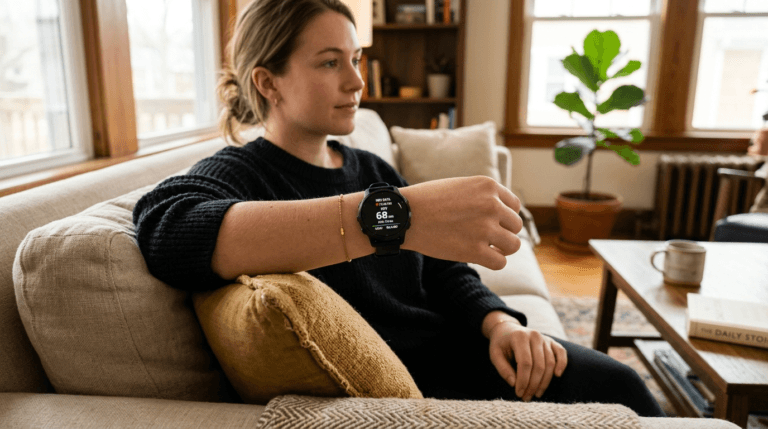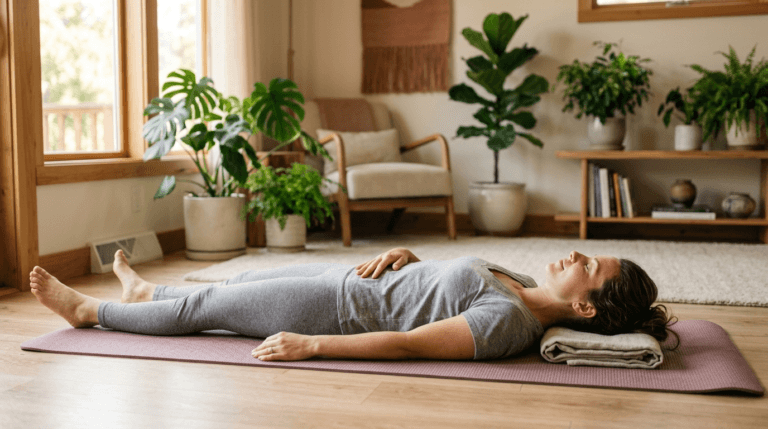
Your nervous system isn’t broken. It’s stuck. If you’ve been wondering how to regulate your nervous system after months or years of chronic stress, you’re asking the right question. A 2023 meta-analysis of 12 randomized controlled trials found that breathwork alone reduces stress by 35%, anxiety by 32%, and depression by 40% (Fincham et al., Scientific Reports, 2023). And breathwork is just one of several evidence-based approaches to nervous system regulation.
Here’s the good news: your body already knows how to shift from survival mode back to safety. It just needs the right signals. This guide covers the science behind nervous system dysregulation, how to recognize it in your own body, and eight specific techniques — from breathwork to somatic exercises — that research supports. Each section links to deeper guides so you can go as far as you want with any method.
This article is for informational purposes only and does not constitute medical advice. Consult a qualified healthcare provider before beginning any new wellness practice.
Key Takeaways
- Nervous system regulation means restoring the balance between your sympathetic (fight-or-flight) and parasympathetic (rest-and-digest) branches so your body responds proportionally to actual threats.
- Chronic stress physically changes your nervous system: cortisol exposure shrinks the hippocampus and weakens prefrontal cortex function (McEwen, Neuropsychopharmacology, 2007).
- Breathwork is the fastest entry point. Five minutes of daily cyclic sighing improves mood 56% more than mindfulness meditation (Balban et al., Cell Reports Medicine, 2023).
- Vagus nerve stimulation through cold exposure, humming, or slow breathing increases heart rate variability — a biomarker of stress resilience (Laborde et al., Neuroscience & Biobehavioral Reviews, 2022).
- Somatic exercises, grounding, and polyvagal-informed practices offer additional pathways to regulation, especially for people who struggle with cognitive approaches like talk therapy or meditation.
- Consistency beats intensity. Even 2-5 minute daily sessions activate the parasympathetic nervous system (Stress and Health, 2025).
What Is Nervous System Regulation?
Nervous system regulation is your body’s ability to move smoothly between states of activation and calm — responding to threats when needed, then returning to baseline when the danger passes. According to a landmark review, chronic psychological stress disrupts this balance by keeping cortisol elevated, which over time damages the hippocampus, impairs memory, and reduces emotional regulation capacity (McEwen, Neuropsychopharmacology, 2007). In other words, a dysregulated nervous system doesn’t just feel bad — it physically changes your brain.
Your autonomic nervous system (ANS) operates in two main modes. The sympathetic branch speeds everything up: heart rate, breathing, muscle tension, adrenaline. The parasympathetic branch, anchored by the vagus nerve, slows everything down: heart rate drops, digestion resumes, muscles relax.
A well-regulated nervous system shifts between these modes flexibly. You get a burst of sympathetic energy when you need to meet a deadline, then return to parasympathetic calm when you sit down for dinner. Problems start when you get stuck in one mode — usually sympathetic overdrive.
Keep in mind: Most wellness content frames nervous system regulation as “calming down.” But regulation isn’t about being calm all the time. It’s about appropriate responses. Sometimes you need activation. The goal is flexibility, not permanent relaxation. That distinction matters because people in freeze states (parasympathetic shutdown) actually need gentle activation, not more calming techniques.
The Role of the Vagus Nerve
The vagus nerve is the longest cranial nerve in your body. It runs from your brainstem through your neck, chest, and abdomen, connecting to your heart, lungs, and digestive organs. It’s the primary channel through which the parasympathetic nervous system operates.
When your vagus nerve fires strongly, your heart rate slows, your breathing deepens, and your digestion activates. This is measured through heart rate variability (HRV) — the beat-to-beat variation in your heart rhythm. Higher HRV indicates stronger vagal tone and better stress resilience. For a deeper look at how to strengthen this nerve, see our vagus nerve exercises guide.
What makes the vagus nerve especially relevant to nervous system regulation? It’s a two-way street. About 80% of vagal fibers are afferent — meaning they send information from the body to the brain (Breit et al., Frontiers in Psychiatry, 2018). So when you change your body’s state (through breathing, movement, or temperature), you’re literally sending “safety signals” to your brain. That’s why body-based approaches often work faster than cognitive ones.
To learn more about measuring and improving this marker, see our vagal tone guide.
What Are the Signs of Nervous System Dysregulation?
An estimated 77% of Americans report physical symptoms caused by stress, and 73% report psychological symptoms (American Psychological Association, 2023). Nervous system dysregulation is the mechanism behind many of these symptoms. It shows up differently in different people, but the patterns are recognizable once you know what to look for.
Sympathetic Overdrive (Fight-or-Flight Stuck “On”)
When your sympathetic branch stays chronically activated, you might notice:
- Racing heart or palpitations at rest
- Shallow, rapid breathing in your upper chest
- Muscle tension in your jaw, neck, or shoulders
- Difficulty sleeping or waking at 3 a.m. with a racing mind
- Irritability or anger that seems disproportionate to the situation
- Digestive problems like acid reflux or IBS-type symptoms
- Hypervigilance — scanning for threats even in safe environments
Dorsal Vagal Shutdown (Freeze Response)
On the other end of the spectrum, some people don’t get stuck in overdrive. Instead, they collapse into shutdown. This is the “freeze” or “flop” response, and it’s associated with the dorsal vagal branch described in polyvagal theory:
- Chronic fatigue that sleep doesn’t fix
- Emotional numbness or feeling disconnected from your body
- Brain fog and difficulty concentrating
- Social withdrawal and loss of motivation
- Feeling “flat” — neither happy nor sad, just empty
The Oscillation Pattern
Many people don’t experience just one state. They bounce between sympathetic overdrive and dorsal vagal shutdown — wired and anxious during the day, then crashing into exhaustion at night. Does that pattern sound familiar? If so, nervous system regulation techniques can help you find a middle ground.

Why Does Chronic Stress Dysregulate Your Nervous System?
Chronic stress fundamentally rewires your nervous system’s set points. Research shows that prolonged cortisol exposure causes measurable structural changes: the amygdala (your threat detector) grows larger and more reactive, while the prefrontal cortex (your rational decision-maker) and hippocampus (your memory center) shrink (McEwen, Neuropsychopharmacology, 2007). Your brain literally remodels itself to prioritize threat detection over rational thinking.
This isn’t a design flaw. It’s an adaptive response. If you lived in a genuinely dangerous environment, a hair-trigger stress response would keep you alive. The problem is that modern stressors — emails, deadlines, financial pressure, social media — trigger the same survival circuits as physical threats, but they never fully resolve.
Your nervous system can’t distinguish between a bear chasing you and a passive-aggressive email from your boss. Both trigger cortisol and adrenaline. The difference is that the bear encounter ends. The email stress loop runs continuously, keeping your system in a state of chronic low-grade activation.
What the research tells us: A 2024 study found that adults with chronic occupational stress showed significantly reduced HRV compared to low-stress controls, with RMSSD values averaging 28% lower — indicating weakened vagal tone and reduced capacity for self-regulation (PMC, 2024).
Over time, this chronic activation depletes your system. Your adrenal glands produce less cortisol (not more), your vagal tone drops, and your nervous system loses its ability to bounce back. That’s when nervous system dysregulation becomes the default state rather than a temporary reaction.
How Do You Regulate Your Nervous System? 8 Evidence-Based Techniques
Learning how to regulate your nervous system comes down to one principle: send your brain “safety signals” through the body. A systematic review of 223 studies confirmed that voluntary slow breathing reliably increases vagally-mediated HRV across single sessions, immediate post-session periods, and multi-session interventions (Laborde et al., Neuroscience & Biobehavioral Reviews, 2022). But breathing is just the beginning.
Below are eight techniques grouped by approach. Each one has peer-reviewed evidence behind it. You don’t need to do all eight. Pick two or three that resonate and build from there.
1. Breathwork for Nervous System Regulation
Breathwork is the single most accessible way to regulate your nervous system. It works because the breath is the only autonomic function you can control consciously. When you slow your exhale, you directly activate the vagus nerve and shift from sympathetic to parasympathetic mode.
A 2025 narrative review found that approximately 67% of effective breathing techniques align with a rhythm of about 6 breaths per minute (Stress and Health, 2025). At this pace, your heart rate oscillates in sync with your breathing — a state called respiratory sinus arrhythmia — which produces the largest measurable HRV gains.
Three starting points, depending on your goal:
- Resonance breathing (5 seconds in, 5 seconds out) — strongest HRV gains, best for daily practice
- Box breathing (4-4-4-4 pattern) — best for acute stress moments
- 4-7-8 breathing — best for sleep and evening wind-down
If anxiety is your primary concern, our guide on breathing exercises for anxiety covers five techniques specifically tested for anxious feelings. For a complete comparison of all methods, see our breathwork techniques guide.
2. Vagus Nerve Exercises
Since the vagus nerve is the primary channel of the parasympathetic nervous system, directly stimulating it can accelerate regulation. A 2018 review in Frontiers in Psychiatry confirmed that vagal activation reduces heart rate, lowers blood pressure, and decreases systemic inflammation (Breit et al., 2018).
Practical vagus nerve exercises include:
- Humming or chanting “om” — vibrations stimulate the vagus nerve where it passes through the larynx
- Cold water face immersion — triggers the dive reflex, which rapidly activates vagal tone
- Gargling vigorously — activates the muscles at the back of the throat connected to the vagus nerve
- Gentle neck stretches — the vagus nerve runs through the neck; stretching this area can stimulate it
Our full vagus nerve exercises guide covers each technique in detail with step-by-step instructions.
3. Somatic Exercises
Somatic exercises focus on internal body awareness and gentle, intentional movement to release stored muscular tension. Unlike traditional exercise, the goal isn’t fitness. It’s reconnecting with your body and releasing patterns of chronic holding.
Why does this help nervous system regulation? Because trauma and chronic stress are stored in the body as muscular tension, restricted breathing patterns, and postural habits. Somatic approaches work from the body upward to the brain. For people who find cognitive approaches like meditation frustrating, somatic exercises offer an alternative path.
Common somatic practices include:
- Body scans — slowly directing attention through each body part
- Pandiculation — consciously contracting and slowly releasing tight muscles (the body’s natural stretch reflex)
- Gentle spinal movements — rolling, arching, and twisting to release tension in the spine
Learn more in our dedicated somatic exercises guide.
4. Grounding Exercises
Grounding techniques anchor your attention in the present moment through sensory engagement. They’re especially useful during acute anxiety or dissociation — those moments when you feel disconnected from your body or surroundings.
The mechanism is straightforward: by flooding your brain with current sensory information (what you see, hear, touch, smell, taste), you override the threat signals that are keeping your nervous system activated. It’s a way of telling your brain, “I’m here, I’m safe, right now.”
Effective grounding methods include:
- 5-4-3-2-1 technique — name 5 things you see, 4 you hear, 3 you touch, 2 you smell, 1 you taste
- Barefoot walking on grass or earth — direct skin contact with natural surfaces
- Cold water on wrists or face — temperature change activates the present-moment sensory system
- Holding ice cubes — the intensity of the cold sensation anchors attention in the body
For a complete toolkit, see our grounding exercises for anxiety guide.
5. Physical Movement
You don’t need a gym membership to regulate your nervous system. Even moderate physical activity significantly impacts autonomic function. A 2023 meta-analysis of 191 studies covering over 14,000 participants found that exercise interventions reduced depression with an effect size comparable to psychotherapy and pharmacotherapy (British Journal of Sports Medicine, 2023).
Movement helps because it completes the stress cycle. When your body activates the fight-or-flight response, it’s preparing you to run or fight. If you don’t actually move, those stress hormones circulate without resolution. Walking, running, dancing, or even vigorous shaking gives your body the physical discharge it’s looking for.
What works best for nervous system regulation specifically? Research suggests:
- Walking in nature — 20-30 minutes, moderate pace
- Yoga — combines movement with breathwork and body awareness
- Swimming — the combination of rhythmic movement and water temperature activates the vagus nerve
- Shaking or tremoring — used in trauma-release exercises (TRE) to discharge stored tension
6. Cold Exposure
Brief cold exposure activates the vagus nerve through the dive reflex — an automatic physiological response that slows heart rate and redirects blood flow when the face contacts cold water. This isn’t about ice baths or extreme cold plunges. Even splashing cold water on your face for 15-30 seconds triggers a measurable vagal response.
A systematic review found that cold water immersion acutely increases parasympathetic activity and reduces sympathetic markers (Breit et al., Frontiers in Psychiatry, 2018). The effect is nearly immediate, making cold exposure one of the fastest tools for nervous system regulation.
Start small: end your shower with 30 seconds of cold water, or hold a cold washcloth against your face and neck. You don’t need to become a cold plunge enthusiast to get the regulatory benefits.
7. Social Connection and Co-Regulation
Humans are wired to regulate each other’s nervous systems. This is called co-regulation, and it’s central to polyvagal theory. When you’re around someone who feels safe and calm, your nervous system picks up on their cues — their relaxed facial muscles, steady voice, slow breathing — and begins to mirror them.
Co-regulation explains why a hug from a trusted person can calm you down faster than any breathing exercise. It also explains why isolation worsens nervous system dysregulation. We’re social mammals. Our nervous systems evolved to function in groups.
Practical co-regulation strategies:
- Make eye contact during conversations (activates the ventral vagal “social engagement” system)
- Speak in softer, slower tones — prosody signals safety to the listener’s nervous system
- Physical touch — a hand on the shoulder, a hug, or sitting close to someone you trust
8. Mindfulness and Body Awareness
Mindfulness meditation trains your awareness of internal states, which is the first step toward regulating them. You can’t regulate what you can’t notice. A 2024 meta-analysis of 36 RCTs found that mindfulness-based interventions significantly reduced cortisol levels, with a standardized mean difference of -0.34 (Psychoneuroendocrinology, 2024).
However, traditional seated meditation isn’t for everyone. If sitting still feels activating (which is common in people with nervous system dysregulation), try movement-based mindfulness: walking meditation, tai chi, or gentle yoga. These provide the same awareness training without requiring stillness.

How Can You Build a Daily Nervous System Regulation Practice?
Consistency matters more than duration when learning how to regulate your nervous system. Research shows that even 2-5 minute daily sessions of slow breathing activate the parasympathetic nervous system (Stress and Health, 2025). You don’t need an hour-long routine. You need a short practice you’ll actually do every day.
Practical tip: Anchor your regulation practice to something you already do. Before your morning coffee, during your commute, or right after brushing your teeth. When you link a new habit to an existing one, you remove the willpower barrier that kills most wellness routines.
A Simple Morning Protocol (10 Minutes)
- Body scan (2 minutes) — lie in bed and notice where you feel tension, tightness, or ease
- Resonance breathing (5 minutes) — inhale 5 seconds, exhale 5 seconds
- Gentle movement (3 minutes) — slow spinal twists, neck rolls, or a brief walk
Mid-Day Reset (3 Minutes)
When stress spikes during your workday, try this quick sequence:
- Box breathing (1 minute) — 4-4-4-4 pattern to interrupt the stress response
- 5-4-3-2-1 grounding (1 minute) — re-anchor in your present environment
- Cold water on wrists (30 seconds) — splash cold water to activate the vagal response
Evening Wind-Down (5 Minutes)
- 4-7-8 breathing (3 minutes) — extended exhale to prepare for sleep
- Progressive muscle relaxation (2 minutes) — tense and release major muscle groups from feet to face
What to Expect Over Time
- Week 1-2: You’ll notice acute effects — slower heart rate, calmer feelings after practice
- Week 3-4: Sleep may improve; you might catch yourself responding instead of reacting to stress
- Month 2-3: Resting HRV should trend upward if you’re tracking it
- Month 4+: Regulation becomes more automatic; your baseline shifts
The 2022 study by Ghati et al. showed that 20 minutes of daily resonance breathing over four weeks increased total HRV power by 55% and reduced perceived stress by 24% (Ghati et al., Frontiers in Physiology, 2022). So the timeline for measurable change is shorter than most people expect.
Does Polyvagal Theory Explain Nervous System Dysregulation?
Stephen Porges’ polyvagal theory provides a framework for understanding why your nervous system gets stuck — and how to get it unstuck. The theory proposes that the autonomic nervous system has three hierarchical states, not just two (Porges, Psychophysiology, 1995).
The Three States
1. Ventral Vagal (Safe and Social): This is the regulated state. You feel connected, present, and able to engage with others. Your heart rate is calm, your facial muscles are relaxed, and your voice has natural prosody. This is the state where healing, learning, and growth happen.
2. Sympathetic (Fight or Flight): When your nervous system detects danger, it shifts into mobilization. Heart rate rises, muscles tense, and your focus narrows to the perceived threat. This state is useful for short bursts but damaging when chronic.
3. Dorsal Vagal (Freeze or Shutdown): When the threat feels overwhelming, the nervous system shifts into collapse. Heart rate drops, you feel numb or disconnected, energy disappears. This is the “playing dead” response — an ancient survival mechanism.
Why This Matters for Regulation
Polyvagal theory suggests that you can’t skip states. To move from dorsal vagal shutdown back to ventral vagal safety, you typically need to pass through sympathetic activation first. That’s why someone in a freeze state might need gentle movement or activation before calming techniques will work.
This has practical implications. If you feel numb and disconnected (dorsal vagal), jumping straight to meditation or slow breathing might not help — and could even feel worse. Instead, try gentle movement, bilateral tapping, or walking first to build some activation. Then use breathing or grounding to settle into a regulated state.
For a full exploration of how to apply this framework, see our polyvagal theory exercises guide.
Can You Measure Your Nervous System Regulation Progress?
Heart rate variability (HRV) is the most accessible biomarker for tracking nervous system regulation at home. A 2024 meta-analysis of 31 studies confirmed that slow-paced breathing reliably increases SDNN (standardized mean difference of 0.77) and reduces systolic blood pressure (SMD = -0.45) (Shao et al., Mindfulness, 2024). These are measurable changes you can track with a consumer wearable.
What to Track
- Resting HRV (RMSSD) — measured overnight or first thing in the morning; should trend upward over weeks
- Resting heart rate — should gradually decrease as vagal tone improves
- Sleep quality — deeper sleep and fewer nighttime wake-ups indicate better regulation
- Subjective stress — rate your daily stress on a 1-10 scale to spot trends
Wearable Options
Several consumer devices measure HRV with reasonable accuracy:
- Oura Ring — tracks overnight HRV and provides a readiness score
- WHOOP Strap — monitors 24/7 HRV with recovery metrics
- Apple Watch — records HRV during sleep and on-demand
- Garmin watches — offer HRV status and Body Battery scores
- Polar chest straps — provide clinical-grade accuracy for biofeedback training
Keep in mind that wrist-based measurements are less accurate than chest straps. Focus on trends over weeks, not individual daily readings.
For detailed guidance on using HRV to track breathwork progress, see our resonance breathing and HRV guide.
Frequently Asked Questions
How long does it take to regulate a dysregulated nervous system?
Acute regulation can happen in minutes. Even a single 2-5 minute breathing session activates the parasympathetic nervous system (Stress and Health, 2025). However, shifting your baseline autonomic tone takes longer. Research shows measurable HRV improvements after 4 weeks of daily practice, with more significant changes appearing at 8-12 weeks. The timeline depends on the severity and duration of your dysregulation.
What is the fastest way to calm your nervous system?
The fastest evidence-backed method is the physiological sigh: two quick inhales through the nose followed by one long exhale through the mouth. Stanford researchers found that just 5 minutes of this pattern improved mood 56% more than mindfulness meditation (Balban et al., Cell Reports Medicine, 2023). Cold water on the face (triggering the dive reflex) is another near-instant option for calming your nervous system.
Can nervous system dysregulation cause physical symptoms?
Yes. Nervous system dysregulation causes a wide range of physical symptoms because the autonomic nervous system controls heart rate, digestion, breathing, and immune function. Common physical manifestations include digestive issues (IBS, acid reflux), chronic muscle tension, headaches, insomnia, and heart palpitations. An estimated 77% of Americans experience physical symptoms from stress (APA, 2023).
Is nervous system regulation the same as stress management?
Not exactly. Stress management typically focuses on reducing external stressors or changing your cognitive response to them. Nervous system regulation works at a deeper level — it addresses the physiological patterns that determine how your body responds to any stimulus. Think of it this way: stress management is strategy, while nervous system regulation is rewiring the hardware that executes the strategy.
How do you know if your nervous system is dysregulated?
Common signs include chronic fatigue that sleep doesn’t fix, difficulty calming down after minor stressors, digestive problems, muscle tension, sleep disruption, emotional reactivity (overreacting to small triggers), or emotional numbness. If your resting heart rate is consistently elevated or your HRV is low for your age and fitness level, those are measurable indicators. A healthcare provider can help you assess autonomic function more precisely.
Can breathwork alone regulate your nervous system?
Breathwork is one of the most effective single tools for nervous system regulation. A meta-analysis of 12 RCTs confirmed significant reductions in stress (35%), anxiety (32%), and depression (40%) from breathwork interventions (Fincham et al., Scientific Reports, 2023). However, a comprehensive approach that includes movement, social connection, and body awareness typically produces the most robust and lasting changes.
What is the vagus nerve’s role in nervous system regulation?
The vagus nerve is the primary channel of the parasympathetic (“rest and digest”) nervous system. About 80% of its fibers are afferent, meaning they carry information from the body to the brain (Breit et al., Frontiers in Psychiatry, 2018). This means body-based practices like slow breathing, humming, and cold exposure send “safety signals” directly to your brain through the vagus nerve. Strengthening vagal tone through these exercises is central to nervous system regulation. Learn specific techniques in our vagus nerve exercises guide and vagal tone guide.
Start Where You Are
Your nervous system adapted to protect you. The racing heart, the tight shoulders, the 3 a.m. wake-ups — those aren’t failures. They’re your body doing exactly what it was designed to do under chronic stress. The difference is that you now have tools to change the signals.
You don’t need to overhaul your life to start regulating your nervous system. Pick one technique from this guide. Try resonance breathing for 5 minutes tomorrow morning. Or splash cold water on your face the next time stress spikes. Or take a 20-minute walk without your phone.
The evidence is clear: these practices produce measurable physiological changes. HRV improves. Cortisol drops. Sleep deepens. And the effects compound over time. The only variable is whether you’ll start.
If you’re ready to explore breathwork in depth, our breathwork beginner’s guide covers every major technique with step-by-step instructions.
This article is for informational purposes only and does not constitute medical advice. Consult a qualified healthcare provider before beginning any new wellness practice.
Last updated: March 23, 2026. All statistics sourced from peer-reviewed journals and verified institutional reports.
References
- Fincham, G.W. et al. (2023). “Effect of breathwork on stress and mental health: a meta-analysis of randomised controlled trials.” Scientific Reports, 13, 432. PMC
- Balban, M.Y. et al. (2023). “Brief structured respiration practices enhance mood and reduce physiological arousal.” Cell Reports Medicine, 4(1). PMC
- McEwen, B.S. (2007). “Physiology and neurobiology of stress and adaptation: central role of the brain.” Neuropsychopharmacology, 32, 107-135. Nature
- Laborde, S. et al. (2022). “Heart rate variability and cardiac vagal tone in psychophysiological research.” Neuroscience & Biobehavioral Reviews, 140. ScienceDirect
- Breit, S. et al. (2018). “Vagus nerve as modulator of the brain-gut axis in psychiatric and inflammatory disorders.” Frontiers in Psychiatry, 9, 44. Frontiers
- Stress and Health (2025). “A52 Breath Method narrative review.” Wiley
- Ghati, N. et al. (2022). “Effect of resonance breathing on heart rate variability and perceived stress.” Frontiers in Physiology. PMC
- Shao, D. et al. (2024). “Effects of slow-paced breathing on HRV and blood pressure: a meta-analysis.” Mindfulness. Springer
- Porges, S.W. (1995). “Orienting in a defensive world: mammalian modifications of our evolutionary heritage.” Psychophysiology, 32(4), 301-318. PubMed
- American Psychological Association (2023). “Stress in America.” APA
- Singh, B. et al. (2023). “Effectiveness of physical activity interventions for improving depression, anxiety and distress.” British Journal of Sports Medicine, 57(18). BMJ
- Cortes-Garcia, L. et al. (2024). “Effects of mindfulness-based interventions on cortisol.” Psychoneuroendocrinology. ScienceDirect
- PMC (2024). “Diaphragmatic breathing RCT: HRV, cortisol, and cytokines.” PMC