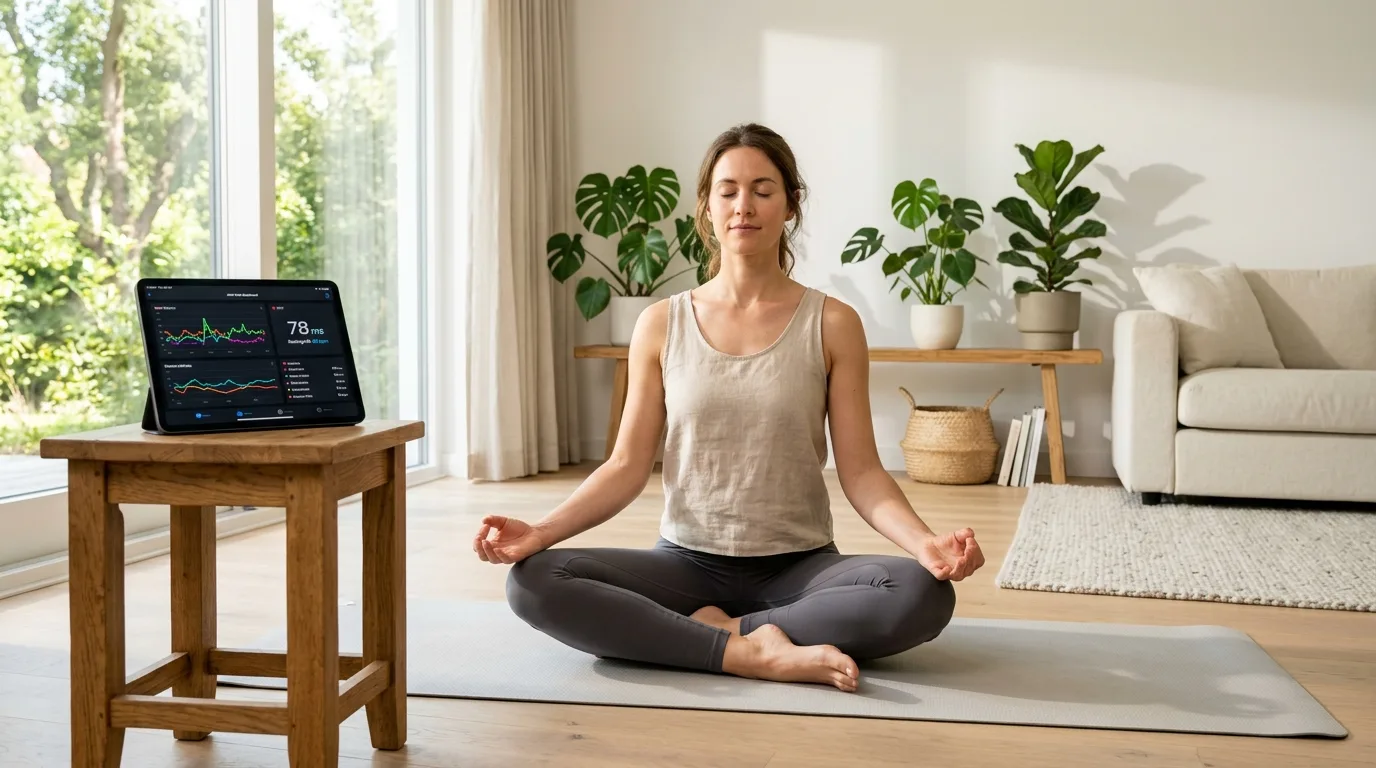
Resonance breathing is a controlled breathing technique performed at 0.1 Hz, which works out to roughly 6 breaths per minute. At that exact frequency, your respiratory cycle locks in phase with your cardiovascular baroreflex, producing the largest measurable swings in heart rate variability that any breathing method reliably generates. A 2022 randomized controlled trial of 50 young adults found that 20 minutes of daily practice over four weeks raised total HRV power by 55% and cut perceived stress scores by 24% (Ghati et al., 2022). If you want one breathwork technique with the strongest science behind it for nervous-system training, this is the one I keep coming back to.
Key Takeaways
- Resonance breathing at 0.1 Hz (roughly 6 breaths/min, 5 s in and 5 s out) synchronizes respiratory sinus arrhythmia with the baroreflex feedback loop, amplifying beat-to-beat heart rate variation.
- Four weeks of 20-minute daily sessions raised total HRV power by 55% and SDNN from 66.69 ms to 78.76 ms in an RCT of 50 young adults (Ghati et al., 2022).
- A single session acutely reduced systolic blood pressure by 4.6 mmHg and increased low-frequency HRV power in 10 healthy men (Fogt et al., 2019).
- A 2025 BYU study pitting three breathing methods head-to-head found that 6 bpm produced the highest LF-HRV, outperforming both square breathing and 4-7-8 (Marchant, 2025).
- Polar H10 chest straps and the Oura Ring measure different HRV metrics. Understanding RMSSD vs. SDNN matters when you interpret your biofeedback data.
What Is Resonance Breathing, and Why Does 0.1 Hz Matter?
The cardiovascular system oscillates at a natural frequency of approximately 0.1 Hz, meaning one complete pressure-regulation cycle every 10 seconds. This is the baroreflex loop: pressure sensors in the aortic arch detect a rise in blood pressure, signal the brainstem, and the heart slows slightly in response, then speeds up again as pressure falls (Lehrer & Gevirtz, 2014). Resonance breathing works by matching respiratory rate to this same 0.1 Hz frequency, so the breath cycle and baroreflex cycle arrive in phase and amplify each other.
The physics concept of resonance is the right analogy here. Push a swing at a random moment and it barely moves. Push at exactly its natural frequency and the amplitude grows with each cycle. Your cardiovascular system does the same thing when your breathing rate matches 0.1 Hz. The heart rate swings harder from beat to beat, which is the signal HRV devices capture.
For most people, 0.1 Hz equals about 6 breaths per minute, or a 5-second inhale followed by a 5-second exhale with no pause at either end. Individual resonance frequencies range from roughly 4.5 to 7 breaths per minute. Clinical biofeedback practitioners sometimes run a resonance frequency assessment to nail down the exact rate, but 6 bpm is a reliable starting point for nearly everyone.
How This Differs From Other Slow-Breathing Techniques
Resonance breathing is not the same as diaphragmatic breathing, box breathing, or the 4-7-8 pattern, even though all of them slow the breath rate below normal. The distinguishing feature is the target: the 0.1 Hz resonance point specifically. Box breathing holds at the top and bottom of each breath, which disrupts the continuous oscillation. The 4-7-8 pattern breathes at roughly 3 bpm, which is below the resonance frequency for most people. Only resonance breathing and coherent breathing (a closely related protocol by Stephen Elliott) consistently hit the 0.1 Hz target.
No breath holds. No counting to eight. Just a continuous, even wave at six cycles per minute.
What Does HRV Actually Measure, and Which Metrics Should You Track?
Heart rate variability is the beat-to-beat variation in the time intervals between successive heartbeats, measured in milliseconds. Higher variability generally indicates a more responsive autonomic nervous system, better cardiovascular fitness, and stronger parasympathetic (rest-and-digest) regulation. A 2022 review in Neuroscience and Biobehavioral Reviews confirmed that slow-paced breathing at 0.1 Hz reliably increases both time-domain and frequency-domain HRV markers (Laborde et al., 2022).
Time-Domain Metrics: RMSSD and SDNN
RMSSD is the root mean square of successive differences between heartbeat intervals. It reflects short-term parasympathetic activity and is the metric most consumer wearables report. SDNN is the standard deviation of all normal heartbeat intervals over a recording window and reflects overall autonomic variability across both branches of the nervous system. Both metrics improve with resonance breathing practice, but they capture slightly different things.
The Ghati et al. (2022) RCT tracked SDNN and showed an increase from 66.69 ms to 78.76 ms after four weeks. The 2024 meta-analysis by Shao and colleagues found SDNN improved with a standardized mean difference of 0.77 and RMSSD improved with an SMD of 0.37 across 31 slow-breathing studies (Shao et al., 2024). SDNN showed the larger effect, likely because resonance breathing’s primary mechanism operates across both sympathetic and parasympathetic branches.
Frequency-Domain Metrics: LF Power and the LF/HF Ratio
Frequency-domain analysis divides HRV into bands. Low-frequency power (LF, 0.04-0.15 Hz) captures fluctuations that include the baroreflex oscillations at 0.1 Hz. High-frequency power (HF, 0.15-0.4 Hz) reflects faster fluctuations tied to respiratory sinus arrhythmia during normal breathing. The LF/HF ratio is sometimes called a sympathovagal balance index, though its interpretation is contested in the research literature.
Resonance breathing’s primary effect is on LF power, because you’re deliberately driving oscillations at exactly 0.1 Hz. The Ghati et al. (2022) data showed the LF/HF ratio drop from 2.05 to 0.25 after four weeks, signaling a substantial shift toward parasympathetic dominance. That’s not a marginal tweak; it’s a fundamental change in autonomic balance.
What Does the Research Show About Resonance Breathing and HRV?
The evidence base for resonance breathing and HRV is among the strongest in breathwork research. A 2025 narrative review of 30 studies found that 23 out of 30 showed significant improvements in at least one HRV parameter, with slow breathing at approximately 6 bpm being the most commonly effective protocol across all reviewed studies (Little, 2025). Here is what the key trials found specifically.
Acute Effects: What Happens in a Single Session
You don’t have to wait four weeks to see changes in your HRV data. A 2019 study in 10 healthy men found that a single resonance frequency breathing session acutely decreased systolic blood pressure by 4.6 mmHg and significantly increased low-frequency HRV power (Fogt et al., 2019). The baroreflex efficacy index also improved within that single session, meaning the body became better at fine-tuning blood pressure response in real time.
This acute effect is useful for practical application. Before a high-stakes meeting or after a difficult conversation, a 10-minute resonance breathing session can measurably shift your autonomic state. I’ve used this before client calls and the data on my Polar H10 consistently shows LF power roughly doubling during the session compared to resting baseline.
The Four-Week RCT: Baseline Autonomic Shift
The most rigorous long-term evidence comes from a 2022 randomized controlled study at Swami Rama Himalayan University. Ghati and colleagues assigned 25 young men to 20 minutes of daily resonance breathing for four weeks, with 25 controls doing no intervention. The results were measured against a matched baseline.
| HRV Metric | Before Practice | After 4 Weeks | Change |
|---|---|---|---|
| SDNN (ms) | 66.69 | 78.76 | +18% (p = 0.001) |
| Total HRV Power (ms2) | 3,570 | 5,543 | +55% (p = 0.002) |
| LF/HF Ratio | 2.05 | 0.25 | Shifted toward parasympathetic (p = 0.02) |
| Perceived Stress Score | 27.65 | 21.0 | -24% (p = 0.01) |
Source: Ghati et al., 2022, PMC8924557
The LF/HF shift from 2.05 to 0.25 is remarkable. A ratio above 1 indicates sympathetic dominance; a ratio below 1 indicates parasympathetic dominance. Four weeks of a 20-minute daily practice moved participants across that threshold decisively. The perceived stress reduction paralleled the physiological changes, which is consistent with the baroreflex-to-brain feedback pathway researchers have proposed.
Head-to-Head: Resonance Breathing vs. Square Breathing vs. 4-7-8
A 2025 study from Brigham Young University directly compared all three popular breathing methods for HRV, CO2, and mood outcomes. All three increased low-frequency HRV compared to rest. But the 6-bpm resonance condition produced the highest LF-HRV, with small to medium effect size advantages over both square breathing and 4-7-8 (Marchant, 2025). The researchers also found no significant difference in HRV outcomes between the 4:6 and 5:5 inhale-exhale ratios, which suggests that hitting the 0.1 Hz frequency matters more than the exact split.
Blood Pressure and Broader Cardiovascular Effects
A 2024 meta-analysis consolidated data from 31 studies with 1,133 total participants and found that slow-paced breathing reduces systolic blood pressure with a standardized mean difference of -0.45 (Shao et al., 2024). A 2023 review in Frontiers in Physiology concluded that mindful breathing at 6 breaths per minute for 15 minutes per day is effective in hypertension management as a complementary technique, though the authors were careful to note this does not replace pharmacological treatment (Ubolsakka-Jones et al., 2023).
How to Practice Resonance Breathing: The 20-Minute Daily Protocol
Resonance breathing is technically simple, which is part of why it’s so well-studied. The 20-minute daily protocol used in the Ghati et al. (2022) RCT is the benchmark, and it’s straightforward to replicate at home. What follows is the exact structure I use, drawn from that study’s protocol and adjusted for practical daily use.
Setup: Position and Equipment
Sit upright in a chair with feet flat on the floor, or sit cross-legged on a cushion. You can lie down, though sitting tends to maintain alertness better during the session. Place one hand on your belly to monitor diaphragmatic movement. You need either a visual pacer app set to 6 bpm, a metronome set to 60 bpm (one tick per second, counting to 5 for inhale and 5 for exhale), or an audio guide with 5-second cues. No other equipment is required to start, though an HRV monitor adds useful feedback.
Step 1: Settle Your Baseline (2 Minutes)
Before starting the paced breathing, sit quietly for 2 minutes with normal breathing. This establishes a resting baseline and lets your nervous system settle after any prior activity. If you’re using an HRV device, note your resting LF power or RMSSD at this point for comparison later.
Step 2: Begin Paced Breathing at 6 Breaths Per Minute (15-18 Minutes)
Inhale slowly through your nose for 5 seconds. Let your belly expand first, then your lower chest. Keep your shoulders still. Exhale through your nose for 5 seconds, letting the air flow out without forcing it. No pause at the top or bottom. The breath cycle should feel like a smooth, continuous wave.
Maintain this rhythm for 15 to 18 minutes. If you feel lightheaded or dizzy in the first few sessions, slow down slightly or take one normal breath before resuming. This usually resolves within a week as your CO2 sensitivity adapts.
Step 3: Close the Session (2 Minutes)
Spend the final 2 minutes returning to natural breathing without any pacer. Observe how you feel. Many practitioners report a noticeable sense of mental clarity and physical calm at this point. If you’re tracking HRV, compare your post-session LF power to your pre-session baseline.
Timing Variations
The 20-minute protocol is the research standard, but research from BYU shows that shorter sessions at the correct frequency still produce measurable HRV effects. Start with 10 minutes if 20 feels like too much, and build up over 2 to 3 weeks. The frequency matters more than the duration, especially early in your practice.
Adjusting the Rate: 4:6 vs. 5:5
If 5 seconds in and 5 seconds out feels forced or uncomfortable, try a 4-second inhale and 6-second exhale. The BYU data found no significant HRV difference between these two ratios. The extended exhale version feels more natural to many beginners and slightly activates the vagal brake through the longer out-breath.
Which HRV Devices Work Best for Resonance Breathing Biofeedback?
Consumer HRV devices have proliferated rapidly. A 2022 validation review of wearable HRV sensors found that chest-strap electrocardiogram (ECG) monitors remain the gold standard for real-time biofeedback, while optical wrist sensors are adequate for overnight trend tracking but less reliable for short-session measurements (Laborde et al., 2022). Here is how the main options compare for resonance breathing use specifically.
Polar H10: Best for Real-Time Biofeedback
The Polar H10 chest strap uses ECG-level beat-to-beat accuracy, which is what clinical biofeedback studies use. It pairs with apps such as HRV4Training, Elite HRV, and the Polar Flow app. During a resonance breathing session, you can watch your LF power rise in real time as you lock into the 0.1 Hz rhythm. I’ve used it paired with HRV4Training and the visual feedback of watching coherence increase is genuinely motivating.
Cost: roughly $100. Requires a compatible app for real-time display. Not suitable for 24/7 wear, so overnight trend data requires a second device.
Oura Ring: Best for Overnight Trend Tracking
The Oura Ring Gen 3 and Gen 4 measure HRV during sleep using photoplethysmography (PPG) from the finger. Finger-based optical sensors are more accurate than wrist-based sensors because the finger has thinner tissue between the sensor and the blood vessel. Oura reports RMSSD and provides a daily Readiness Score. It won’t show real-time biofeedback during a breathing session, but it gives you the overnight baseline trend that tells you whether your daily practice is moving your numbers over weeks.
Cost: roughly $299 to $349 plus a monthly subscription. The most reliable overnight metric tracker in this category.
WHOOP Strap: Best for Recovery Integration
WHOOP measures HRV continuously and reports recovery as a percentage. It integrates well with athletes who already track training load and sleep. The HRV reading is wrist-based, which introduces more motion artifact than a chest strap or ring sensor. For resonance breathing biofeedback specifically, it’s less useful than the Polar H10, but for longer-term trend tracking alongside other performance metrics, it’s comprehensive.
Cost: subscription model at roughly $30 per month. No purchase price for the hardware.
Apple Watch: Most Accessible Starting Point
Apple Watch Series 4 and later measure HRV using the optical heart sensor during the Breathe and Mindfulness apps, and passively during sleep. The data syncs to the Health app, where you can track SDNN trends over time. Accuracy is lower than a chest strap and can vary significantly with wrist position and skin tone. For someone who already owns an Apple Watch, it’s a reasonable starting point before investing in dedicated HRV hardware.
Garmin Watches: HRV Status Feature
Garmin’s HRV Status feature (available on Fenix, Forerunner, and Vivoactive series) tracks overnight HRV and provides a 5-day average with a status indicator. The optical sensor is wrist-based, with similar limitations to Apple Watch. The Body Battery feature provides a proxy readiness score. Useful if you’re already a Garmin user but not the best standalone choice for resonance biofeedback.
| Device | Sensor Type | Metric Reported | Real-Time Biofeedback | Best Use Case |
|---|---|---|---|---|
| Polar H10 | ECG chest strap | RMSSD, LF, HF power | Yes (with app) | Session biofeedback |
| Oura Ring | PPG finger | RMSSD, Readiness Score | No | Overnight trend tracking |
| WHOOP Strap | PPG wrist | RMSSD, Recovery % | No | Recovery + training integration |
| Apple Watch | PPG wrist | SDNN | Limited (Breathe app) | Accessible entry point |
| Garmin | PPG wrist | RMSSD, HRV Status | No | Existing Garmin users |
If you want to go deeper on how HRV is measured on a wearable, my vagal tone guide covers the RMSSD metric and the devices that track it.
Resonance Breathing vs. Other Breathwork Techniques
The BYU comparison study is rare because it directly measured three popular techniques under identical conditions. Most breathwork research tests one protocol in isolation. Across 31 slow-breathing studies, a 2024 meta-analysis confirmed that slow-paced breathing in general increases SDNN (SMD = 0.77) and reduces systolic blood pressure (SMD = -0.45), but the protocols that most consistently hit these effects were those near the 0.1 Hz target (Shao et al., 2024).
| Technique | Rate (bpm) | Hz Equivalent | Primary HRV Effect | Best Use Case |
|---|---|---|---|---|
| Resonance breathing | ~6 | 0.10 Hz | Highest LF-HRV; baroreflex amplification | Daily HRV training, nervous-system baseline |
| Box breathing | ~4 | 0.07 Hz | Moderate HRV increase; includes breath holds | Focus, acute stress relief |
| 4-7-8 breathing | ~3 | 0.05 Hz | Moderate HRV; long exhale phase | Sleep onset, evening relaxation |
| Cyclic sighing | Variable | Variable | Mood improvement; CO2 management | Quick mood reset, acute anxiety |
| Diaphragmatic breathing | 8-12 | 0.13-0.20 Hz | Mild parasympathetic activation | General relaxation; beginner foundation |
Different techniques serve different needs. Resonance breathing is not the fastest-acting option. For acute anxiety relief, cyclic sighing or an extended-exhale technique produces faster subjective relief. Resonance breathing is the long-term practice that gradually resets your autonomic baseline over weeks and months.
Broader Breathwork Research Context
A 2023 meta-analysis of 12 RCTs involving 785 participants found that breathwork in general produced significant effects on stress (Hedges’ g = -0.35, p = 0.0009) and anxiety (g = -0.32, p less than 0.0001) (Fincham et al., 2023). Resonance breathing’s specific advantage over other breathwork methods is its precision: it targets the 0.1 Hz resonance point rather than simply slowing the breath down in general, which produces larger and more consistent LF-HRV gains than most alternatives.
What Are the Long-Term Benefits of Daily Resonance Breathing?
A 2025 study in Scientific Reports tested light-guided resonant breathing in a simulated office environment and found it significantly enhanced psychophysiological stress recovery compared to a control condition, suggesting the effects transfer from quiet lab settings to real-world workplace stress (Weiser et al., 2025). The practical applications go well beyond a number on a HRV dashboard.
Nervous-System Resilience and Stress Recovery
The Steffen et al. (2017) study of 95 participants showed that breathing at the resonance frequency produced lower systolic blood pressure not only during the breathing session itself, but also during a subsequent laboratory stress test and the recovery period that followed (Steffen et al., 2017). The practice didn’t just calm participants in the moment. It made them more resilient to subsequent stress. That transfer effect is the most clinically meaningful finding in the entire resonance breathing literature.
Cognitive Performance
The Ghati et al. (2022) study used Trail Making Tests to assess cognitive function alongside HRV measurements. After four weeks, Trail A (processing speed) improved from 27.82 seconds to 23.34 seconds (p = 0.03), and Trail B (executive function) improved from 63.39 seconds to 53.52 seconds (p = 0.01). These gains likely reflect improved cerebral blood flow and reduced stress interference on prefrontal function, both of which are plausible downstream effects of better autonomic regulation.
Emotional Regulation and Mood
The Steffen et al. (2017) study measured positive mood using standardized scales and found significantly higher scores in the resonance frequency group compared to both the control group and a group that breathed at a slightly off-resonance rate (p less than 0.001, effect size eta = 0.19). A 2025 study on resonance breathing in generalized anxiety disorder also reported improvements in HRV and inhibitory control, suggesting the practice may help anxious individuals regulate emotional responses more effectively (Tatschl et al., 2025).
Frequently Asked Questions
How long until resonance breathing improves my HRV?
Acute HRV changes appear within a single session. Fogt et al. (2019) recorded significant LF-HRV increases and a 4.6 mmHg blood pressure drop during one resonance breathing session. For lasting baseline shifts in overnight RMSSD or SDNN, the evidence suggests consistent daily practice for at least four weeks, based on the Ghati et al. (2022) protocol of 20 minutes per day.
Is 6 breaths per minute the right rate for everyone?
Not exactly. The average resonance frequency is 0.1 Hz (6 bpm), but individual rates range from roughly 4.5 to 7 breaths per minute. Biofeedback assessment can identify your personal resonance frequency. For most beginners, 6 bpm is a reliable starting point. Research shows that even breathing one breath per minute above your exact resonance frequency still provides substantial HRV benefits (Fogt et al., 2019).
Do I need a biofeedback device to start?
No. A simple timer or free breathing pacer app set to 6 bpm provides everything you need to practice. A device like the Polar H10 paired with HRV4Training adds real-time feedback that can accelerate your learning, but the research confirms that consistent paced breathing at 6 bpm without any device produces measurable HRV gains. Consumer wearables like the Oura Ring or Apple Watch can track overnight RMSSD trends to confirm progress over weeks.
Can I combine resonance breathing with other breathwork?
Yes. Many practitioners use resonance breathing as a daily baseline and supplement it with other techniques for specific situations. Box breathing for acute focus, 4-7-8 for sleep onset, or cyclic sighing for a quick anxiety reset all pair well with a daily resonance practice. The key is consistency with your primary practice before adding variation.
Is resonance breathing safe for people with anxiety or panic disorder?
For most people, yes. Some individuals with panic disorder may find slow, controlled breathing uncomfortable at first. If this happens, start with 2-3 minute sessions at a slightly faster rate (7-8 bpm) and slow down gradually over 2-3 weeks. A 2025 study found that resonance breathing improved both HRV and inhibitory control in participants with generalized anxiety disorder (Tatschl et al., 2025). Always consult a healthcare provider if you have a diagnosed anxiety condition before starting.
What’s the difference between resonance breathing and coherent breathing?
The terms are often used interchangeably, and they target the same 0.1 Hz breathing rate. Coherent breathing is the term Stephen Elliott uses for his protocol in The New Science of Breath. Resonance frequency breathing is the clinical biofeedback term. Both describe the same physiological mechanism: breathing at the rate that resonates with the cardiovascular system’s natural oscillation frequency and maximizes HRV amplitude.
References
- Ghati, N., et al. (2022). Effect of Resonance Breathing on Heart Rate Variability and Cognitive Functions in Young Adults: A Randomised Controlled Study. Cureus. https://pmc.ncbi.nlm.nih.gov/articles/PMC8924557/
- Steffen, P. R., et al. (2017). The Impact of Resonance Frequency Breathing on Measures of Heart Rate Variability, Blood Pressure, and Mood. Frontiers in Public Health. https://pmc.ncbi.nlm.nih.gov/articles/PMC5575449/
- Lehrer, P. M., and Gevirtz, R. (2014). Heart rate variability biofeedback: how and why does it work? Frontiers in Psychology, 5, 756. https://pmc.ncbi.nlm.nih.gov/articles/PMC4104929/
- Laborde, S., et al. (2022). Heart rate variability and slow-paced breathing: when coherence meets resonance. Neuroscience and Biobehavioral Reviews. https://www.sciencedirect.com/science/article/abs/pii/S0149763422000653
- Fogt, D. L., et al. (2019). Acute effects of resonance frequency breathing on cardiovascular regulation. Physiological Reports. https://pmc.ncbi.nlm.nih.gov/articles/PMC6882954/
- Marchant, J. (2025). Comparing the Effects of Square, 4-7-8, and 6 Breaths-per-Minute Breathing Conditions on Heart Rate Variability, CO2 Levels, and Mood. BYU ScholarsArchive. https://scholarsarchive.byu.edu/cgi/viewcontent.cgi?article=11705&context=etd
- Shao, R., et al. (2024). The Effect of Slow-Paced Breathing on Cardiovascular and Emotion Functions: A Meta-Analysis and Systematic Review. Mindfulness. https://link.springer.com/article/10.1007/s12671-023-02294-2
- Fincham, G. W., et al. (2023). Effect of breathwork on stress and mental health: A meta-analysis of randomised-controlled trials. Scientific Reports. https://pmc.ncbi.nlm.nih.gov/articles/PMC9828383/
- Little, A. (2025). The A52 Breath Method: A Narrative Review of Breathwork for Mental Health and Stress Resilience. Stress and Health. https://pmc.ncbi.nlm.nih.gov/articles/PMC12341363/
- Ubolsakka-Jones, C., et al. (2023). Mindful breathing as an effective technique in the management of hypertension. Frontiers in Physiology. https://www.frontiersin.org/journals/physiology/articles/10.3389/fphys.2023.1339873/full
- Weiser, S., et al. (2025). Light-guided resonant breathing enhances psychophysiological stress recovery in a simulated office environment. Scientific Reports. https://www.nature.com/articles/s41598-025-24813-y
- Tatschl, J. M., et al. (2025). Effects of A Brief Resonance Frequency Breathing Exercise on Heart Rate Variability and Inhibitory Control in the Context of Generalised Anxiety Disorder. Applied Psychophysiology and Biofeedback. https://link.springer.com/article/10.1007/s10484-025-09687-0