A 2022 meta-analysis of 25 controlled trials found that body-based therapies produce effect sizes of d = 0.75 for anxiety and d = 0.89 for depression, outperforming several conventional interventions (Muller et al., Frontiers in Psychology, 2022). I came across somatic work after years of trying to think my way out of stress. Meditation helped. Breathwork helped more. But there was still a layer of physical tension that neither one fully reached: tight shoulders that wouldn’t loosen, a jaw I’d been clenching for years without noticing. That’s the gap somatic exercises fill.
This guide covers seven somatic exercises grounded in somatic psychology, with step-by-step instructions for each. The focus here is specifically on body-awareness practices rooted in the work of Peter Levine’s Somatic Experiencing (SE) framework and Thomas Hanna’s clinical somatics: interoception, pandiculation, body scanning for sensation and tension, and trauma-informed movement. If you’re looking for physical stimulation of the vagus nerve through cold exposure or humming, that’s a different article. Our vagus nerve exercises guide covers those techniques. For the broader nervous system picture, see our nervous system regulation guide.
Key Takeaways
- Body-based therapies produce large effect sizes: d = 0.75 for anxiety and d = 0.89 for depression across 25 controlled trials (Muller et al., 2022).
- Somatic Experiencing (SE) significantly reduced PTSD symptoms, with effects lasting 15 months post-treatment in a randomized controlled trial (Brom et al., Journal of Traumatic Stress, 2017).
- Progressive muscle relaxation decreased cortisol by 24% and reduced anxiety scores by 48% in a 2022 clinical trial (Loew et al., Frontiers in Psychiatry, 2022).
- The core mechanism of somatic exercises is pandiculation: a three-step cycle of contracting, slowly releasing, and fully relaxing a muscle, which resets the nervous system’s baseline tension setting at the cortical level.
- All seven techniques are free, require no equipment, and can be done in 5 to 15 minutes.
What Are Somatic Exercises and How Do They Work?
Body-based therapies produce an effect size of d = 0.89 for depression and d = 0.75 for anxiety, according to a 2022 meta-analysis of 25 controlled studies (Muller et al., Frontiers in Psychology, 2022). Somatic exercises are movement-based practices that restore the connection between your mind and body by releasing tension stored in muscles, fascia, and the nervous system. The word “somatic” comes from the Greek soma, meaning body.
Thomas Hanna coined the term “somatics” in the 1970s to describe practices that work from the inside out, focusing on how movements feel rather than how they look. Peter Levine extended this into Somatic Experiencing (SE) in the 1990s after observing how animals discharge stress through involuntary shaking and tremoring, and asking why humans often don’t.
The core idea is this. When you experience stress or trauma, your nervous system activates a fight-or-flight response. If that energy doesn’t get discharged through physical action, it gets stored in your body as chronic muscle tension. Tight shoulders. Clenched jaw. Chronic lower back pain. Somatic exercises give your body a way to complete that interrupted stress response. They work from the body upward, not the mind downward.
What Is Pandiculation and Why Does It Matter?
The key mechanism that separates somatic exercises from conventional stretching is pandiculation. Regular stretching temporarily lengthens a muscle by applying external force. Pandiculation is a three-step cycle: deliberately contract the muscle, then slowly and fully release it, then rest and feel the difference. This process resets the brain’s motor control of that muscle at the cortical level, rather than just temporarily elongating the tissue.
Somatic exercises produce large clinical effect sizes for mental health. A 2022 meta-analysis of 25 controlled trials found body-based therapies reduced depression symptoms with an effect size of d = 0.89 and anxiety symptoms at d = 0.75, outperforming several conventional interventions (Muller et al., Frontiers in Psychology, 2022).
Why Do Somatic Exercises Reduce Stress So Effectively?
A 2022 clinical trial found that progressive muscle relaxation, one form of somatic practice, reduced salivary cortisol levels by 24% and cut anxiety scores by 48% compared to baseline (Loew et al., Frontiers in Psychiatry, 2022). The reason is biological, not psychological. Somatic exercises target the autonomic nervous system directly, bypassing the thinking mind entirely.
Your stress response lives in the body before it reaches your conscious mind. When something threatens you, your muscles tense, heart rate spikes, and breathing gets shallow, all before you form a single thought about what’s happening. The amygdala processes threats faster than the prefrontal cortex can reason through them.
Somatic exercises reverse this sequence. Rather than trying to think your way out of stress (top-down), they change your body’s physical state first (bottom-up). Relaxed muscles send safety signals through afferent nerve pathways to the brain. The brain then updates its threat assessment. You feel calmer not because you convinced yourself to calm down, but because your body told your brain there’s no danger.
What Is Sensory Motor Amnesia?
Thomas Hanna identified a specific mechanism he called sensory motor amnesia. When muscles remain chronically contracted, they consume energy, restrict blood flow, and continuously signal “tension” to the brain. Over time, the brain forgets how to fully relax those muscles. The contraction becomes the new normal. Somatic exercises restore that forgotten connection, teaching the nervous system that it’s safe to let go.
Somatic practices reduce stress by directly lowering cortisol and resetting nervous system activation. A 2022 clinical trial found that progressive muscle relaxation decreased salivary cortisol by 24% and reduced anxiety scores by 48% compared to baseline, demonstrating that physical tension release produces measurable biochemical changes (Loew et al., Frontiers in Psychiatry, 2022).
The 7 Best Somatic Exercises for Stress Relief
These seven exercises are ordered from the most gentle and accessible to the most physically involved. Each targets a different aspect of the stress-tension cycle. Start with the first two, then add others as your body awareness develops.
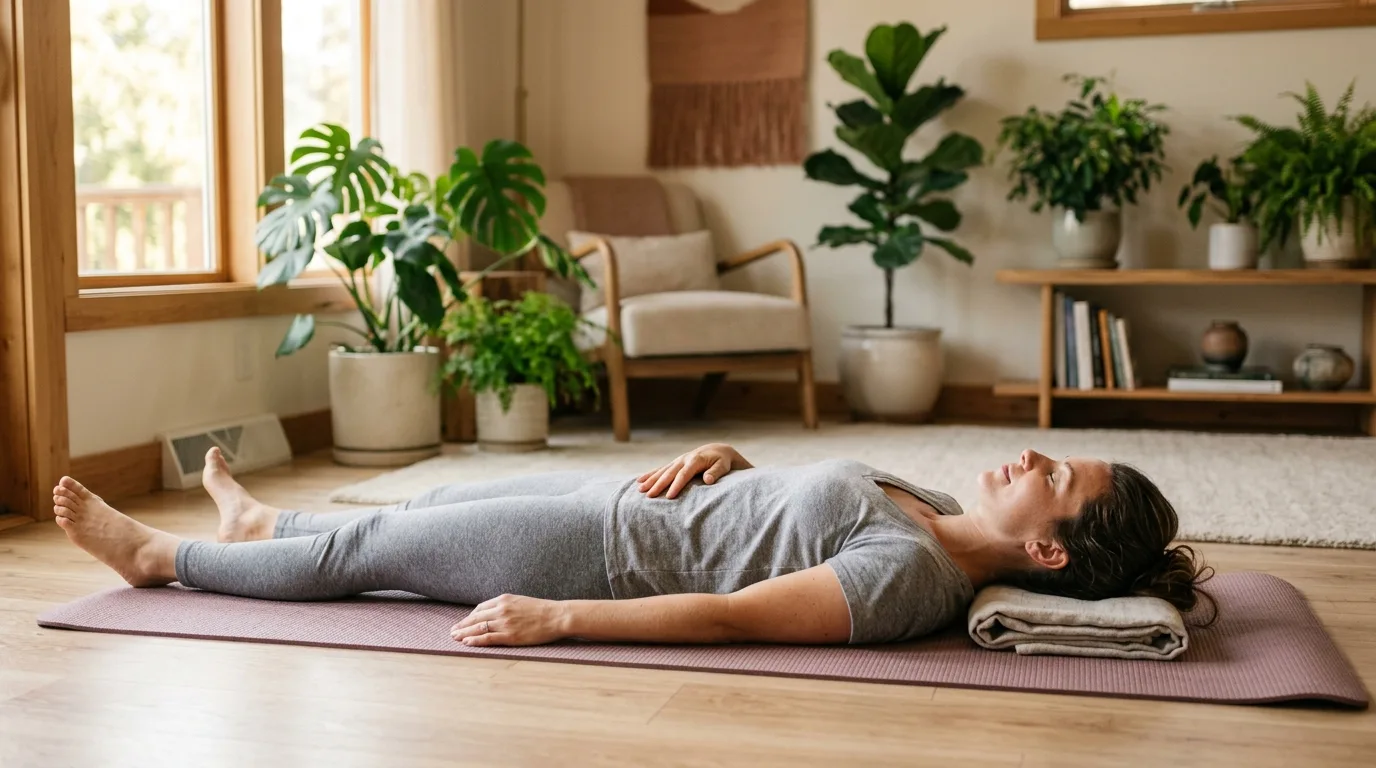
1. Body Scan With Intentional Release
The body scan is the entry point to all somatic work. Unlike a mindfulness body scan, where you simply observe sensations, this version adds an active release component. You notice tension, then consciously let it go. Research on body-based awareness interventions shows that body scanning significantly reduces perceived stress and increases interoceptive awareness, your ability to sense what’s happening inside your body (Price & Hooven, Frontiers in Psychology, 2018).
Interoception is central to somatic psychology. When you develop more precise body awareness, you notice stress accumulating earlier, before it becomes overwhelming. That gives you a much larger window to intervene.
How to practice:
- Lie on your back with your arms at your sides. Close your eyes.
- Start at the top of your head. Notice any tightness in your scalp, forehead, or jaw.
- On your next exhale, deliberately release any tension you find. Let gravity do the work.
- Move slowly down through your neck, shoulders, arms, hands, chest, belly, hips, legs, and feet.
- Spend 30 to 60 seconds on each body region. Don’t rush.
- When you find a stubborn area, try gently tensing it first at about 20% effort, then releasing completely. This is pandiculation.
- Total time: 10 to 15 minutes.
Best for: Beginners, evening wind-down, identifying where you hold stress in your body.
2. Diaphragmatic Breathing With Body Awareness
You may already use breathwork techniques as a standalone practice. This somatic version adds a layer of body awareness that deepens the effect. Rather than counting breaths, you track how each breath moves through your torso and notice which muscles engage unnecessarily. A 2024 randomized controlled trial found that diaphragmatic breathing increased heart rate variability (p = 0.006) and decreased cortisol (p less than 0.001) in just one session (PMC, 2024).
The body awareness component isn’t decorative. When you notice that your shoulders lift with every inhale, or that your lower back arches unnecessarily, you’ve found a chronic tension pattern. The somatic part is noticing it and choosing to release it on the exhale.
How to practice:
- Sit or lie down comfortably. Place one hand on your chest and one on your belly.
- Inhale slowly through your nose for 4 to 5 seconds, directing the breath into your belly.
- As you inhale, notice which muscles engage. Do your shoulders lift? Does your lower back arch?
- Exhale slowly for 6 to 7 seconds. Consciously release any muscles that activated unnecessarily.
- After 5 breaths, move your hands to your ribcage. Breathe laterally, expanding your ribs sideways.
- Notice any difference between your left and right sides. Don’t try to fix it. Just notice.
- Continue for 5 to 10 minutes, alternating between belly breathing and lateral rib breathing.
Best for: Integrating breathwork with body awareness, reducing chest tightness, building interoception.
3. Progressive Muscle Relaxation (PMR)
Progressive muscle relaxation is the most studied somatic exercise with the strongest clinical evidence base. Originally developed by Edmund Jacobson in the 1930s, PMR involves systematically tensing and releasing muscle groups throughout the body. A 2022 clinical study in Frontiers in Psychiatry found that PMR reduced anxiety scores by 48% and decreased cortisol levels by 24% (Loew et al., 2022). It’s one of the few somatic practices with enough research to appear in clinical treatment guidelines.
The mechanism is the contrast between tension and release. By deliberately creating tension first, you give your nervous system a clear before-and-after signal. That contrast trains the nervous system to recognize and choose the relaxed state.
How to practice:
- Sit or lie in a comfortable position. Take three slow breaths to settle in.
- Start with your feet. Curl your toes tightly for 5 to 7 seconds.
- Release suddenly and completely. Notice the sensation of relaxation for 15 to 20 seconds.
- Move to your calves. Flex your feet with toes toward shins for 5 to 7 seconds, then release.
- Continue up through thighs, glutes, abdomen, hands (make fists), biceps, shoulders (shrug up to ears), and face (scrunch everything).
- At each stage, notice the contrast between tension and release. That contrast is the practice.
- After finishing all muscle groups, lie still for 2 to 3 minutes and scan for any remaining tension.
- Total time: 10 to 20 minutes.
Best for: Chronic muscle tension, insomnia, generalized anxiety, building baseline body awareness.
4. Somatic Shaking (TRE-Inspired Tremoring)
TRE (Tension and Trauma Releasing Exercises), developed by David Berceli, uses specific positions to activate the body’s natural tremor mechanism. This is a built-in mammalian stress discharge system that most adults have gradually suppressed. A 2014 study by Berceli et al. found that TRE reduced anxiety and PTSD symptoms in military veterans, with participants reporting decreased overall stress and improved sleep (Berceli et al., 2014). The tremoring response appears to discharge excess activation from the nervous system through the same mechanism seen in animals after a stress response.
How to practice (simplified home version):
- Stand with your feet shoulder-width apart. Bend your knees slightly.
- Lean against a wall with your back flat. Slide down until your thighs start to burn, like a wall sit.
- Hold this position for 2 to 3 minutes until your legs begin to tremble. This is normal and intentional.
- Slowly slide down to lie on the floor. Bring the soles of your feet together and let your knees fall open in a butterfly position.
- Lift your pelvis slightly off the floor. You may notice tremors continuing in your legs and hips.
- Let the tremors happen. Don’t try to control or stop them.
- If the tremoring feels too intense, straighten your legs to reduce it.
- Continue for 5 to 15 minutes. End by lying flat with legs extended for 2 minutes.
Best for: Stored physical tension, stress discharge, trauma recovery with appropriate guidance.
5. Slow Somatic Spinal Movements
Your spine is the central highway of your nervous system. Chronic stress often manifests as stiffness and pain along the spine, particularly in the lower back and between the shoulder blades. A 2017 study found that Hanna Somatic Education significantly reduced functional limitations in participants with chronic musculoskeletal pain (Corey et al., Complementary Therapies in Clinical Practice, 2017). The movements described here draw directly from Hanna’s clinical somatics framework.
These movements use pandiculation rather than stretching. You’re not trying to create range of motion. You’re retraining the muscles along the spine to release habitual holding patterns that have become the nervous system’s default.
How to practice:
- Lie on your back with knees bent and feet flat on the floor.
- Arch and flatten: Slowly arch your lower back, creating a small gap between your back and the floor. Then slowly flatten it by tilting your pelvis. Move at about half the speed you think is right. Repeat 8 to 10 times.
- Side bend: Keep your feet planted. Slowly hike your right hip up toward your right ribcage, shortening the right side of your waist. Release slowly. Repeat on the left. Do 5 to 8 repetitions per side.
- Gentle twist: Let both knees fall slowly to the right while your left shoulder stays on the floor. Bring knees back to center slowly. Repeat on the left side. Do 5 to 8 repetitions per side.
- After each movement, pause for 3 to 5 breaths and notice how your spine feels against the floor.
- Total time: 10 to 15 minutes.
Best for: Lower back tension, desk-worker stiffness, morning mobility, chronic spinal holding patterns.
6. Somatic Foot Grounding
Your feet contain over 200,000 nerve endings, yet most people have almost no conscious awareness of them. This somatic exercise uses the feet as an anchor point to activate the body’s grounding response, drawing attention out of anxious thoughts and into physical sensation. The practice is rooted in somatic psychology’s emphasis on interoception as the entry point to nervous system regulation.
Grounding techniques, including body-based approaches, have been shown to reduce anxiety and dissociation symptoms. The foot awareness exercise specifically builds proprioceptive precision, your sense of where your body is in space, which is often disrupted during stress and anxiety.
How to practice:
- Stand barefoot on a firm surface. Close your eyes if you feel stable enough.
- Shift your weight slowly forward until you feel your toes grip the floor. Hold for 3 seconds.
- Shift your weight backward onto your heels. Notice the difference. Hold for 3 seconds.
- Rock side to side, shifting weight from the inner edges of your feet to the outer edges.
- Come to stillness. Notice the full footprint of each foot on the ground. Can you feel all ten toes? The arch? The heel?
- Slowly rise onto the balls of your feet. Notice which muscles activate up through your calves, thighs, and core.
- Lower down slowly. Repeat 5 times.
- Finish by standing still for 1 minute, simply feeling the connection between your feet and the ground.
- Total time: 5 to 8 minutes.
Best for: Anxiety spirals, dissociation, returning to the present moment, building interoceptive awareness from the ground up.
7. Somatic Neck Release for Interoception
This exercise comes from Somatic Experiencing practice and targets the area where physical tension most visibly reflects nervous system state for many people: the neck and shoulders. A 2022 systematic review found that voluntary slow breathing significantly increases vagally-mediated heart rate variability across 223 studies (Laborde et al., Neuroscience & Biobehavioral Reviews, 2022). Combining targeted neck release with slow breathing amplifies the interoceptive signal.
The eye-movement component here is drawn from Levine’s SE orientation exercises, which use lateral eye gaze to assess the nervous system’s readiness to shift out of a stress response. Spontaneous sighing, yawning, or swallowing during this exercise are signs of parasympathetic activation. Welcome them.
How to practice:
- Sit comfortably. Interlace your fingers behind your head, cradling your skull.
- Keep your eyes looking straight ahead. Without turning your head, shift your eyes slowly to the right. Hold for 30 to 60 seconds.
- Notice any spontaneous sigh, yawn, or swallow. These are signs of nervous system regulation. They’re good.
- Return your eyes to center. Repeat on the left side.
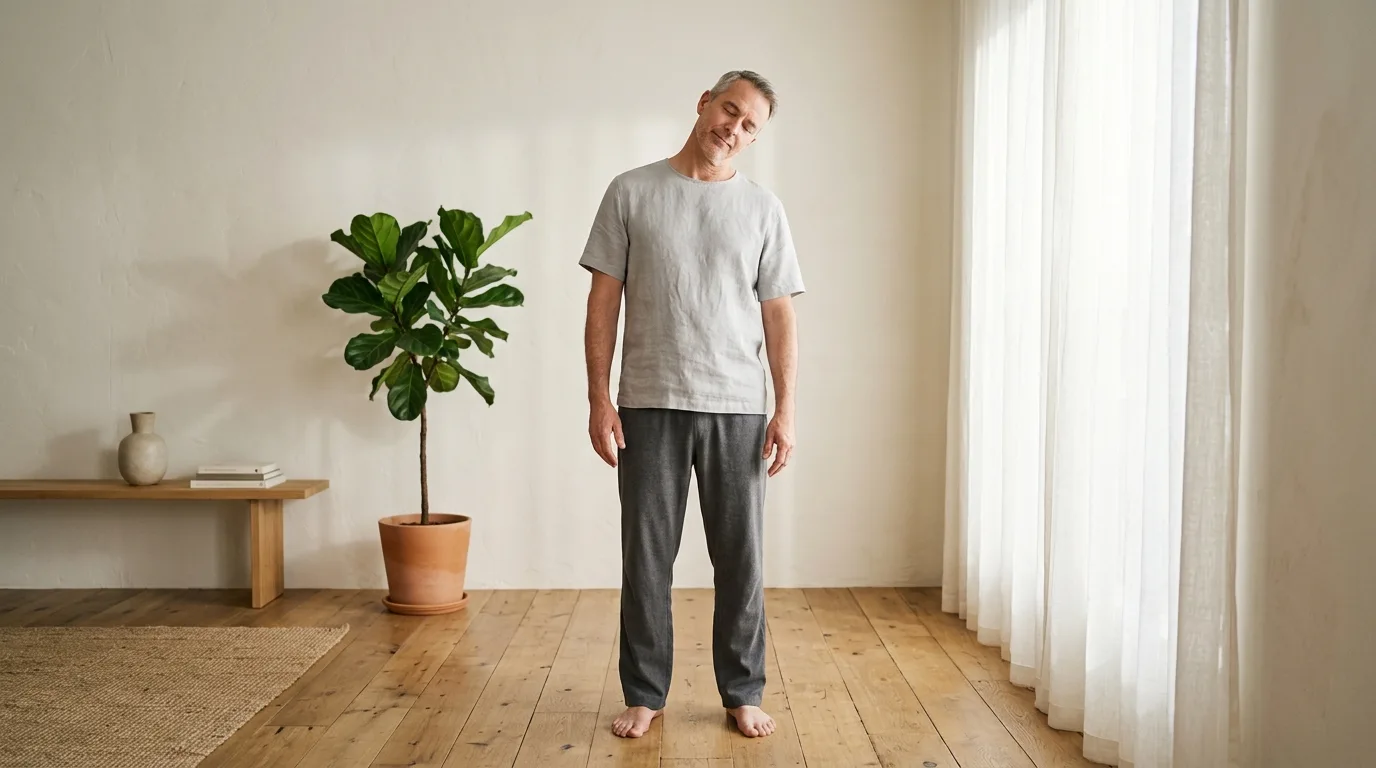
- Next, slowly tilt your right ear toward your right shoulder. Stop at the first sign of stretch. Don’t push.
- Breathe into the stretch for 5 slow breaths. On each exhale, see if you can release 1% more without forcing.
- Return to center slowly. Repeat on the left.
- Finish with 3 to 5 slow head circles in each direction, moving as slowly as possible.
- Total time: 5 to 10 minutes.
Best for: Neck and shoulder tension, building interoceptive awareness along the vagal pathway, headache prevention.
How Do Somatic Exercises Compare to Other Stress Relief Methods?
Somatic exercises show competitive effect sizes when placed alongside other evidence-based stress relief approaches. This comparison draws on published effect sizes and clinical outcomes from peer-reviewed research. The data here is not a ranking. It’s a map for choosing the right tool for a specific need.
| Method | Effect Size (Anxiety) | Speed of Relief | Equipment Needed | Best For |
|---|---|---|---|---|
| Somatic exercises | d = 0.75 | 10 to 15 min | None | Stored tension, trauma-informed work |
| Breathwork | g = 0.32 | 2 to 5 min | None | Acute stress, daily use |
| Meditation (MBSR) | g = 0.33 | 2 to 8 weeks | None or app | Focus, rumination |
| Progressive muscle relaxation | d = 0.57 | 10 to 20 min | None | Chronic tension, sleep |
| Yoga | d = 0.44 | 30 to 60 min | Mat | Flexibility and calm |
| CBT (talk therapy) | d = 0.50 to 0.80 | 6 to 12 weeks | Therapist | Clinical anxiety and depression |
Sources: Muller et al. (2022), Fincham et al. (2023), Hofmann et al. (2012), Cramer et al. (2018)
Somatic exercises and breathwork aren’t competitors. They’re complements. Breathwork gives you fast, acute relief. Somatic exercises address the deeper muscular and nervous system patterns that keep stress returning. For a complete approach, combining both with a foundation of nervous system regulation is more effective than either alone.
How Can You Build a Daily Somatic Routine?
Even 5 minutes of daily somatic practice can shift your baseline stress level. Research on body-based interventions consistently shows that session frequency matters more than session length (Hopper et al., International Journal of Environmental Research and Public Health, 2023). A short daily practice produces better outcomes than a long weekly session.
Weeks 1 to 2: Start With Two Exercises
Begin with the body scan (exercise 1) and diaphragmatic breathing with body awareness (exercise 2). Practice one in the morning and one before bed. That’s 10 to 15 minutes per day. The goal at this stage isn’t stress relief yet. It’s building interoceptive accuracy so you can notice what your body is doing.
Weeks 3 to 4: Add Movement
Introduce progressive muscle relaxation (exercise 3) or slow spinal movements (exercise 5) to one of your sessions. You’re now building body awareness and starting to release stored tension patterns that have accumulated over time.
Month 2 and Beyond: Explore and Personalize
Try TRE-style shaking (exercise 4) if you’re curious about deeper release work. Add somatic foot grounding (exercise 6) when you need a quick anxiety reset during the day. Layer in the somatic neck release (exercise 7) if neck and shoulder tension is a recurring pattern for you.
Sample Weekly Schedule
| Day | Morning (5 to 10 min) | Evening (10 to 15 min) |
|---|---|---|
| Monday | Diaphragmatic breathing with awareness | Body scan |
| Tuesday | Somatic foot grounding | Progressive muscle relaxation |
| Wednesday | Slow spinal movements | Body scan |
| Thursday | Diaphragmatic breathing with awareness | TRE shaking (short session) |
| Friday | Somatic foot grounding | Progressive muscle relaxation |
| Saturday | Slow spinal movements | Somatic neck release |
| Sunday | Rest or gentle body scan | Your choice |
Don’t treat this schedule as rigid. The whole point of somatic work is tuning into what your body needs today, not following a preset program regardless of how you feel. Some days, 5 minutes of body scanning is exactly right. Other days, your lower back will ask for more time on spinal movements.
If you already practice breathing exercises for anxiety, somatic exercises are a natural next step. They deepen the body awareness that breathwork begins.
Who Should Try Somatic Exercises?
Somatic exercises are safe for most adults. The techniques in this guide use gentle, controlled movements with no impact or strain. A few groups should proceed with extra care.
Somatic exercises are well-suited for:
- Stressed professionals dealing with chronic muscle tension
- People with desk-related pain in the neck, shoulders, or lower back
- Anyone who finds meditation frustrating or insufficient on its own
- Individuals recovering from burnout
- People exploring nervous system regulation and looking for body-based entry points
Proceed with caution if you have:
- A history of severe trauma or PTSD (work with a certified Somatic Experiencing practitioner)
- Recent surgery or acute injuries (consult your doctor first)
- Epilepsy or seizure disorders, particularly with TRE and tremoring exercises
- Dissociative disorders, as somatic work can intensify dissociation without proper guidance
The key principle: start gentle, go slow, and stop if anything feels wrong. Somatic exercises should feel like a release. Not a struggle.
Frequently Asked Questions
How long does it take for somatic exercises to work?
Many people notice a shift in tension and mood after their first session. A clinical trial on progressive muscle relaxation showed anxiety reductions of 48% over the study period (Loew et al., Frontiers in Psychiatry, 2022). That said, rewiring chronic tension patterns typically takes 4 to 8 weeks of consistent daily practice. The acute relaxation response happens immediately. The lasting nervous system changes build over time.
Are somatic exercises the same as yoga?
No. Both involve body awareness, but somatic exercises focus on internal sensation and nervous system reprogramming rather than achieving specific postures. Yoga emphasizes flexibility, strength, and form. Somatic work emphasizes feeling, releasing, and retraining muscle tension at the neurological level through pandiculation. Some yoga traditions, like yin yoga and yoga nidra, share significant overlap with somatic principles, but the underlying intent is different.
Can somatic exercises help with chronic pain?
Research suggests they can. A 2017 study on Hanna Somatic Education found significant reductions in functional limitations among chronic pain participants (Corey et al., Complementary Therapies in Clinical Practice, 2017). The theory is that much chronic pain stems from sensory motor amnesia: muscles that have forgotten how to fully relax. Somatic exercises retrain those muscles at the cortical level rather than just temporarily lengthening them.
Do I need a therapist to do somatic exercises?
For the exercises in this guide, no. Body scans, PMR, diaphragmatic breathing with awareness, spinal movements, grounding, and neck releases are all safe for self-guided practice. TRE tremoring and deeper Somatic Experiencing work can bring up intense emotions, particularly with a trauma history. In those cases, working with a certified SE practitioner or TRE provider is strongly recommended before attempting those techniques independently.
How are somatic exercises different from regular stretching?
Regular stretching elongates muscles temporarily. Somatic exercises use pandiculation, a three-step process of contracting, slowly releasing, and fully relaxing, to reset the brain’s motor control of muscle length and tension. This creates lasting changes rather than temporary flexibility gains. Stretching treats the muscle. Somatic exercises retrain the nervous system that controls it. The difference shows up over weeks, not in one session.
References
- Brom, D., Stokar, Y., Lawi, C., Nuriel-Porat, V., Ziv, Y., Lerner, K., & Ross, G. (2017). Somatic Experiencing for Posttraumatic Stress Disorder: A randomized controlled outcome study. Journal of Traumatic Stress, 30(3), 304-312. https://pubmed.ncbi.nlm.nih.gov/28493511/
- Price, C. J., & Hooven, C. (2018). Interoceptive awareness skills for emotion regulation: Theory and approach of Mindful Awareness in Body-Oriented Therapy (MABT). Frontiers in Psychology, 9, 798. https://pmc.ncbi.nlm.nih.gov/articles/PMC7046797/
- Berceli, D., Salmon, M., Bonifas, R., & Ndefo, N. (2014). Effects of self-induced unclassified therapeutic tremors on quality of life among non-professional caregivers. Global Advances in Health and Medicine, 3(5), 42-48. https://pubmed.ncbi.nlm.nih.gov/24819758/
- Loew, T. H., Krokos, E., & Sohn, M. (2022). Progressive muscle relaxation reduces cortisol and anxiety. Frontiers in Psychiatry, 12, 765692. https://pmc.ncbi.nlm.nih.gov/articles/PMC8721422/
- Muller, L., et al. (2022). Body-oriented psychological therapies for anxiety and depression: A meta-analysis. Frontiers in Psychology, 13, 833404. https://pmc.ncbi.nlm.nih.gov/articles/PMC8951883/
- Laborde, S., et al. (2022). Effects of voluntary slow breathing on heart rate and heart rate variability: A systematic review and a meta-analysis. Neuroscience & Biobehavioral Reviews, 138, 104711. https://pubmed.ncbi.nlm.nih.gov/35623448/
- Corey, S. M., et al. (2017). Hanna Somatic Education for chronic musculoskeletal pain. Complementary Therapies in Clinical Practice, 29, 59-64. https://pubmed.ncbi.nlm.nih.gov/28917376/
- PMC (2024). Diaphragmatic breathing RCT: HRV, cortisol, and cytokines. https://pmc.ncbi.nlm.nih.gov/articles/PMC11636440/
- Hopper, S., Nesi, J., & Murray, S. (2023). Breathing practices for stress and anxiety reduction. International Journal of Environmental Research and Public Health. https://pmc.ncbi.nlm.nih.gov/articles/PMC10741869/
- Fincham, G. W., et al. (2023). Effect of breathwork on stress and mental health. Scientific Reports, 13, 432. https://pmc.ncbi.nlm.nih.gov/articles/PMC9828383/