Your mind is racing. The meeting starts in four minutes. Or you’re on a crowded train and something tips you over the edge. Or it’s 2 a.m. and the spiral is already in motion. You don’t need a long practice right now. You need something that works this minute . Grounding techniques are widely used in clinical trauma and anxiety treatment to interrupt acute distress, though controlled trials isolating grounding as a standalone intervention remain limited (Hammond & Brown, 2025 ). What the research does show is that sensory re-anchoring to the present disrupts the amygdala threat loop rapidly. That’s the premise of this guide.
Grounding exercises work by giving your brain new sensory data to process. When anxiety floods your system, your amygdala is running a threat loop. Sensory input breaks that loop. Not by calming you down through willpower, but by giving your nervous system something real to orient to. The nine techniques here are organized by what anxiety looks like for you: acute panic, physical tension, or racing thoughts.
How Do Grounding Exercises Actually Stop Anxiety? Grounding exercises reduce acute anxiety by generating sensory input that competes with the amygdala’s threat signal. A meta-analysis of 39 mindfulness-based intervention studies found a pooled effect size of d = 0.56 for anxiety reduction, comparable to some pharmacological approaches (Hofmann et al., 2010 ). The mechanism is not willpower. It’s neuroscience.
Editorial take: I work in sales, which means pre-call dread, post-rejection spirals, and the odd 3 a.m. inbox check are just part of the job. What I’ve found is that sensory grounding doesn’t ask anything from me intellectually. When I’m too anxious to think clearly, I don’t need another thinking task. I need something external to lock onto. That’s the real value of these techniques. The Amygdala Override: Why Thinking Doesn’t Work When a panic response fires, your prefrontal cortex goes partially offline. That’s not a metaphor. Anxiety literally impairs the rational-thinking circuitry you’d need to “logic” your way calm. Trying to argue yourself out of a panic attack is like trying to fix a blown fuse with a spreadsheet.
Grounding sidesteps this entirely. Instead of recruiting the impaired prefrontal cortex, sensory grounding feeds the brain new bottom-up data from your senses. Research from UCLA found that simply labeling emotional experience, a cognitive grounding component, reduces amygdala reactivity by up to 30% (Lieberman et al., 2007 ). The act of naming what you feel or notice creates a measurable neural shift.
Two Pathways: Top-Down and Bottom-Up Grounding works through two distinct neural pathways. Top-down techniques like cognitive naming and visualization give the prefrontal cortex structured data, which competes with the amygdala’s alarm signal. Bottom-up techniques like cold water and physical touch send signals through peripheral nerves directly to the brainstem, activating the parasympathetic nervous system without any cognitive effort required.
This is why the two categories aren’t interchangeable. During a full panic episode, bottom-up wins. During a rumination spiral, top-down is often more effective. The right tool depends on where you are in the anxiety cycle right now.
Editorial take: Most grounding guides treat all nine techniques as equivalent options. They’re not. Sensory techniques work fastest during acute panic because they don’t require executive function. Physical techniques address the body’s stored tension. Mental techniques are best for the slow-burn rumination variety of anxiety that doesn’t feel like panic but drains you just as effectively. Matching technique to anxiety type is the skill most guides skip. Which Grounding Technique Should You Use? Body-based grounding interventions are especially effective during dissociative or panicked states, while cognitive techniques show stronger results for rumination and worry cycles (Price and Hooven, 2018 ). The table below maps technique to situation.
Technique Type Time Best For 5-4-3-2-1 Sensory Scan Sensory 2-3 min Panic, dissociation, overwhelm in public Cold Water Grounding Sensory 30-60 sec Acute anxiety spike, emotional flooding Tactile Object Focus Sensory 2-5 min Restlessness, pre-meeting anxiety Barefoot Earthing Physical 5-15 min Chronic stress, cortisol reduction Progressive Muscle Release Physical 5-7 min Tension, jaw clenching, bedtime anxiety Body Scan Awareness Physical 5-10 min Dissociation, emotional numbness Box Breathing With Grounding Cues Breathwork/Sensory 3-5 min Pre-performance anxiety, focus under pressure Cognitive Naming (Categories Game) Mental 2-3 min Rumination, racing thoughts, meetings Anchoring Visualization Mental 3-5 min Anticipatory anxiety, worry spirals
breathing exercises for anxiety
Sensory Grounding Exercises for Acute Anxiety Sensory grounding works by giving the brain concrete, real-time data that competes with threat-focused thinking. A study of psychiatric inpatients found that structured sensory input reduced distress in 78% of participants (Champagne and Stromberg, 2004 ). These three techniques are the fastest acting tools in this guide.
1. The 5-4-3-2-1 Technique This is the most widely taught grounding exercise in clinical settings. Therapists recommend it as a first-line tool for acute panic and dissociation because it doesn’t require any cognitive capacity beyond noticing. It systematically uses all five senses to pull attention into the present moment.
How to do it:
5 things you can see. Look for details you’d normally overlook. The grain of the desk. Light on a window frame. The texture of your sleeve.4 things you can physically feel. Fabric against your skin. Weight of your feet on the floor. Temperature of the air. The chair back pressing against you.3 things you can hear. Traffic. The hum of a refrigerator. Your own breath.2 things you can smell. Coffee. The detergent on your shirt. If you can’t find two, move to a slightly different spot.1 thing you can taste. The residue from your last drink. Pop a mint if helpful.Why it works: Each step narrows your focus further. By the time you reach taste, most people report a measurable reduction in anxiety intensity. You’ve spent two or three minutes giving your brain real sensory input instead of imagined threats.
Best for: Panic attacks, dissociative episodes, overwhelm in public spaces.
2. Cold Water Grounding Cold exposure triggers the mammalian dive reflex, an involuntary response that slows heart rate and redirects blood to vital organs. Cold water on the face can reduce heart rate by 10-25% within seconds through direct vagal nerve activation (Alboni et al., 2011 ). It’s the fastest grounding technique available.
How to do it:
Run cold water over your wrists for 30-60 seconds. Alternatively, splash cold water on your face or hold ice in your hands. Focus entirely on the sensation: temperature, the shock of it, how your skin responds. Breathe slowly while the cold does its work. Why it works: The intense sensory signal floods the brain with real data, interrupting the anxiety loop. At the same time, the dive reflex directly activates the parasympathetic nervous system. No willpower needed. No slow breathing practice required. Just cold water.
Best for: Acute anxiety attacks, emotional flooding, moments when you need relief within a minute.
Editorial take: Cold water on the wrists is my personal emergency technique for pre-call anxiety. I’ve kept it in my rotation for two years. It works because it requires nothing from me mentally. I can be mid-spiral and three seconds of cold water on my wrists changes the quality of attention immediately. The sensation is just too loud to ignore. 3. Tactile Object Focus (Grounding Stone) Holding and deliberately exploring a physical object gives the brain a concrete focal point. This is a core tool in dialectical behavior therapy (DBT) for managing emotional dysregulation and anxiety-driven restlessness. Any small object works: a smooth stone, a set of keys, a textured stress ball.
How to do it:
Pick up the object. Close your eyes if comfortable. Explore it slowly. Notice weight, temperature, texture, edges, and any rough patches. Describe the object to yourself in detail: “This is cool, slightly heavier on one end, smooth except for a small ridge near the top.” Continue for 2-5 minutes or until anxiety decreases. Why it works: Detailed sensory description requires prefrontal cortex engagement, which directly competes with amygdala-driven threat processing. You can’t fully attend to a detailed texture and a catastrophic thought simultaneously. The object wins, if you let it.
Best for: Generalized anxiety, restlessness, waiting rooms, situations where visible movement isn’t appropriate.
Physical Grounding Exercises for Body Tension Physical grounding uses body awareness and deliberate movement to shift your nervous system state from the bottom up. A meta-analysis of 12 studies on body-oriented interventions found significant reductions in both anxiety and PTSD symptoms compared to control conditions (Price and Hooven, 2018 ). These techniques are especially useful when anxiety lives primarily in your body: clenched jaw, tight chest, stomach in knots.
Walking barefoot on natural ground is one of the most accessible physical grounding exercises. A pilot study found that earthing during sleep reduced nighttime cortisol and realigned cortisol secretion to a healthier diurnal rhythm, with some participants showing reductions of up to 31% (Ghaly and Teplitz, 2004 ). The research base is still early, but the sensory benefits of bare skin on natural surfaces are real regardless of mechanism.
How to do it:
Remove shoes and socks. Stand or walk on grass, soil, sand, or stone. Focus on the sensations in your feet: temperature, texture, firmness, moisture. Walk slowly for 5-15 minutes, placing each foot deliberately. No outdoor access? Stand on a cool tile floor and notice the same sensations. Best for: Chronic stress, cortisol-related anxiety, accessible outdoor environments.
5. Progressive Muscle Release (Quick Version) Progressive muscle relaxation (PMR) has been studied since Edmund Jacobson developed it in the 1930s. A meta-analysis of 11 randomized controlled trials found that PMR significantly reduced state anxiety (standardized mean difference = -0.57) compared to control conditions (Manzoni et al., 2008 ). This version takes about five minutes.
How to do it:
Start with your feet. Curl your toes tightly for 5 seconds. Release and notice the contrast. Calves next: tense firmly for 5 seconds. Release. Continue upward: thighs, abdomen, fists, shoulders, face. With each release, exhale slowly and stay with the sensation of letting go. Why it works: The tension-release cycle makes relaxation tangible. You’re not trying to relax by hoping. You’re creating the physical contrast that proves relaxation is possible. This is particularly useful for people who carry anxiety as physical tension, which is more common than most guides acknowledge.
Best for: Physical tension, bedtime anxiety, difficulty relaxing.
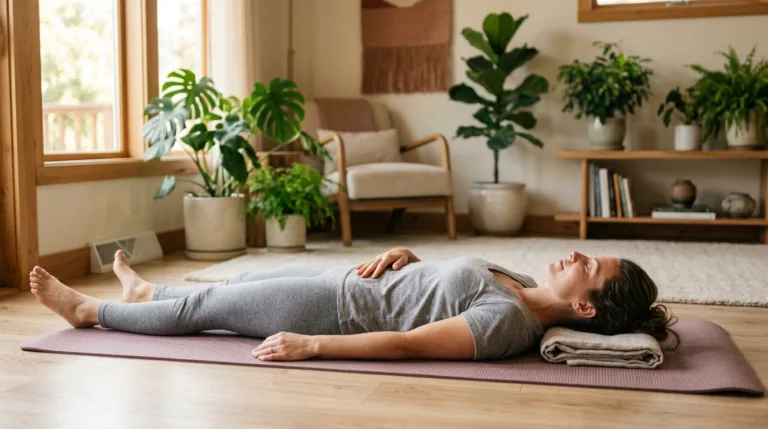
6. Body Scan Awareness The body scan is a mindfulness-based grounding technique that systematically notices sensation throughout the body. A systematic review and meta-analysis found that mindfulness-based practices reduce physiological stress markers, including cortisol, in stressed adults (Pascoe et al., 2017 ). The body scan is particularly useful when anxiety creates a disconnected or “floaty” feeling.
How to do it:
Sit or lie down. Close your eyes. Start at the top of your head. Just notice. Don’t try to change anything. Move slowly downward: forehead, eyes, jaw, neck, shoulders, arms, hands, chest, belly, hips, legs, feet. Spend 10-15 seconds on each area. Notice temperature, tension, tingling, or numbness. Anywhere you find tension, breathe toward it for a few extra seconds before continuing. Best for: Dissociation, emotional numbness, “in my head” feeling.
somatic exercises
Mental Grounding Exercises for Rumination and Worry Mental grounding exercises work by occupying working memory with a structured task, leaving less cognitive bandwidth for anxious rumination. Research on cognitive load theory supports this: engaging working memory with moderately demanding tasks significantly reduces intrusive thoughts and emotional reactivity (Van den Hout and Engelhard, 2012 ). These are the tools for the slow-burn, thought-loop variety of anxiety.
7. Cognitive Naming (The Categories Game) This technique forces your brain into a structured cognitive task that competes with anxious rumination. It’s a lightweight form of cognitive defusion from acceptance and commitment therapy (ACT), which works by creating a gap between you and your anxious thoughts.
How to do it:
Pick a category: dog breeds, countries, types of fruit, movie directors, anything. Name as many items as you can. Go deliberately, not quickly. When you run out, switch categories. Continue for 2-3 minutes or until anxiety decreases. Variations that also work well:
Count backward from 100 by 7s (100, 93, 86, 79…). Spell words backward in your head. Recite lyrics or poetry from memory. Best for: Racing thoughts, rumination, situations where physical grounding isn’t appropriate (meetings, public transport, phone calls).
8. Anchoring Visualization Visualization-based grounding builds a detailed mental “safe anchor” you can return to when anxiety spikes. Unlike other grounding techniques, this one creates a reusable resource that gets stronger with practice.
How to do it:
Close your eyes. Picture a place where you feel completely safe and calm. Real or imagined both work. Build the scene in detail: colors, lighting, what surrounds you. Add sounds: water, birds, silence, music. Add physical sensations: warmth, a breeze, soft ground underfoot. Stay in the scene for 3-5 minutes. Breathe naturally. Before opening your eyes, pick one detail to carry as a micro-anchor you can recall instantly later. Why it works: Detailed visualization activates many of the same brain regions as real sensory experience. Your nervous system doesn’t fully distinguish between a vividly imagined safe place and actually being there. That’s not a wellness claim. It’s established in sensory neuroscience.
Best for: Anticipatory anxiety, worry about upcoming events, difficulty falling asleep.
How to Use Box Breathing as a Portable Grounding Anchor Box breathing on its own activates the parasympathetic nervous system through slow, rhythmic respiration. When you add sensory grounding cues to each count, it becomes a dual-action tool: respiratory regulation plus present-moment anchoring at the same time. This combination is particularly effective for pre-performance anxiety, the kind that shows up before a difficult conversation, a presentation, or a high-stakes call.
Editorial take: Box breathing alone is powerful. But attaching a sensory cue to each count turns it into a grounding anchor specifically for acute pre-event anxiety. The two-channel engagement, breathing and noticing, means neither the breath work nor the worry can occupy full cognitive bandwidth. I use this before difficult conversations and it works faster than either technique alone. Box Breathing With Grounding Cues: Step by Step How to do it:
Sit with both feet flat on the floor. Press them down. Notice the floor beneath you. Inhale for 4 counts while noticing one thing you can see. Hold for 4 counts while noticing one thing you can physically feel. Exhale for 4 counts while noticing one thing you can hear. Hold for 4 counts while thinking of one thing you’re grateful for. Repeat for 3-5 rounds. The box pattern (4-4-4-4) activates the vagus nerve through extended exhalation and breath holds. The sensory cues on each phase keep your attention anchored to the present rather than drifting back to the worry. Most people find their anxiety has shifted noticeably after two full rounds.
This technique is distinct from longer breathwork practices designed to build vagal tone over weeks. It’s a tool for right now, not a training protocol. breathwork techniques guide
How Do You Build a Daily Grounding Practice? Consistency matters more than session length. Research on habit formation found that new behaviors take an average of 66 days to become automatic, but even short daily repetitions count toward that threshold (Lally et al., 2010 ). The goal is to make one grounding technique a familiar reflex before you need it, not to memorize all nine at once.
Start With One, Not Nine Pick the technique that matches your most common anxiety pattern. Panic or dissociation: start with the 5-4-3-2-1 method. Physical tension: start with progressive muscle release. Thought loops: start with cognitive naming. Practice that one technique daily for two weeks before adding another. You’ll know it’s working when you reach for it without thinking.
Attach Grounding to Existing Moments Habit research is clear: new behaviors stick faster when they’re anchored to existing routines. Here’s a practical mapping:
Morning, while coffee brews: 2-minute body scan.Commute or transit: 5-4-3-2-1 technique (silent, no one notices).Lunch break, if outdoors accessible: 10 minutes barefoot earthing.Before a difficult meeting or call: Box breathing with grounding cues, 3 rounds.Bedtime: Progressive muscle release or anchoring visualization.The Speed Dial Approach Identify three go-to techniques at three different speeds. You won’t always have five minutes. You won’t always have privacy. Having three options ready means you’re never without a tool.
Under 60 seconds: Cold water on wrists, ice in hands.2-3 minutes: 5-4-3-2-1, cognitive naming.5-10 minutes: Body scan, progressive muscle release.Track What Actually Works for You Keep a simple note on your phone. Date, technique, anxiety level before (1-10), anxiety level after. After two weeks, you’ll see clear patterns about which grounding exercises work best for your specific anxiety profile. Not everyone responds the same way. Some people find cold water immediately grounding. Others find it activating. Your data is more reliable than any general recommendation, including this one.
somatic exercises
Frequently Asked Questions What is the 5-4-3-2-1 grounding technique? The 5-4-3-2-1 technique is a sensory grounding exercise that engages all five senses to anchor attention to the present moment. You identify 5 things you can see, 4 you can feel, 3 you can hear, 2 you can smell, and 1 you can taste. Research on sensory-based interventions found that structured sensory input reduced distress in 78% of psychiatric inpatients (Champagne and Stromberg, 2004 ). It typically takes 2-3 minutes and requires no equipment.
Do grounding exercises work for panic attacks? Yes, particularly sensory and cold-water techniques. Sensory grounding works during acute panic precisely because it bypasses rational thinking, which anxiety impairs. Cold water activates the mammalian dive reflex and can reduce heart rate by 10-25% within seconds (Alboni et al., 2011 ). These are not cures for panic disorder, but they are effective tools for interrupting an active panic episode. If you experience frequent panic attacks, consult a healthcare provider.
How are grounding exercises different from breathwork? Grounding exercises primarily work through sensory input, body awareness, and cognitive redirection. Breathwork works through respiratory mechanics that directly influence the autonomic nervous system. Both reduce anxiety, and they complement each other well. Box breathing with grounding cues (technique 7 in this guide) combines both. breathing exercises for anxiety
Can you do grounding exercises at work without anyone noticing? Yes. Several techniques are completely invisible. Cognitive naming (silently listing categories), tactile object focus (holding a pen or smooth stone), and the 5-4-3-2-1 technique done with open eyes all look indistinguishable from sitting quietly. Box breathing looks like slow, controlled breathing, which doesn’t attract attention. Progressive muscle release can be limited to hands and feet under a desk.
How quickly do grounding exercises reduce anxiety? Cold water grounding works within 30-60 seconds. The 5-4-3-2-1 technique typically produces a noticeable shift within 2-3 minutes. Progressive muscle release and body scans take 5-10 minutes but often produce deeper results. The key variable is practice: research suggests new habits take 66 days to become automatic (Lally et al., 2010 ). Grounding techniques practiced when calm become more reliably effective during anxiety spikes.
About the Author Ulrich Baldauf is the founder of wuusaa, a research curation site covering sleep, breathwork, and nervous system regulation. He works in sales and has spent years applying evidence-based wellness practices to manage high-performance demands. He is not a clinician. wuusaa curates peer-reviewed research and translates it into practical guidance.
References Alboni, P., Alboni, M., and Gianfranchi, L. (2011). Diving bradycardia: A mechanism of defence against hypoxic damage. Journal of Cardiovascular Medicine , 12(6), 422-427. https://pubmed.ncbi.nlm.nih.gov/21164553/ Champagne, T., and Stromberg, N. (2004). Sensory approaches in inpatient psychiatric settings: Innovative alternatives to seclusion and restraint. Journal of Psychosocial Nursing and Mental Health Services , 42(9), 34-44. https://pubmed.ncbi.nlm.nih.gov/15127156/ Ghaly, M., and Teplitz, D. (2004). The biologic effects of grounding the human body during sleep as measured by cortisol levels and subjective reporting of sleep, pain, and stress. Journal of Alternative and Complementary Medicine , 10(5), 767-776. https://pubmed.ncbi.nlm.nih.gov/15650465/ Hammond, C., and Brown, E. (2025). Building an operational definition of grounding: A systematic review. Trauma, Violence, and Abuse . https://journals.sagepub.com/doi/10.1177/15248380251343189 Hofmann, S. G., Sawyer, A. T., Witt, A. A., and Oh, D. (2010). The effect of mindfulness-based therapy on anxiety and depression: A meta-analytic review. Journal of Consulting and Clinical Psychology , 78(2), 169-183. https://pubmed.ncbi.nlm.nih.gov/20350028/ Lally, P., van Jaarsveld, C. H. M., Potts, H. W. W., and Wardle, J. (2010). How are habits formed: Modelling habit formation in the real world. European Journal of Social Psychology , 40(6), 998-1009. https://pubmed.ncbi.nlm.nih.gov/20025046/ Lieberman, M. D., Eisenberger, N. I., Crockett, M. J., Tom, S. M., Pfeifer, J. H., and Way, B. M. (2007). Putting feelings into words: Affect labeling disrupts amygdala activity in response to affective stimuli. Psychological Science , 18(5), 421-428. https://pubmed.ncbi.nlm.nih.gov/17576282/ Manzoni, G. M., Pagnini, F., Castelnuovo, G., and Molinari, E. (2008). Relaxation training for anxiety: A ten-years systematic review with meta-analysis. BMC Psychiatry , 8, 41. https://pubmed.ncbi.nlm.nih.gov/18752854/ Pascoe, M. C., Thompson, D. R., Jenkins, Z. M., and Ski, C. F. (2017). Mindfulness mediates the physiological markers of stress: Systematic review and meta-analysis. Journal of Psychiatric Research , 95, 156-178. https://pubmed.ncbi.nlm.nih.gov/28863392/ Price, C. J., and Hooven, C. (2018). Interoceptive awareness skills for emotion regulation: Theory and approach of mindful awareness in body-oriented therapy (MABT). Frontiers in Psychology , 9, 798. https://pubmed.ncbi.nlm.nih.gov/29946276/ Van den Hout, M. A., and Engelhard, I. M. (2012). How does EMDR work? Journal of Experimental Psychopathology , 3(5), 724-738. https://pubmed.ncbi.nlm.nih.gov/22169170/ About the author
Ulrich Baldauf
Founder of wuusaa
Ulrich works in sales and curates peer-reviewed research on breathwork, sleep, and nervous-system regulation — translating the science into practical techniques anyone can use. He is not a clinician.
Read the full story →