Pregnancy is one of the few life stages where sleeping position genuinely affects health outcomes for both the pregnant person and the developing baby. The recommendation that’s everywhere, sleep on your left side, is real, but the timing and reasoning behind it are more nuanced than the one-line version.
This article walks through what the major obstetric bodies actually say about sleeping position trimester by trimester, the research behind the third-trimester recommendation, why the left side specifically gets singled out, and the practical question of how to actually stay on your side when your body has redistributed its center of gravity. We summarize sources; we don’t prescribe.
Key Takeaways
- Best sleeping position pregnancy guidance from Mayo Clinic and ACOG: side sleeping is recommended, especially in the third trimester after about 28 weeks.
- The left side is often singled out for better placental blood flow, but either side is dramatically better than back-sleeping in late pregnancy.
- Research from NICHD (2019) found that sleep position in early and mid pregnancy (up to 30 weeks) is not associated with pregnancy complications.
- The mechanism is anatomical: the gravid uterus can compress the inferior vena cava when supine, reducing venous return to the heart.
- This article summarizes what major medical bodies recommend and is not medical advice. For specific concerns about your pregnancy, talk to your obstetric care provider.
What Mayo Clinic and ACOG Actually Recommend
The cleanest summary of the consensus position comes from Mayo Clinic and ACOG, both of which recommend side sleeping during pregnancy.
Mayo Clinic recommends side sleeping during pregnancy, particularly in the third trimester, with knees slightly bent. They specifically note that sleeping on the left side may improve blood flow to the placenta and reduce pressure on the inferior vena cava (Mayo Clinic). ACOG’s guidance, summarized in obstetric publications, recommends side sleeping with knees slightly bent.
The phrasing matters. Both bodies recommend side sleeping in late pregnancy. The left-side preference is presented as a secondary refinement, not a strict requirement. Either side is dramatically better than supine in the third trimester, the left side may have a small additional advantage for placental blood flow, but the larger health-relevant difference is side vs back, not left vs right.
The Research Behind the Third-Trimester Recommendation
The recommendation against late-pregnancy supine sleeping is based on observational research linking back sleeping in the third trimester to higher risk of stillbirth.
An individual participant data meta-analysis published in 2019 by Cronin and colleagues pooled data from multiple studies and found an adjusted odds ratio of 2.63 for late stillbirth in pregnant people who reported going to sleep supine, compared to those who reported going to sleep on their side (Cronin et al., EClinicalMedicine, 2019). The MiNESS study from Manchester reported a similar magnitude, about a 2.3-fold increased risk of late stillbirth (after 28 weeks) when going to sleep on the back (Manchester University NHS / MiNESS, 2017).
The risk is associated with the position the pregnant person goes to sleep in, not necessarily the position they end up in by morning. This matters practically: if you fall asleep on your side and roll onto your back during the night, the research is less applicable than if you start the night supine.
Important context for interpreting the absolute risk: late stillbirth is rare in absolute terms, and the increased relative risk operates on a relatively low baseline. The numbers translate to a meaningful but not overwhelming change in absolute risk. The recommendations against supine sleeping in late pregnancy are based on the consistency of the finding across multiple studies, not on a dramatic absolute risk.
What About the First and Second Trimesters?
This is where the messaging often gets blurred. The third-trimester recommendation has been broadly publicized; the early-pregnancy nuance often hasn’t.
A 2019 study from NICHD (the NIH’s National Institute of Child Health and Human Development) found that sleep position in early and mid pregnancy (up to 30 weeks) was not associated with pregnancy complications (NICHD, 2019). Pregnant people in the first and second trimesters can sleep in whatever position is comfortable. The strict side-sleeping recommendation specifically applies to late pregnancy when the gravid uterus is large enough to compress the major blood vessels when supine.
Practically, this means a few things. If you’re in your first trimester and you’ve been worried about sleeping on your back, you don’t need to worry yet. If you’re a stomach sleeper in early pregnancy, you can keep doing that until your changing body makes it physically uncomfortable (which usually happens naturally around 14-18 weeks). The transition to side sleeping is something to start preparing for around week 20-24, with full commitment by about week 28.
Why the Left Side Specifically
The mechanism is the same anatomy that makes the left side recommended for acid reflux (covered in Best Sleeping Position for Acid Reflux & GERD), but applied to a different problem.
The inferior vena cava, the largest vein returning blood from the lower body to the heart, runs along the right side of the spine. The aorta runs along the left side. When you’re lying on your back in late pregnancy, the gravid uterus presses down on both vessels. The inferior vena cava, being more compressible, gets the worst of it (Mayo Clinic News Network).
When you’re on your left side, the uterus shifts to the left, away from the inferior vena cava on the right. Venous return improves. Cardiac output improves. Placental blood flow is generally considered better. When you’re on your right side, the uterus presses partially against the vena cava, better than supine, but not as good as left.
The Auckland-based research that suggested halved stillbirth risk on left vs right was a single small study and has not been replicated in larger work. We mention it because the question comes up often, but we don’t headline it as a finding. The defensible position is: side > back, with left side as a slight refinement on either-side guidance.
Pregnancy Sleep Position Recommendations by Trimester
Major obstetric bodies issue different guidance by trimester because the underlying anatomy changes. The table below summarizes Mayo Clinic, ACOG, and NICHD guidance per trimester.
| Trimester | Recommendation | Reason |
|---|---|---|
| First (0-13 wks) | Any comfortable position | No association with complications (NICHD 2019) |
| Second (14-27 wks) | Side preferred, transition begins | Stomach becomes physically uncomfortable |
| Third (28+ wks) | Side, left preferred (Mayo Clinic) | Inferior vena cava compression on back; aOR 2.63 stillbirth supine (Cronin 2019) |
How to Actually Stay on Your Side
Knowing left side is the recommendation doesn’t help if you wake up on your back four nights in seven. The practical setup matters more than the intention.
Pregnancy Pillows
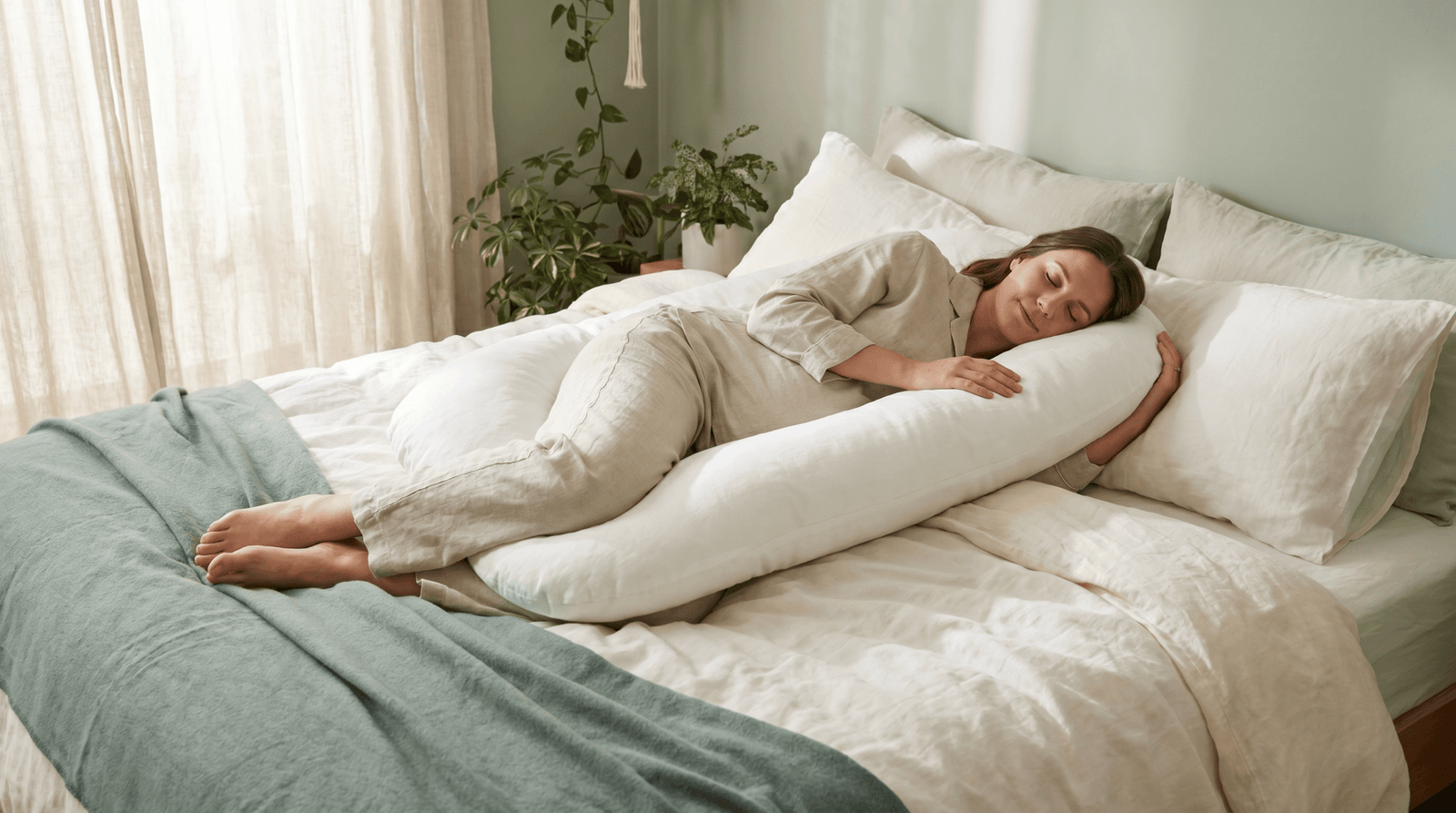
The product category specifically designed for this is the pregnancy pillow, large U-shaped or C-shaped pillows that support the back, the belly, and the legs simultaneously. They make rolling onto the back physically harder by occupying that space.
The biggest practical benefit isn’t the back-prevention; it’s the comfort during late pregnancy. The growing belly puts strain on the lower back, the hips ache from side sleeping for months, and the abdominal weight feels uncomfortable when there’s no support underneath. Pregnancy pillows address all three at once.
If a dedicated pregnancy pillow feels like too much commitment, the lower-tech equivalent is two regular pillows: one between the knees, one supporting the belly from below. The principle, distribute the weight, support the spine, is the same.
Wedge Under the Belly
A small wedge or rolled towel under the belly while lying on your side reduces the pulling sensation on the abdominal muscles and uterine ligaments. This often helps with the discomfort that makes side sleeping hard in the first place.
Wedge Behind the Back
If you’re prone to rolling onto your back during the night, a wedge or large pillow behind your back creates a physical barrier. You’ll still drift slightly toward the back during the night, but the wedge keeps you off your back proper.
Don’t Stress About Waking on Your Back
Worth saying explicitly: the published research is about the position you go to sleep in. If you wake up briefly during the night and find yourself on your back, that’s not the same situation. Roll back onto your side and go back to sleep without alarm. Pregnant people who chronically anxious about back-sleeping during the night often sleep worse overall, which has its own implications.
If Sleep Is Difficult Anyway
Pregnancy disrupts sleep in many ways that aren’t directly position-related, frequent bathroom trips, restless legs, heartburn, lower back pain, anxiety about the upcoming birth. If position is one part of a broader sleep difficulty, the related guides:
- Best Sleeping Position for Acid Reflux & GERD, pregnancy heartburn often responds to the same left-side strategy
- Wind Down Routine for Better Sleep, calming pre-bed habits
- Sleep Meditation Techniques, guided audio approaches that work well during pregnancy
- Yoga Nidra for Sleep, particularly helpful for pregnancy-related anxiety
- How to Fall Asleep Fast, cognitive techniques for the can’t-shut-off-the-thoughts hours
None of those are pregnancy-specific guidance. They’re general sleep techniques that work fine during pregnancy. For pregnancy-specific medical concerns about sleep, sleep apnea developing during pregnancy, severe insomnia, restless legs, talk to your obstetric care provider.
What to Avoid in Late Pregnancy
Direct from major obstetric body recommendations:
- Going to sleep on your back after about 28 weeks. Side is recommended, with left side as a slight refinement.
- Stomach sleeping in late pregnancy. Usually impossible by then for physical reasons, but worth saying explicitly.
- Heavy exertion immediately before bed. Not directly position-related, but contributes to the sleep difficulty pregnant people experience generally.
- Large meals close to bedtime, especially heartburn-triggering foods. The hormonal and physical changes of pregnancy make GERD common, and eating close to bed amplifies it.
None of this is medical advice. It’s a summary of what Mayo Clinic, ACOG, and NICHD recommend. Your specific care plan is between you and your obstetric care provider.
Frequently Asked Questions
What is the best sleeping position during pregnancy?
Best sleeping position pregnancy questions almost always come down to one answer in late pregnancy. Mayo Clinic and the American College of Obstetricians and Gynecologists (ACOG) both recommend side sleeping during pregnancy, especially in the third trimester after about 28 weeks. The left side is often singled out because of better placental blood flow and reduced pressure on the inferior vena cava, but either side is dramatically better than supine in late pregnancy. The mechanism: the gravid uterus can compress the inferior vena cava when you’re on your back, reducing venous return to the heart.
When should I start sleeping on my side during pregnancy?
The strict side-sleeping recommendation applies specifically to late pregnancy. A 2019 study from NICHD found that sleep position in early and mid pregnancy (up to 30 weeks) was not associated with pregnancy complications. Pregnant people in the first and second trimesters can sleep in whatever position is comfortable. The transition to consistent side sleeping is something to start preparing for around week 20-24, with full commitment by about week 28.
Is it dangerous to sleep on your back during pregnancy?
The research is specifically about late pregnancy (after about 28 weeks) and specifically about the position you go to sleep in. An individual participant data meta-analysis found an adjusted odds ratio of 2.63 for late stillbirth in pregnant people who reported going to sleep supine compared to side sleepers. The increased relative risk operates on a low absolute baseline, so the absolute change is meaningful but not overwhelming. The recommendation against supine sleeping after 28 weeks is consistent across major obstetric bodies.
What if I wake up on my back during pregnancy?
This happens to many pregnant people and isn’t the same situation as deliberately going to sleep on your back. The published research is about the position you go to sleep in, not the position you wake up in. If you wake up on your back during the night, roll back onto your side and go back to sleep without alarm. Chronic anxiety about back-sleeping during the night often disrupts sleep more than the occasional brief back-sleeping does.
Is the left side really better than the right side during pregnancy?
The left side may have a small advantage in terms of placental blood flow because of where the inferior vena cava sits, but the larger health-relevant difference is side vs back, not left vs right. If you have a strong preference for the right side, sleeping on the right is dramatically better than supine and is generally fine. If you have other reasons to prefer left (such as nighttime acid reflux, which is common in late pregnancy), the left side handles both at once.
What kind of pillow setup helps with pregnancy sleep?
Dedicated pregnancy pillows, large U-shaped or C-shaped pillows that support the back, belly, and legs simultaneously, are the product category designed for this. The lower-tech equivalent is two regular pillows: one between the knees, one supporting the belly from below. A wedge under the belly while lying on the side reduces pulling on the abdominal muscles. A wedge behind the back creates a physical barrier against rolling onto the back. The combination tends to outperform any single intervention.
Will side sleeping help with pregnancy heartburn?
Often, yes, and the same position is recommended for both pregnancy and GERD. Left-side sleeping reduces nighttime acid reflux substantially compared to right-side or supine. Combined with not eating within 3 hours of bed and head elevation (a wedge pillow), left-side sleeping addresses both the obstetric reason for side sleeping and the heartburn that’s common in late pregnancy.
References
- Cronin, R.S. et al. (2019). An individual participant data meta-analysis of maternal going-to-sleep position, interactions with fetal vulnerability, and the risk of late stillbirth. EClinicalMedicine. PMC6543170
- Manchester University NHS Foundation Trust / MiNESS study. (2017). New research confirms risk of stillbirth doubled when women go to sleep on their backs in the third trimester. MFT NHS
- NICHD. (2019). Sleep position in early-to-mid pregnancy not associated with complications. NICHD
- Mayo Clinic. Pregnancy and back pain, sleep positions. Mayo Clinic
- Mayo Clinic News Network. Women’s wellness: sleep tips during pregnancy. Mayo Clinic News Network
- American College of Obstetricians and Gynecologists. Pregnancy sleeping position guidance (summarized in obstetric education materials). via Sleep Foundation summary