You’ve been on all day. Now it’s 10:30 p.m., your brain is still running through tomorrow’s task list, and your phone screen is the brightest thing in the room. Sleep isn’t going to happen on command. The CDC reports that one in three American adults regularly fails to get enough sleep (CDC, 2022). A structured wind down routine fixes the transition problem that sits at the root of that statistic. Baylor University researchers found that writing a specific to-do list for just five minutes before bed cut sleep onset by nine minutes compared to journaling about completed tasks (Scullin et al., Journal of Experimental Psychology, 2018). That’s a single element of a good pre-sleep protocol. This guide gives you the rest.
The unique angle here is precision: an exact, chronological 90-minute timeline with specific activities at 90, 60, 30, and 15 minutes before your target bedtime. No vague advice to “relax more.” A learnable sequence your nervous system can be conditioned to recognize as the on-ramp to sleep. If you’ve already read our complete sleep guide, this is the practical evening implementation.
Key Takeaways
- Blue light from screens suppresses melatonin production and delays your circadian clock by up to 1.5 hours. Screens off 60-90 minutes before bed is the single highest-leverage change (Chang et al., PNAS, 2015).
- A warm bath or shower at 40-42.5 degrees Celsius, taken 1-2 hours before bed, significantly improves both sleep onset and sleep quality across 5,322 participants (Haghayegh et al., Sleep Medicine Reviews, 2019).
- Writing tomorrow’s to-do list helps you fall asleep 9 minutes faster by offloading unfinished tasks from working memory (Scullin et al., 2018).
- New habits take an average of 66 days to become automatic, though the range spans 18 to 254 days. Consistency beats perfection at every stage (Lally et al., European Journal of Social Psychology, 2010).
- The ideal wind down routine lasts 60-90 minutes and follows a predictable sequence. Routines combining physiological relaxation (bathing, breathwork) with cognitive offloading (journaling) produce the strongest sleep improvements.
Why Does a Wind Down Routine Actually Matter?
Sleep isn’t a switch you flip. It’s a gradual hormonal transition that your environment and behavior can either support or sabotage. A 2015 study in PNAS showed that reading on a light-emitting device before bed suppressed melatonin secretion, delayed the circadian clock by 1.5 hours, and reduced next-morning alertness compared to reading a printed book (Chang et al., 2015). That single finding illustrates the problem: most people walk into bed already fighting a delayed clock.
The Cortisol-Melatonin Handoff
In a healthy circadian rhythm, cortisol peaks in the morning and declines through the day. Melatonin production begins roughly two hours before your natural bedtime, when light levels drop. This moment is called the dim light melatonin onset (DLMO). The problem is that bright overhead lights, phone screens, stressful content, and late-night problem-solving all keep cortisol elevated and delay melatonin release. A wind down routine creates a deliberate buffer zone where you remove these disruptions and let the hormonal transition happen naturally.
What Research Shows About Pre-Sleep Routines
A systematic review in Sleep Medicine Reviews found that consistent bedtime routines are strongly associated with shorter sleep onset latency and longer total sleep time (Mindell et al., 2015). The underlying mechanism is behavioral conditioning: when you repeat the same calming sequence each evening, your brain starts treating those activities as sleep cues. Eventually, dimming the lights or brewing tea triggers a measurable drowsiness response. That’s classical conditioning working in your favor.
Evening use of light-emitting devices suppresses melatonin secretion, delays the circadian clock by approximately 1.5 hours, and reduces next-morning alertness compared to reading a printed book. This effect is independent of screen content, driven by the photonic suppression of melatonin by blue-spectrum light (Chang et al., PNAS, 2015).
For a full breakdown of the factors that affect sleep architecture, from light exposure to bedroom temperature, see our complete sleep guide.
What Does the Ideal Wind Down Timeline Look Like?
The most effective wind down routines last 60-90 minutes. A University of Texas meta-analysis of 5,322 participants confirmed that warm bathing 1-2 hours before bedtime at 40-42.5 degrees Celsius significantly improved both sleep onset latency and overall sleep quality (Haghayegh et al., Sleep Medicine Reviews, 2019). That bathing window alone dictates that your routine must start at least 60 minutes before lights-out. Below is the full protocol for someone targeting an 11:00 p.m. bedtime.
T-90: 9:30 p.m. — Dim the Lights and Create the Environment
Dim overhead lights or switch to warm-toned lamps. Harvard Health researchers found that blue light suppresses melatonin for roughly twice as long as green light and shifts circadian rhythms by approximately twice as much (Harvard Health Publishing, 2020). If you have smart bulbs, program them to shift to warm amber tones at this moment. Put your phone on Do Not Disturb. The goal is to simulate sunset conditions indoors and give your DLMO the environmental signal it needs to begin.
This is also the moment to do a hard stop on work communications. Checking email at 9:30 p.m. loads new cognitive tasks into working memory and triggers task-switching networks, which directly competes with the cognitive offloading you’ll do with journaling later.
T-75: 9:45 p.m. — Warm Bath or Shower
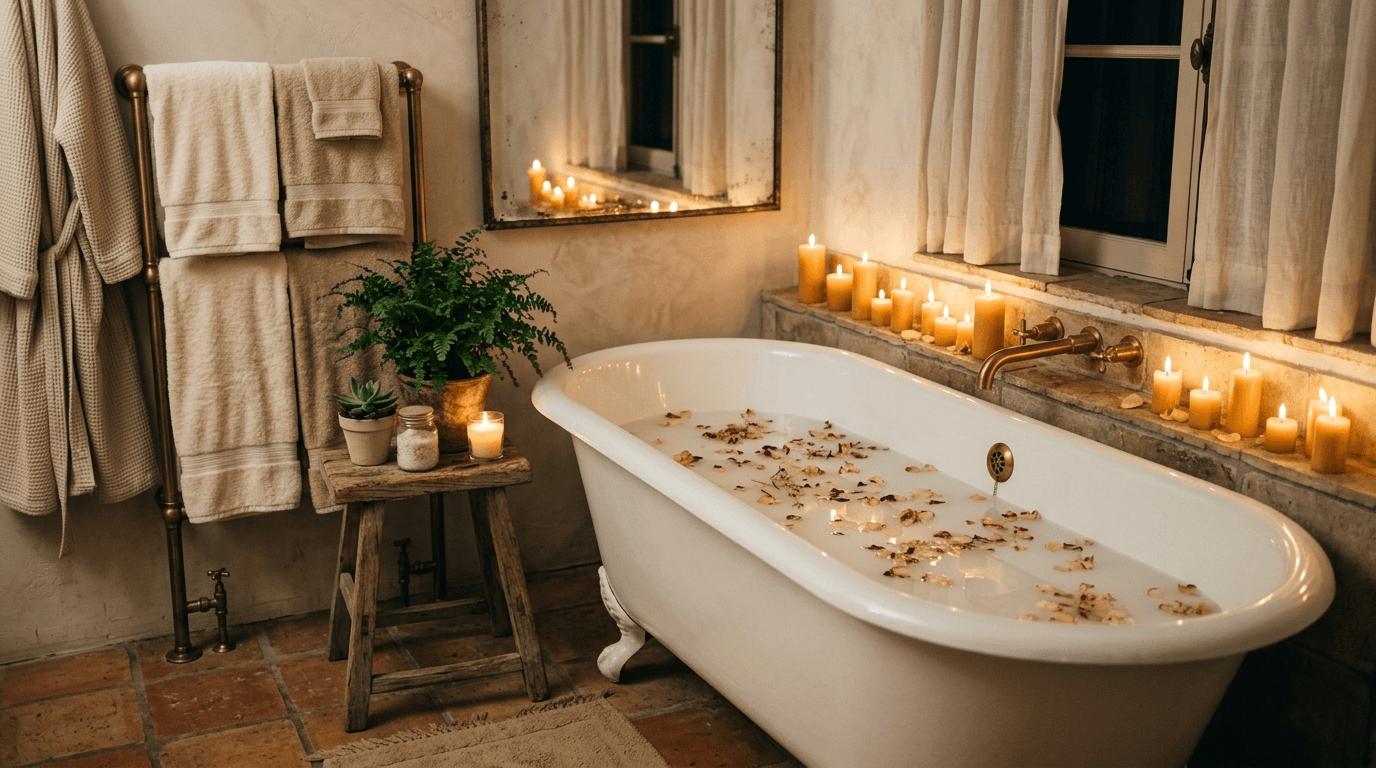
Take a warm bath or shower for 10-20 minutes at 40-42.5 degrees Celsius (104-108.5 degrees Fahrenheit). The mechanism is thermoregulatory: warm water dilates blood vessels in your hands and feet. When you step out, your core body temperature drops rapidly. This drop mimics and accelerates the natural cooling your body performs before sleep, signaling your circadian system that rest is imminent. The Haghayegh meta-analysis confirmed this effect across 5,322 participants from 13 studies (2019). Even a 10-minute warm shower is enough to trigger the vasodilation needed for the temperature drop effect.

T-60: 10:00 p.m. — Herbal Tea and Light Snack
Brew a cup of caffeine-free herbal tea. Chamomile is the most studied option: a randomized controlled trial with 60 older adults found that chamomile extract significantly improved sleep quality scores compared to placebo (Adib-Hajbaghery & Mousavi, Complementary Therapies in Clinical Practice, 2017). Valerian root and passionflower are other commonly used options, though the evidence base is smaller. If you’re hungry, keep any snack small. A handful of almonds, a banana, or a small bowl of oatmeal contains tryptophan or magnesium that may support melatonin production. Avoid alcohol entirely at this stage.
T-45: 10:15 p.m. — Journaling or Reading
Choose one of two activities. Journaling: write tomorrow’s to-do list in as much specific detail as possible. The more granular the entries, the faster participants in the Scullin et al. study fell asleep. The mechanism is cognitive offloading: writing tasks down gives your brain permission to stop rehearsing them. Reading: use a physical book or a non-backlit e-reader. Light-emitting devices undo the environmental conditions you’ve been building since 9:30 p.m. A printed book has no screen flicker, no notifications, and no blue light.
Do not read on your phone, even with night mode. Night mode reduces but does not eliminate blue light exposure, and the content (social media, news, messaging) is cognitively activating regardless of screen temperature settings.
T-30: 10:30 p.m. — Gentle Stretching or Breathwork
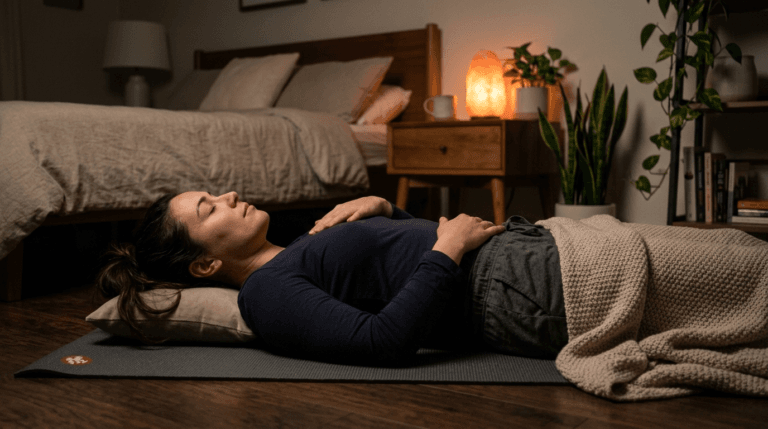
Spend 10-15 minutes on static stretching or a breathwork exercise. A study in the Journal of Physiotherapy found that a stretching routine before bed improved sleep quality and reduced insomnia severity in postmenopausal women compared to controls (Araujo et al., 2019). For breathwork, the 4-7-8 breathing technique is the most direct pre-sleep option. Its 8-count exhale produces pronounced vagal stimulation and was shown to reduce heart rate significantly in a 2022 clinical study (Vierra et al., Physiological Reports, 2022). If breath-holding feels uncomfortable, simple diaphragmatic breathing with a longer exhale than inhale achieves the same parasympathetic activation.
4-7-8 breathing for sleep breathwork techniques guideT-15: 10:45 p.m. — Final Preparations and Lights Out
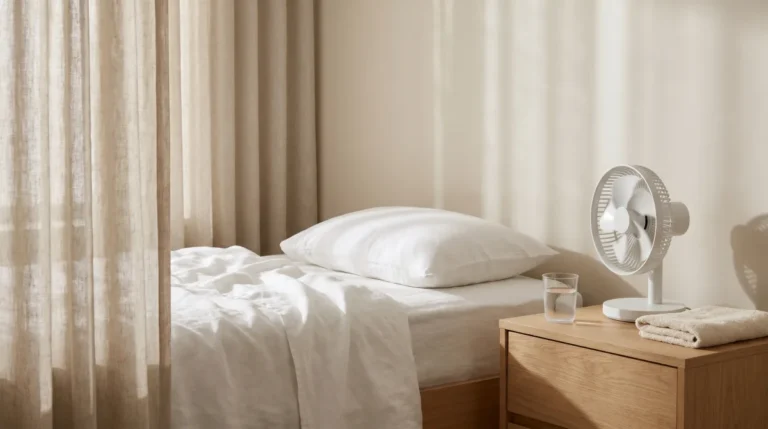
Get into bed. Keep the room dark and cool. Your body’s natural pre-sleep temperature drop is facilitated by a cool sleeping environment, typically 65-68 degrees Fahrenheit (18-20 degrees Celsius). If your mind is still active after the full sequence, try a brief sleep meditation or a progressive muscle relaxation body scan. Most people who have followed the full protocol find they don’t need additional tools at this stage. The sequence has already done the work.
sleep meditationWhich Wind Down Activities Have the Strongest Evidence?
A scoping review of relaxation interventions found that techniques combining physiological relaxation with cognitive relaxation outperform single-modality approaches (Neuendorf et al., Evidence-Based Complementary and Alternative Medicine, 2017). That finding explains why the chronological protocol above stacks multiple evidence-backed activities rather than relying on any single one.
Warm Bathing: Thermoregulation as a Sleep Lever
The Haghayegh meta-analysis is the most robust evidence available on pre-sleep bathing. Across 5,322 participants from 13 studies, warm bathing at 40-42.5 degrees Celsius taken 1-2 hours before bedtime improved both sleep onset latency and sleep quality ratings. The mechanism is well understood: peripheral vasodilation followed by rapid core temperature drop mimics the body’s natural pre-sleep cooling. Duration of 10-30 minutes was effective; even a brief warm shower triggers the response.
Journaling: Cognitive Offloading for Faster Sleep Onset
The Scullin et al. (2018) study used polysomnography (sleep lab measurement) rather than self-report, which makes its findings particularly credible. Participants were randomly assigned to write a to-do list for the next few days or to write about tasks they’d already completed. The to-do list group fell asleep nine minutes faster. Crucially, the more specific and detailed the to-do list, the faster participants fell asleep. The mechanism: writing tasks down offloads them from working memory, reducing the “cognitive arousal” that keeps the brain active after lights-out.
Writing a specific to-do list before bed reduced sleep onset latency by an average of 9 minutes compared to journaling about completed tasks. The effect was dose-dependent: more specific and detailed task lists produced faster sleep onset. The mechanism is cognitive offloading, which reduces working memory load and associated cognitive arousal (Scullin et al., Journal of Experimental Psychology: General, 2018).
Breathwork: The Fastest Physiological Shift
Extended-exhale breathing techniques activate the vagus nerve, triggering the parasympathetic rest-and-digest response. The 4-7-8 technique’s 8-count exhale is particularly effective before sleep. A 2022 clinical study found it reduced heart rate by 7.21% and significantly increased parasympathetic activity (Vierra et al., 2022). If breath-holding is uncomfortable, simple diaphragmatic breathing with a 4-count inhale and 6-count exhale achieves similar vagal activation.
Progressive Muscle Relaxation
Progressive muscle relaxation (tensing then releasing muscle groups sequentially) addresses physical tension that often persists into the pre-sleep period. A meta-analysis of 11 randomized controlled trials found it significantly reduced anxiety with a standardized mean difference of -0.57 (Manzoni et al., BMC Psychiatry, 2008). Since anxiety is a primary driver of insomnia, reducing it through PMR translates directly to better sleep onset. A complete technique guide is in our progressive muscle relaxation article.
progressive muscle relaxationWhat Should You Avoid in the 90 Minutes Before Bed?
Knowing what to include is half the equation. Certain evening habits actively undermine the hormonal transition, even when you don’t feel their effects until you’re lying in the dark. The National Sleep Foundation’s Sleep in America Poll found that 95% of Americans used an electronic device within an hour of bedtime (National Sleep Foundation, 2011). That single statistic explains a lot about why so many people struggle to fall asleep.
Screens and Blue Light
The Chang et al. (2015) finding is unambiguous: light-emitting devices suppress melatonin, delay circadian timing by 1.5 hours, and reduce next-morning alertness. “Night mode” and blue-light-blocking glasses reduce but do not eliminate the problem. More importantly, the cognitive content on screens (news, social media, work messages) keeps cortisol elevated regardless of screen temperature settings. The most effective approach is to put your phone in another room 60-90 minutes before bed and buy a cheap alarm clock so you don’t need your phone for a wake-up signal.
Alcohol
Alcohol reduces sleep onset latency, which feels like it helps. But a 2013 review in Alcoholism: Clinical and Experimental Research found that even moderate doses disrupted sleep architecture, specifically reducing REM sleep in the first half of the night (Ebrahim et al., 2013). You fall asleep faster but sleep worse, with less restorative deep and REM sleep. The net effect on next-day functioning is negative.
Heavy Meals
Eating a large meal within two hours of bedtime raises core body temperature as your digestive system works. This opposes the natural core temperature drop your circadian system needs as a sleep signal. A light snack is fine. Anything that requires serious digestive work is not. This is particularly relevant for people who experience nighttime acid reflux, which lying down after a heavy meal can exacerbate. See our guide on the best sleeping position for acid reflux for more.
best sleeping position for acid refluxWork and Analytical Thinking
Checking email after 9 p.m. loads new tasks into working memory. This is the opposite of the cognitive offloading the to-do list journaling achieves. Intense analytical thinking, financial planning, or difficult conversations all activate your task-switching networks and elevate cortisol. Save these for earlier in the evening. Your wind down window should be a cognitively quiet zone from the moment you dim the lights.
How Can You Customize the Protocol for Your Life?
Research on habit formation shows it takes an average of 66 days for a new behavior to become automatic, though the range spans 18 to 254 days depending on the person and behavior (Lally et al., European Journal of Social Psychology, 2010). The best routine is the one you’ll actually follow. Below are three sample adaptations of the core protocol, each built on the same evidence-based elements.
The Busy Professional: 45-Minute Compressed Protocol
If you’re regularly working until 9 or 10 p.m., a 90-minute routine isn’t realistic. This compressed version preserves the three highest-leverage elements.
- 0 min: Phone into another room, switch to dim warm-toned lighting.
- 5 min: Warm shower (even 5 minutes triggers thermoregulatory cooling).
- 10 min: Write tomorrow’s specific to-do list. Keep it practical and detailed.
- 15 min: Brew chamomile tea. Read a physical book.
- 35 min: Four cycles of 4-7-8 breathing in bed, lights off.
This 35-40 minute active routine is significantly better than going from screen to pillow. It won’t produce the same depth of conditioning as the full protocol, but it catches the three highest-return activities: thermoregulation, cognitive offloading, and vagal activation.
The Parent: Piggybacking on the Kids’ Routine
Parents can fold their own wind down into or immediately after their children’s bedtime sequence. The key advantage: dimming the whole house for the kids’ routine simultaneously starts your own melatonin production.
- Kids’ routine (30 min): Bath, stories, lights out. Dim the entire house during this process.
- Your warm bath (15 min): Once the kids are settled.
- Journal (10 min): To-do list, anything on your mind.
- Gentle stretching (10 min): Focus on neck, shoulders, and lower back.
- Breathwork in bed (5 min): Cyclic sighing or 4-7-8 breathing.
The Night Owl: Working with Your Chronotype
Night owls have a delayed circadian rhythm. Melatonin release starts later. Don’t fight the chronotype. Build your routine around your natural sleep time, not a socially conventional one. The biggest mistake night owls make is using late-night hours for screen time and stimulating activities. Shift those hours to calming activities and you often find you can fall asleep 30-45 minutes earlier than your current baseline, not because your chronotype changed, but because your pre-sleep behavior stopped fighting it.
- T-90: Hard stop on screens. Switch to reading, puzzles, or crafts.
- T-60: Warm amber lighting throughout the house.
- T-45: Warm bath with lavender oil or Epsom salts.
- T-30: Stretching plus progressive muscle relaxation.
- T-15: Chamomile tea plus to-do list journaling.
How Long Before the Routine Becomes Automatic?
Most people notice some improvement within the first few nights, primarily from the physiological effects of warm bathing and breathwork. These benefits appear in the first session and don’t require conditioning. The deeper benefit, where your brain treats the routine itself as a sleep cue and starts generating drowsiness on cue, takes longer. Research on habit automaticity found it takes an average of 66 days, with a wide range of 18 to 254 days depending on behavior complexity and individual factors (Lally et al., 2010).
Week 1: Adjustment Phase
Your brain is learning the new cues. You may not fall asleep faster yet, but you’ll feel calmer during the routine. The warm bath and breathwork produce immediate physiological benefits even before the habit is established. Focus on doing the sequence in the same order each night rather than optimizing any single element.
Weeks 2-4: Association Phase
Your brain starts linking the routine’s activities with sleep. Ever notice how certain smells or sounds can make you feel drowsy? That’s the same mechanism: classical conditioning. You may notice that dimming the lights or brewing tea triggers a subtle shift in your state. That’s the conditioning taking hold. Don’t break the sequence during this phase, even on weekends.
Months 2-3: Automatic Phase
The routine requires less willpower. Sleep onset latency typically shows measurable improvement at this stage. The key is not quitting during the first two weeks when results feel modest. The conditioning effect is being built even if you can’t feel it yet.
Building a wind down routine into an automatic habit takes an average of 66 days, though individual variation spans 18 to 254 days. Early physiological benefits (reduced heart rate, lower cortisol from breathwork and warm bathing) appear within the first session, while the conditioned sleep-cue response strengthens over weeks of consistent practice (Lally et al., European Journal of Social Psychology, 2010).
If you want a more guided approach to the sleep phase itself, our sleep meditation guide covers five techniques with step-by-step scripts, including a body scan that works well as the final T-15 activity on evenings when your mind is still busy.
sleep meditation guideFrequently Asked Questions
How long should a wind down routine be?
The ideal routine lasts 60-90 minutes. This gives your body time to complete the cortisol-melatonin transition and allows warm bathing to work within its optimal 1-2 hour window. A meta-analysis of 5,322 participants confirmed that bathing at 40-42.5 degrees Celsius in that window produces the best sleep improvements (Haghayegh et al., 2019). A 30-minute routine is still significantly better than going straight from screens to bed.
Does a warm bath or shower actually help you sleep?
Yes. The mechanism is well understood. Warm water dilates blood vessels in your extremities. When you step out, your core body temperature drops rapidly, mimicking the natural pre-sleep cooling your circadian system uses as a sleep cue. The Haghayegh et al. meta-analysis confirmed this effect across 5,322 participants. Optimal water temperature is 40-42.5 degrees Celsius (104-108.5 degrees Fahrenheit). Even a 10-minute warm shower produces the thermoregulatory response.
What is the best breathing technique for a wind down routine?
The 4-7-8 technique is purpose-built for pre-sleep use. Its 8-count exhale maximizes vagal stimulation and a 2022 study found it reduced heart rate by 7.21% and increased parasympathetic activity significantly (Vierra et al., 2022). If the breath-hold is uncomfortable, diaphragmatic breathing with a longer exhale than inhale achieves similar vagal activation.
Should I avoid all screens before bed?
Ideally, yes, for at least 60 minutes. The Chang et al. study in PNAS showed light-emitting devices delay circadian timing by 1.5 hours (2015). Night mode settings reduce but don’t eliminate the problem. More importantly, stimulating screen content (social media, news, work email) keeps cortisol elevated regardless of display temperature settings. A printed book produces neither blue light nor cognitive activation.
Can journaling before bed reduce anxiety and improve sleep?
Writing a specific to-do list reduces sleep onset latency by 9 minutes by offloading unfinished tasks from working memory. The Scullin et al. polysomnography study (2018) showed the effect is dose-dependent: more specific task lists produce faster sleep onset. Gratitude journaling and expressive writing also show anxiety-reducing effects, though the strongest sleep-specific evidence is for the forward-looking to-do list format.
References
- Adib-Hajbaghery, M., & Mousavi, S. N. (2017). The effects of chamomile extract on sleep quality among elderly people: A clinical trial. Complementary Therapies in Clinical Practice, 28, 109-113. https://pubmed.ncbi.nlm.nih.gov/28236605/
- Araujo, C. G., et al. (2019). Effects of a passive stretching programme on sleep quality of older women. Journal of Physiotherapy, 65(4), 223-226. https://pubmed.ncbi.nlm.nih.gov/31521460/
- CDC. (2022). Sleep and sleep disorders: Data and statistics. Centers for Disease Control and Prevention. https://www.cdc.gov/sleep/about/index.html
- Chang, A. M., Aeschbach, D., Duffy, J. F., & Czeisler, C. A. (2015). Evening use of light-emitting eReaders negatively affects sleep, circadian timing, and next-morning alertness. Proceedings of the National Academy of Sciences, 112(4), 1232-1237. https://pubmed.ncbi.nlm.nih.gov/25535358/
- Ebrahim, I. O., Shapiro, C. M., Williams, A. J., & Fenwick, P. B. (2013). Alcohol and sleep I: Effects on normal sleep. Alcoholism: Clinical and Experimental Research, 37(4), 539-549. https://pubmed.ncbi.nlm.nih.gov/23347102/
- Haghayegh, S., Khoshnevis, S., Smolensky, M. H., Diller, K. R., & Castriotta, R. J. (2019). Before-bedtime passive body heating by warm shower or bath to improve sleep: A systematic review and meta-analysis. Sleep Medicine Reviews, 46, 124-135. https://pubmed.ncbi.nlm.nih.gov/31102877/
- Harvard Health Publishing. (2020). Blue light has a dark side. Harvard Medical School. https://www.health.harvard.edu/staying-healthy/blue-light-has-a-dark-side
- Lally, P., van Jaarsveld, C. H. M., Potts, H. W. W., & Wardle, J. (2010). How are habits formed: Modelling habit formation in the real world. European Journal of Social Psychology, 40(6), 998-1009. https://pubmed.ncbi.nlm.nih.gov/20025046/
- Manzoni, G. M., Pagnini, F., Castelnuovo, G., & Molinari, E. (2008). Relaxation training for anxiety: A ten-years systematic review with meta-analysis. BMC Psychiatry, 8, 41. https://pubmed.ncbi.nlm.nih.gov/18752854/
- Mindell, J. A., Li, A. M., Sadeh, A., Kwon, R., & Goh, D. Y. (2015). Bedtime routines for young children: A dose-dependent association with sleep outcomes. Sleep, 38(5), 717-722. https://pubmed.ncbi.nlm.nih.gov/25117004/
- National Sleep Foundation. (2011). Sleep in America Poll: Technology and sleep. https://pmc.ncbi.nlm.nih.gov/articles/PMC3836340/
- Neuendorf, R., Wahbeh, H., Chamine, I., Yu, J., Hutchison, K., & Oken, B. S. (2017). The effects of mind-body interventions on sleep quality: A systematic review. Evidence-Based Complementary and Alternative Medicine, 2017. https://pubmed.ncbi.nlm.nih.gov/26983557/
- Scullin, M. K., Krueger, M. L., Ballard, H. K., Pruett, N., & Bliwise, D. L. (2018). The effects of bedtime writing on difficulty falling asleep: A polysomnographic study comparing to-do lists and completed activity lists. Journal of Experimental Psychology: General, 147(1), 139-146. https://pubmed.ncbi.nlm.nih.gov/29058942/
- Vierra, J., Boonla, O., & Prasertsri, P. (2022). Effects of sleep deprivation and 4-7-8 breathing control on heart rate variability, blood pressure, blood glucose, and endothelial function in healthy young adults. Physiological Reports, 10(14), e15389. https://pmc.ncbi.nlm.nih.gov/articles/PMC9277512/