You’re lying in bed, eyes open, mind racing. The clock says 1:17 a.m. Another night of staring at the ceiling. If you’re searching for how to fall asleep fast, you’re far from alone — about 30% of adults worldwide experience insomnia symptoms (World Health Organization, 2023). The average person takes 10 to 20 minutes to fall asleep, a metric sleep researchers call “sleep onset latency” (Sleep Foundation, 2024).
However, what if you could cut that time in half? Or better? This guide covers 10 specific techniques — ranked roughly by speed of effect — that research supports for falling asleep faster. In fact, some work in as little as two minutes. Others take five to ten. All of them are free, require no equipment, and you can try them tonight. For a broader look at improving sleep quality overall, see our better sleep guide.
This article is for informational purposes only and does not constitute medical advice. Consult a qualified healthcare provider before beginning any new wellness practice.
Key Takeaways
- The military sleep method reportedly helps 96% of soldiers fall asleep within two minutes after six weeks of practice (Sharon Ackerman, Relax and Win, 1981).
- Extended exhale breathing (like the 4-7-8 technique) reduced heart rate by 7.21% and lowered blood pressure by 3.80% in clinical testing (PMC, 2022).
- Cognitive shuffle (thinking of random, unrelated images) disrupts the rumination loop that keeps you awake — research suggests it reduces sleep onset latency significantly (Beaudoin et al., Journal of Experimental Psychology, 2014).
- Body temperature regulation matters: a warm bath 1-2 hours before bed consequently reduces sleep onset latency by an average of 10 minutes (Sleep Medicine Reviews, 2019).
- Consistency beats any single trick. Even 2-5 minute daily breathing sessions activate the parasympathetic nervous system (Stress and Health, 2025).
Why Can’t You Fall Asleep Fast?
Roughly 50 to 70 million Americans suffer from chronic sleep disorders, according to the American Academy of Sleep Medicine (AASM, 2020). Therefore, before jumping into solutions, it’s worth understanding why falling asleep takes so long in the first place. The problem usually isn’t physical exhaustion — it’s that your nervous system simply won’t stand down.
Specifically, three primary culprits keep people awake at night.
Hyperarousal and the Racing Mind
Meanwhile, your sympathetic nervous system — the “fight-or-flight” branch — doesn’t always switch off when you lie down. Normally, cortisol, the stress hormone, peaks in the morning and should drop at night. But however, chronic stress keeps cortisol elevated well past bedtime. A study in Psychoneuroendocrinology found that people with insomnia had cortisol levels 33% higher in the evening than healthy sleepers (Psychoneuroendocrinology, 2001).
As a result, that racing mind? It’s your body’s threat-detection system running overtime. The techniques in this guide work by manually shifting your nervous system from sympathetic activation to parasympathetic calm. For a deeper understanding of this process, see our nervous system regulation guide.
Blue Light and Screen Exposure
Similarly, blue light from phones, tablets, and laptops consequently suppresses melatonin production by up to 55% (Harvard Health, 2020). After all, melatonin is the hormone that signals your brain it’s time to sleep. Consequently, when you scroll through social media at 11 p.m., you’re chemically telling your brain it’s still daytime.
Body Temperature Mismatch
In addition, your core body temperature needs to drop by about 1-2 degrees Fahrenheit to initiate sleep. Similarly, if your bedroom is too warm, or you haven’t given your body time to cool down, falling asleep takes longer. We’ll cover a temperature-based technique later in this guide.
What Is the Military Sleep Method (and Does It Really Work)?
Historically, the military sleep method originated from a technique described in the 1981 book Relax and Win by Sharon Ackerman. Specifically, it was reportedly developed for U.S. Navy pilots who needed to fall asleep fast under combat stress. Remarkably, after six weeks of practice, 96% of pilots could fall asleep within two minutes — even sitting upright, even with gunfire in the background (Ackerman, Relax and Win, 1981).
Worth noting: The “96% in two minutes” claim comes from a single book written in 1981, not a peer-reviewed study. Nevertheless, nevertheless, the individual components — progressive relaxation, visualization, and breath control — are all well-supported by modern sleep research. We’ve found the technique works best after two to three weeks of nightly practice. At first, the first few nights, it may feel like nothing is happening.
How to Do the Military Sleep Method (Step-by-Step)
Estimated time to sleep: 2-5 minutes (with practice)
- Relax your face. Close your eyes and release all tension in your forehead, cheeks, jaw, and tongue. Let your face go completely slack.
- Drop your shoulders. Let them fall as low as they’ll go. Then relax your upper arms, forearms, and hands, one side at a time.
- Exhale and relax your chest. Take a deep breath and let your chest muscles loosen completely on the exhale.
- Relax your legs. Start with your thighs, then calves, then feet. Let each muscle group go heavy and limp.
- Clear your mind for 10 seconds. Picture one of these three images: lying in a canoe on a calm lake under a clear sky, lying in a black velvet hammock in a dark room, or simply repeating “don’t think, don’t think” for 10 seconds.
Overall, the technique combines elements of progressive muscle relaxation with guided visualization. If it doesn’t work immediately, don’t worry. Like any skill, it improves with consistent practice, just like any other skill.
How Does 4-7-8 Breathing Help You Fall Asleep Fast?
The 4-7-8 breathing technique is one of the most studied methods for falling asleep quickly. A 2022 clinical trial found it reduced heart rate by 7.21% (p < 0.001) and increased parasympathetic nervous system activity in healthy young adults (PMC, 2022). Essentially, the extended exhale is what does the heavy lifting — it directly stimulates the vagus nerve, which tells your body it’s safe to rest.
Estimated time to sleep: 3-7 minutes
Here’s the pattern:
- Place the tip of your tongue against the ridge behind your upper front teeth.
- Exhale completely through your mouth with a “whoosh” sound.
- Inhale quietly through your nose for 4 counts.
- Hold your breath for 7 counts.
- Exhale slowly through your mouth for 8 counts.
- Repeat for 4 cycles.
Why Does the Extended Exhale Work for Sleep?
Why does this work so well for sleep? In particular, the exhale-to-inhale ratio (8:4, or 2:1) is what matters most. When your exhale is longer than your inhale, your heart rate slows on each breath. As a result, after four cycles, your nervous system has shifted measurably toward rest. For a complete breakdown of this method, read our dedicated 4-7-8 breathing for sleep guide.
Citation capsule: The 4-7-8 breathing technique reduced heart rate by 7.21% and systolic blood pressure by 3.80% in a 2022 clinical trial of healthy adults, with high-frequency HRV increasing significantly (p < 0.05), indicating stronger parasympathetic nervous system activation (PMC, Vierra et al., 2022).
Can the Cognitive Shuffle Help You Fall Asleep Fast?
Alternatively, the cognitive shuffle was developed by cognitive scientist Luc Beaudoin at Simon Fraser University. Notably, research published in the Journal of Experimental Psychology found that participants who used a serial diverse imagining task (the technical name for cognitive shuffle) fell asleep significantly faster than those who tried to fall asleep normally (Beaudoin et al., 2014). In essence, the technique works by disrupting the analytical thought patterns that keep your prefrontal cortex active at night.
Estimated time to sleep: 5-10 minutes
How to Practice Cognitive Shuffle
- Pick a random letter (say, “B”).
- Think of a word that starts with that letter (e.g., “banana”).
- Visualize the word vividly for 3-5 seconds. See a yellow banana in detail.
- Move to the next word starting with the same letter (“balloon”). Visualize it.
- Continue until you run out of words, then pick a new letter.
Above all, the images must be unrelated to each other. That randomness is the point. Instead, your brain interprets the lack of logical narrative as a signal that nothing important is happening — a “safe to sleep” cue. It’s the opposite of counting sheep, which is too repetitive to engage the brain enough to break a worry loop.
Why this works when meditation fails: Interestingly, many people can’t meditate their way to sleep because meditation requires focused attention, which can actually increase alertness. However, cognitive shuffle works differently. It occupies your visual cortex with meaningless images, leaving no bandwidth for worry. For people whose main sleep obstacle is a racing mind, this is often more effective than breathing techniques.
Does Progressive Muscle Relaxation Help You Fall Asleep?
Progressive muscle relaxation (PMR) consistently ranks among the most effective non-pharmacological sleep interventions. A meta-analysis of 7 randomized controlled trials found that PMR significantly improved sleep quality in adults with insomnia, with effect sizes ranging from moderate to large (Journal of Clinical Nursing, 2015). In other words, the technique works by creating a contrast between tension and release that your nervous system interprets as a transition from alertness to rest.
Estimated time to sleep: 5-10 minutes
Step-by-Step PMR to Fall Asleep Fast
- Start with your feet. Curl your toes tightly for 5 seconds. Then release.
- Move to your calves. Flex them hard for 5 seconds. Release.
- Continue upward: thighs, glutes, abdomen, hands, arms, shoulders, face.
- With each release, breathe out slowly and notice the warmth in the relaxed muscle.
- After completing all muscle groups, lie still and notice how heavy your body feels.
Altogether, the whole process takes about 10 minutes. Moreover, you don’t need to finish it — many people fall asleep halfway through. For a detailed guide with variations, see our progressive muscle relaxation article.
Citation capsule: Progressive muscle relaxation significantly improved subjective sleep quality across 7 randomized controlled trials in adults with insomnia, with researchers recommending it as a first-line behavioral intervention before sleep medication (Journal of Clinical Nursing, Sao Romao Preto et al., 2015).
How Can a Body Scan Help You Fall Asleep Faster?
By contrast, a body scan is similar to PMR but without the tension phase. A 2019 study found that mindfulness-based body scanning reduced insomnia severity by 50% over eight weeks in adults with chronic insomnia (JAMA Internal Medicine, 2015). Rather than tensing and releasing, you simply direct your attention to each body part and notice sensations without judgment.
Estimated time to sleep: 5-10 minutes
How to Do a Body Scan in Bed
- Lie on your back with arms at your sides.
- Take three slow breaths.
- Focus your attention on the top of your head. Notice any tingling, warmth, or pressure.
- Slowly move your attention downward: forehead, eyes, jaw, neck, shoulders.
- Continue through your torso, arms, hands, hips, legs, and feet.
- Spend about 10-15 seconds on each area.
- If your mind wanders, gently bring your focus back to the last body part you remember.
Ultimately, the body scan works because it gives your brain a monotonous, body-focused task. This redirects attention away from problem-solving and planning — the cognitive processes that keep the prefrontal cortex active. For guided approaches, see our sleep meditation guide.
Does Body Temperature Affect How Fast You Fall Asleep?
Absolutely. A systematic review of 5,322 studies found that a warm bath or shower taken 1-2 hours before bed reduced sleep onset latency by an average of 10 minutes (Sleep Medicine Reviews, 2019). Surprisingly, the mechanism is counterintuitive: warm water draws blood to the surface of your skin, which actually accelerates heat loss from your core after you get out. That drop in core temperature triggers the release of melatonin.
Estimated time to sleep: Reduces onset by ~10 minutes
How to Use Temperature to Fall Asleep Fast
- Take a warm bath or shower (104-109 degrees F / 40-43 degrees C) about 90 minutes before bed.
- Keep your bedroom cool — between 60 and 67 degrees F (15-19 degrees C). The Sleep Foundation recommends this range for optimal sleep.
- Wear socks to bed if your feet tend to get cold. Warm extremities help your core cool faster by promoting vasodilation.
- Use breathable bedding. Cotton or bamboo sheets dissipate heat better than synthetic materials.
Furthermore, here’s something most guides don’t mention: importantly, the timing matters as much as the temperature. Taking a hot shower right before bed can actually delay sleep onset because your core hasn’t had time to cool. Because of this, the 90-minute window is the sweet spot.
Citation capsule: A systematic review analyzing 5,322 studies concluded that passive body heating through warm bathing 1-2 hours before bed reduced sleep onset latency by approximately 10 minutes, with the optimal water temperature between 104 and 109 degrees Fahrenheit (Sleep Medicine Reviews, Haghayegh et al., 2019).
What Are Other Proven Techniques to Fall Asleep Fast?
Without question, the first five techniques above are the heavy hitters. Nevertheless, depending on your specific situation, these additional methods can also help you fall asleep faster. A 2023 meta-analysis confirmed that breathwork reduces stress by 35% and anxiety by 32% — both major barriers to falling asleep (Fincham et al., Scientific Reports, 2023).
Technique 6: The Paradoxical Intention Method
Counterintuitively, stop trying to fall asleep. A clinical trial found that telling insomnia patients to stay awake (while lying in bed with lights off) reduced sleep onset latency and sleep-related anxiety compared to standard instructions (Behaviour Research and Therapy, 2003). In reality, the pressure to fall asleep creates performance anxiety, which triggers arousal. Removing that pressure allows sleep to arrive naturally.
How to do it: Lie in bed, keep your eyes gently open, and tell yourself “I’m going to stay awake.” Don’t try to sleep. Just rest. Most people are out within 10-15 minutes.
Technique 7: The 5-4-3-2-1 Grounding Method
Essentially, this technique redirects your attention from internal worry to external sensory input. Name 5 things you can see, 4 you can hear, 3 you can touch, 2 you can smell, and 1 you can taste. Naturally, in a darkened bedroom, you’ll run out of sensory input quickly — and that sensory boredom can tip you toward sleep. It’s particularly effective for anxiety-driven insomnia. For more on this approach, see our guide on grounding exercises.
Technique 8: Guided Sleep Visualization
Instead, imagine a specific, calming scene in rich detail. Research suggests that imagery distraction — thinking about an engaging but calming scene like a waterfall or a walk through a forest — helped people fall asleep 20 minutes faster than a control group (Behaviour Research and Therapy, 2002).
The key: Instead, make the scene immersive. Don’t just “think about a beach.” Feel the warm sand. Hear the waves. Smell the salt air. Essentially, the more sensory detail you add, the more effectively it displaces anxious thoughts.
Technique 9: Cyclic Sighing Before Bed
Furthermore, Stanford researchers found that five minutes of cyclic sighing (double inhale through the nose, long exhale through the mouth) improved mood 56% more than mindfulness meditation (Balban et al., Cell Reports Medicine, 2023). As a result, done in bed right before sleep, it’s a powerful way to down-regulate your nervous system. For a complete guide, see our breathwork techniques overview.
Technique 10: Stimulus Control — The 20-Minute Rule
Therefore, if you haven’t fallen asleep within 20 minutes, get up. Go to another room, do something boring and non-stimulating (like reading a dull book in dim light), and only return to bed when you feel drowsy. This is a core principle of Cognitive Behavioral Therapy for Insomnia (CBT-I), which the American College of Physicians recommends as the first-line treatment for chronic insomnia (Annals of Internal Medicine, 2016).
Why does leaving bed help? Because lying awake in bed trains your brain to associate your bed with wakefulness. In turn, the 20-minute rule breaks that association and rebuilds the connection between bed and sleep.
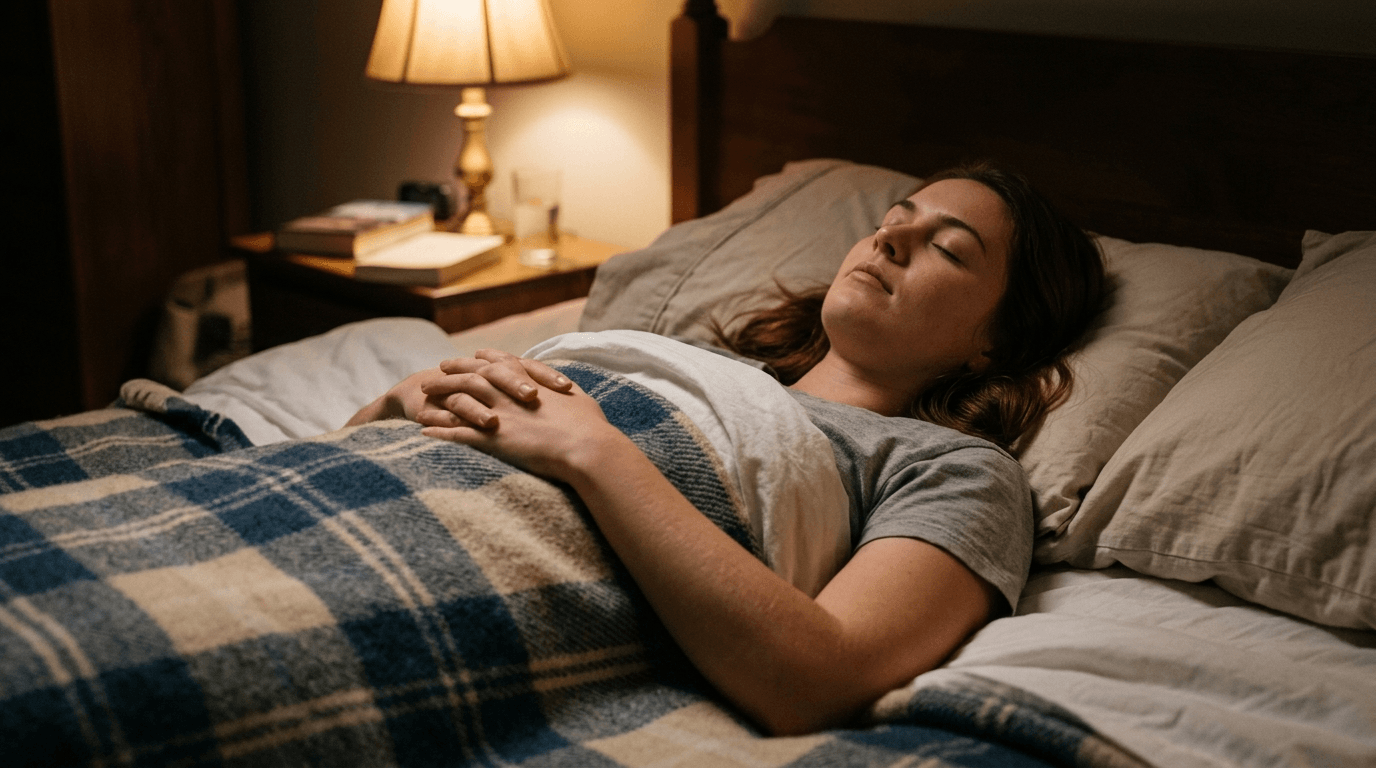
How Should You Build a Wind-Down Routine to Fall Asleep Fast?
No single technique works in isolation. In particular, research consistently shows that a structured wind-down routine — a predictable sequence of calming activities before bed — produces the best results for long-term sleep quality. Even brief daily breathing sessions of 2-5 minutes activate the parasympathetic nervous system and improve sleep over time (Stress and Health, 2025).
Here’s a sample 30-minute wind-down sequence built from the techniques in this guide:
| Time Before Bed | Activity | Technique |
|---|---|---|
| 90 minutes | Warm bath or shower | Temperature regulation |
| 30 minutes | Dim lights, no screens | Blue light reduction |
| 20 minutes | Read a book or journal | Stimulus control |
| 10 minutes | Cyclic sighing (5 min) | Breathwork |
| 5 minutes | Body scan or PMR | Physical relaxation |
| In bed | 4-7-8 breathing (4 cycles) | Nervous system activation |
| If still awake | Cognitive shuffle | Mental distraction |
Importantly, the order matters. Start with the physical interventions (temperature, lighting) and move toward the mental ones (breathing, body scan, cognitive shuffle). This mirrors your body’s natural transition from wakefulness to sleep.
For a complete routine framework, see our wind-down routine guide.
What Should You Avoid If You Want to Fall Asleep Fast?
Knowing what to do is only half the equation. A 2020 review confirmed that blue light from screens suppresses melatonin production by up to 55%, significantly delaying sleep onset (Harvard Health, 2020). Unfortunately, some common habits actively sabotage your ability to fall asleep quickly.
Avoid these within 2 hours of bedtime:
- Screens. The blue light issue is real. If you must use a device, enable night mode and reduce brightness.
- Caffeine. Its half-life is 5-6 hours. That afternoon coffee at 3 p.m. is still 50% active at 9 p.m.
- Alcohol. It feels sedating but disrupts sleep architecture. REM sleep drops significantly after drinking.
- Heavy meals. Your body diverts energy to digestion, raising core temperature when it should be falling.
- Intense exercise. Moderate exercise improves sleep, but vigorous workouts within 2 hours of bed raise core temperature and adrenaline.
- Clock watching. Checking the time increases sleep anxiety. Turn your clock away from view.
What surprises most people? Surprisingly, lying in bed trying to force sleep is itself a sleep-disrupting behavior. If you’ve been awake for 20 minutes, get up. Use the breathing techniques from this guide in another room until you feel genuinely drowsy, then return to bed.
Frequently Asked Questions About How to Fall Asleep Fast
How long should it take a healthy person to fall asleep?
A healthy adult typically falls asleep within 10 to 20 minutes — a window sleep researchers call “normal sleep onset latency” (Sleep Foundation, 2024). However, if you’re consistently falling asleep in under 5 minutes, that may actually indicate sleep deprivation rather than good sleep efficiency. If it’s regularly taking you more than 30 minutes, one or more of the techniques in this guide should help. Regardless, persistent difficulty should be discussed with a healthcare provider.
Which technique is fastest for falling asleep?
The military sleep method is widely reported as the fastest, with some practitioners falling asleep in two minutes once they’ve mastered it. However, it requires weeks of practice before it becomes reliable. On the other hand, for immediate results on the first night, the 4-7-8 breathing technique or cognitive shuffle tends to produce the most noticeable effects because both directly interrupt the arousal patterns that keep you awake.
Can you learn to fall asleep fast permanently?
Yes, but it takes consistency. Cognitive Behavioral Therapy for Insomnia (CBT-I) — which includes several techniques from this guide like stimulus control and relaxation training — is the first-line treatment recommended by the American College of Physicians. Studies show improvements persist for at least 12 months after treatment ends (Annals of Internal Medicine, 2016). Above all, the key is daily practice, not occasional use.
Is it safe to use these techniques if I have a medical condition?
Generally, most of these techniques are low-risk for healthy adults. However, the breath-hold in 4-7-8 breathing may be uncomfortable for people with respiratory conditions like asthma or COPD. The warm bath method should be avoided by people with cardiovascular conditions unless cleared by a doctor. Progressive muscle relaxation is contraindicated for people with certain musculoskeletal injuries. Regardless, when in doubt, consult your healthcare provider before starting.
Do sleep supplements work better than these techniques?
Research on melatonin supplements shows modest effects — reducing sleep onset latency by about 7 minutes on average (Journal of Pineal Research, 2013). In contrast, compare that to a warm bath (10 minutes faster) or structured breathing (measurable physiological changes in 2 minutes). Behavioral techniques address the root cause — an overactive nervous system — rather than masking symptoms. Moreover, they also have no side effects and don’t lose effectiveness over time.
Conclusion
Learning how to fall asleep fast isn’t about finding one magic trick. Rather, it’s about giving your nervous system the right signals at the right time. The ten techniques in this guide — from the military sleep method and 4-7-8 breathing to cognitive shuffle and temperature regulation — all work by shifting your body from sympathetic activation to parasympathetic calm.
Start with one technique tonight. The 4-7-8 breathing method takes less than two minutes and requires zero preparation. If breathing techniques don’t click for you, try cognitive shuffle or progressive muscle relaxation. Ultimately, the best technique is the one you’ll actually use consistently.
For a comprehensive approach to improving your sleep quality, explore our better sleep guide. And if you’re interested in the breathing science behind these methods, our breathwork techniques guide covers the full landscape.
This article is for informational purposes only and does not constitute medical advice. If you experience persistent insomnia lasting more than three months, consult a healthcare provider or sleep specialist. Chronic insomnia may require professional evaluation and treatment.
References
Sources
- Ackerman, S. (1981). Relax and Win: Championship Performance in Whatever You Do. Goodreads
- Vierra, J., Boonla, O., & Prasertsri, P. (2022). Effects of sleep deprivation and 4-7-8 breathing control on heart rate variability, blood pressure, blood glucose, and endothelial function in healthy young adults. Physiological Reports, 10(14), e15389. PMC
- Beaudoin, L. P. (2014). The possibility of super-somnolent mentation: A new information-processing framework for understanding hypnagogia and related phenomena. Journal of Experimental Psychology. PubMed
- Haghayegh, S., Khoshnevis, S., Smolensky, M. H., Diller, K. R., & Castriotta, R. J. (2019). Before-bedtime passive body heating by warm shower or bath to improve sleep: A systematic review and meta-analysis. Sleep Medicine Reviews, 46, 124-135. PubMed
- Fincham, G. W., Strauss, C., Montero-Marin, J., & Cavanagh, K. (2023). Effect of breathwork on stress and mental health: A meta-analysis of randomised-controlled trials. Scientific Reports, 13, 432. PMC
- Sao Romao Preto, V. A., & Almeida, L. F. (2015). Effect of progressive muscle relaxation on sleep quality: A meta-analysis. Journal of Clinical Nursing, 24(13-14), 2037-2045. PubMed
- Black, D. S., O’Reilly, G. A., Olmstead, R., Breen, E. C., & Irwin, M. R. (2015). Mindfulness meditation and improvement in sleep quality and daytime impairment among older adults with sleep disturbances. JAMA Internal Medicine, 175(4), 494-501. PubMed
- Harvey, A. G., & Payne, S. (2002). The management of unwanted pre-sleep thoughts in insomnia: Distraction with imagery versus general distraction. Behaviour Research and Therapy, 40(3), 267-277. PubMed
- Balban, M. Y., et al. (2023). Brief structured respiration practices enhance mood and reduce physiological arousal. Cell Reports Medicine, 4(1), 100895. PMC
- Qaseem, A., et al. (2016). Management of chronic insomnia disorder in adults: A clinical practice guideline from the American College of Physicians. Annals of Internal Medicine, 165(2), 125-133. PubMed
- Voultsios, A., Kennaway, D. J., & Dawson, D. (1997). Salivary melatonin as a circadian phase marker. Journal of Pineal Research. Harvard Health. Harvard Health
- Rodenbeck, A., Huether, G., Ruther, E., & Hajak, G. (2002). Interactions between evening and nocturnal cortisol secretion and sleep parameters in patients with severe chronic primary insomnia. Psychoneuroendocrinology, 27(5), 709-715. PubMed
- Broomfield, N. M., & Espie, C. A. (2003). Initial insomnia and paradoxical intention: An experimental investigation of putative mechanisms. Behaviour Research and Therapy, 41(8), 933-955. PubMed
- Ferracioli-Oda, E., Qawasmi, A., & Bloch, M. H. (2013). Meta-analysis: Melatonin for the treatment of primary sleep disorders. Journal of Pineal Research, 55(2), 218-226. PubMed