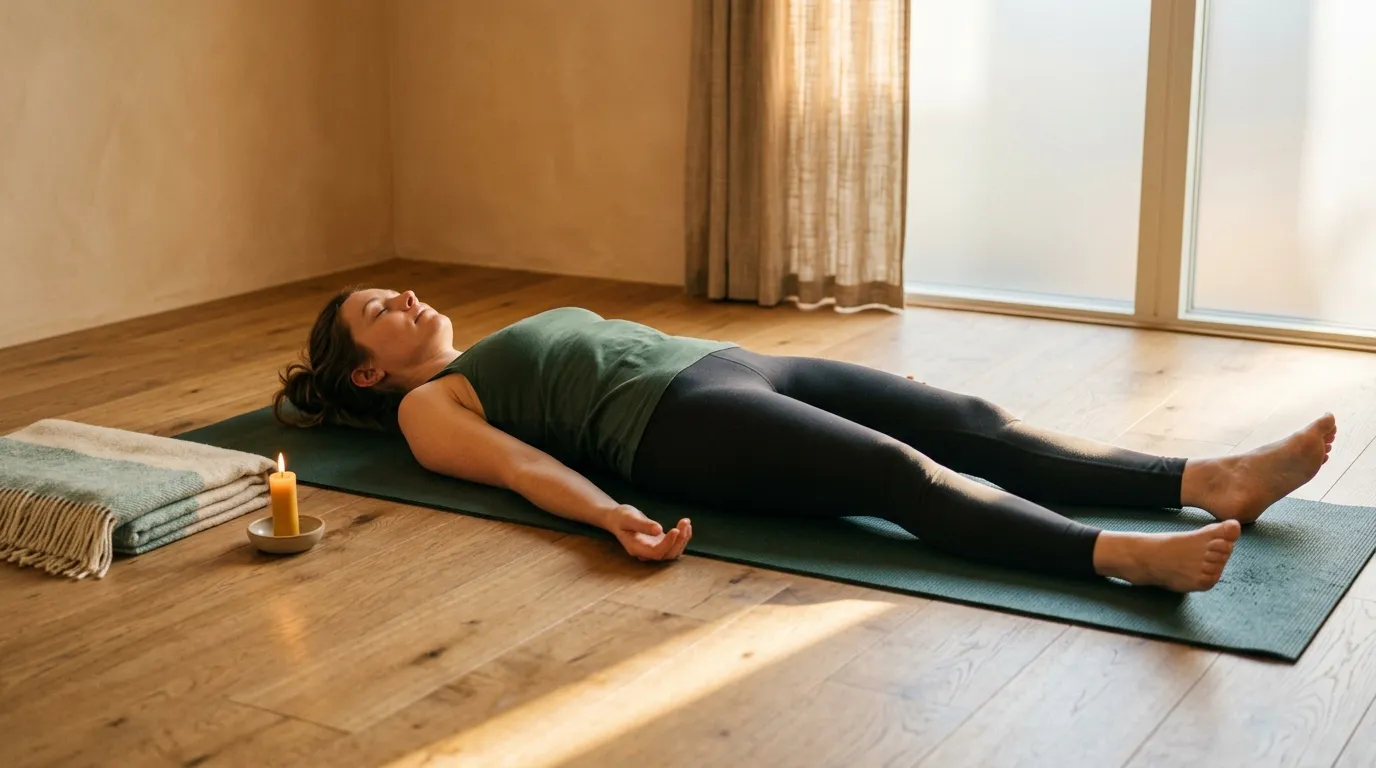
You’re lying in bed, exhausted, but your body won’t let go. Your shoulders are bunched up near your ears. Your jaw is clenched. You don’t even notice until someone points it out. Most of us carry tension we can’t feel — and that’s exactly the problem body scan meditation solves. A large randomized controlled trial of 2,239 participants found that body scan meditation produced the strongest stress reduction of all techniques tested, with an effect size of d=-0.56 (Nature Human Behaviour, 2024). That’s not a marginal difference. It outperformed mindful breathing, loving-kindness meditation, and walking exercises. If you’re new to meditation, body scan is one of the most effective places to start.
Key Takeaways
– Body scan meditation produced the strongest stress reduction (d=-0.56) of all techniques in a 2,239-person RCT (Nature Human Behaviour, 2024). – A 10-minute body scan reduces pain-related distress significantly (p=0.005) (Journal of Behavioral Medicine, 2014). – Regular body scan practice measurably improves interoceptive accuracy — your ability to feel what’s happening inside your body (Applied Psychology, 2025). – You don’t need experience, equipment, or even a quiet room. Just 10 minutes and a place to lie down.
What Is Body Scan Meditation?
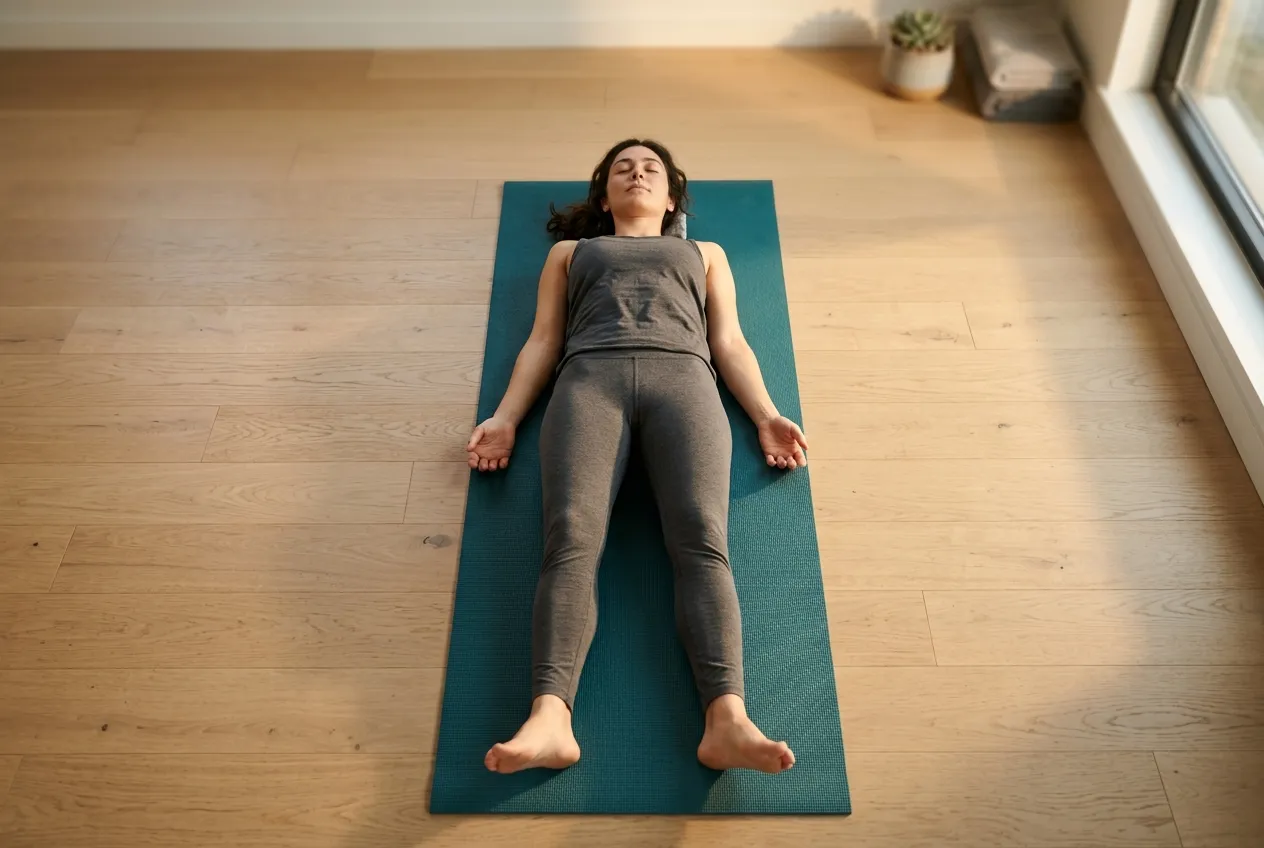
Body scan meditation is a mindfulness technique where you move your attention slowly through each part of your body, noticing sensations without trying to change them. A meta-analysis of 14 randomized controlled trials found that body scan practice produces a significant increase in mindfulness, with a Hedge’s g effect size of 0.268 (Applied Psychology, Gan et al., 2022).
Unlike breathing exercises that focus on one anchor point, a body scan moves your awareness from your toes to the top of your head — or the reverse. You’re not trying to relax. You’re trying to notice. The relaxation happens as a byproduct.
Here’s how it works in practice: you lie down, close your eyes, and systematically direct attention to each body region. Feet. Calves. Thighs. Abdomen. Chest. Hands. Arms. Neck. Face. At each stop, you spend 30-60 seconds simply observing whatever you feel. Warmth, tightness, tingling, numbness — it all counts.
The real power of body scan isn’t relaxation itself. It’s building interoception — your brain’s ability to read signals from your own body. Most stressed professionals have terrible interoception. They don’t notice their jaw is clenched until they get a headache. Body scan trains you to catch tension before it compounds.
Body scan meditation significantly increased mindfulness scores across 14 RCTs, producing a Hedge’s g effect size of 0.268 (Gan et al., Applied Psychology, 2022). This meta-analytic evidence confirms body scan as a reliable method for cultivating present-moment awareness.
Why Is Body Scan Meditation So Effective for Stress?
A 2024 study in Nature Human Behaviour compared multiple mind-body techniques head-to-head across 2,239 participants and found body scan produced the largest stress reduction effect (d=-0.56), outperforming mindful breathing, loving-kindness, and movement-based practices (Nature Human Behaviour, 2024).
Why does body scan beat other techniques? Three mechanisms work together.
It Lowers Cortisol — Measurably
An eight-week study where participants practiced body scan meditation for 20 minutes daily found significantly reduced hair cortisol concentrations and an improved cortisol-to-DHEA ratio compared to an audiobook control group (Goldstein et al., Mindfulness/Springer, 2019). Hair cortisol reflects your stress load over months, not just the moment you’re tested. This means body scan doesn’t just make you feel calmer — it changes your chronic stress biology.
It Rewires How You Process Pain and Discomfort
A study of 55 chronic pain patients found that a single 10-minute body scan significantly reduced pain-related distress (p=0.005) and pain interference with daily activities (p=0.036) (Ussher et al., Journal of Behavioral Medicine, 2014). The pain itself didn’t disappear. But participants’ relationship to it shifted. They stopped bracing against it.
It Trains Your Brain to Read Internal Signals
Two randomized controlled trials involving 175 participants showed that just two weeks of daily body scan practice significantly improved interoceptive accuracy — specifically, the ability to track one’s own heartbeat (p<.001) (Schwerdtfeger et al., Applied Psychology, 2025). A broader meta-analysis of 29 RCTs with 2,191 participants confirmed that mindfulness-based programs produce the largest improvements in interoception (g=0.41) compared to other meditation approaches (Treves et al., Scientific Reports, 2025).
Why does interoception matter? Because people who can accurately sense their internal states make better decisions about when to rest, eat, and stop pushing. It’s the difference between burning out and catching yourself early.
[CHART: horizontal bar | Body Scan vs Other Techniques: Stress Reduction | Body Scan d=-0.56, Mindful Breathing, Loving-Kindness, Walking | Nature Human Behaviour, 2024]
In the largest head-to-head comparison of relaxation techniques (n=2,239), body scan meditation produced the strongest stress reduction effect (d=-0.56), surpassing mindful breathing and loving-kindness meditation (Nature Human Behaviour, 2024).
Does Body Scan Meditation Help You Sleep?
Yes — and the evidence is strong. A landmark trial published in JAMA Internal Medicine found that older adults who completed a six-week mindfulness program including body scan improved their PSQI sleep scores from 10.2 to 7.4, compared to just 10.2 to 9.1 in the control group, producing an effect size of 0.89 (JAMA Internal Medicine, Black et al., 2015).
An effect size of 0.89 is considered large in clinical research. For context, many pharmaceutical sleep aids produce smaller improvements.
How Body Scan Prepares Your Body for Sleep
Body scan works for sleep because it systematically deactivates your sympathetic nervous system. As you move attention through each body region, you’re essentially telling your nervous system to stand down. Muscles you didn’t know were tense begin to release. Your breathing naturally slows.
A 2020 study confirmed that combining deep breathing with body scan (30 minutes daily for eight weeks) significantly decreased global PSQI sleep scores in older adults (Suwanno et al., Complementary Therapies in Medicine, 2020). The combination of breath and body awareness seems to be particularly powerful for sleep.
When to Practice Body Scan for Sleep
Do your body scan in bed, right before sleep. Unlike morning meditation where you want alertness, here you want drowsiness. Lying flat is ideal. If you fall asleep during the scan, that’s actually the goal. Start at your feet and work upward — most people don’t make it past their torso before drifting off.
What I’ve found: When I use body scan meditation for sleep, I rarely finish the full sequence. Somewhere around my ribcage, my mind goes quiet and I’m out. On nights when I skip it — especially after stressful days — I notice the difference within minutes. My thoughts start looping instead of settling.
How to Do a 10-Minute Body Scan Meditation (Step-by-Step Script)
This body scan meditation script takes about 10 minutes. You can do it lying in bed, on a yoga mat, or even seated in a chair. No app required. Read through this once, then try it from memory — it doesn’t need to be perfect.
Step 1: Get Comfortable (1 minute)
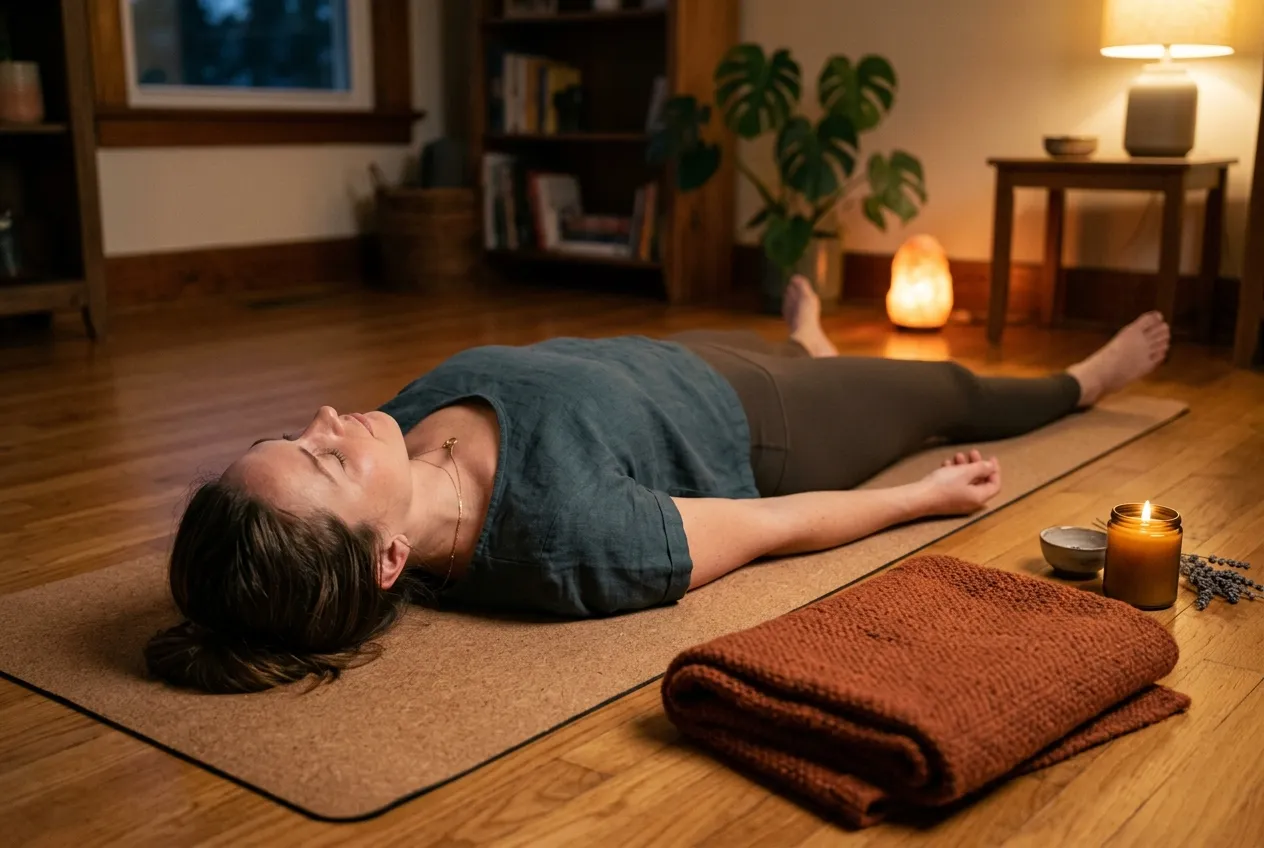
Lie on your back with your arms at your sides, palms facing up. Let your feet fall open naturally. Close your eyes. Take three slow, deep breaths. With each exhale, let your body sink a little heavier into the surface beneath you. Don’t try to relax — just notice the weight of your body.
Step 2: Bring Attention to Your Feet (1 minute)
Focus on your toes. Notice any sensations — tingling, warmth, pressure against socks or sheets. You’re not trying to feel anything specific. You’re just observing what’s already there. If you feel nothing, that’s fine too. Notice the nothing. Then expand your attention to the soles of your feet, your heels, and the tops of your feet.
Step 3: Move Through Your Lower Legs (1 minute)
Shift your attention to your ankles, then your calves, then your shins. Notice the contact between your legs and the surface you’re lying on. If you feel tension, don’t try to release it. Just acknowledge it. “There’s tightness here.” That’s enough.
Step 4: Scan Your Upper Legs and Hips (1 minute)
Move awareness into your thighs — front, back, and sides. Then shift to your hips and pelvis. This area often holds tension people don’t notice. Spend a few extra breaths here. Notice whether one hip feels different from the other. There’s no right answer.
Step 5: Notice Your Abdomen and Lower Back (1.5 minutes)
Bring attention to your belly. Feel it rise and fall with each breath. Don’t change your breathing — just observe the movement. Then shift awareness to your lower back. Is there space between your back and the floor? Warmth? Pressure? You’re building a map of your own body.
Step 6: Scan Your Chest, Shoulders, and Upper Back (1.5 minutes)
Move up to your ribcage and chest. Feel your heartbeat if you can. This is interoception in action — the same skill that body scan strengthens over time. Then notice your shoulders. Most people carry significant tension here without realizing it. Don’t force your shoulders down. Just notice where they are.
Step 7: Travel Down Your Arms and Hands (1 minute)
Shift attention from your shoulders to your upper arms, elbows, forearms, wrists, and hands. Notice each finger individually. Are your hands clenched or open? Warm or cool? The hands are rich with nerve endings, so you’ll likely feel more here than in your legs.
Step 8: Finish with Your Neck, Face, and Head (1.5 minutes)
Move to your neck and throat. Then your jaw — unclench it if it’s tight. Your cheeks, eyes, forehead. The muscles around your eyes hold a surprising amount of tension, especially if you spend hours on screens. Finally, notice the top of your head. Take one last breath and imagine your awareness expanding to hold your entire body at once.
Step 9: Return Slowly (30 seconds)
Take three deep breaths. Wiggle your fingers and toes. Open your eyes when you’re ready. If you’re doing this for sleep, skip this step entirely — let yourself drift off.
Practitioner note: This script follows the toes-to-head sequence used in most clinical research, including the MBSR (Mindfulness-Based Stress Reduction) protocol developed by Jon Kabat-Zinn. In my experience, people who struggle with meditation find body scan easier than breath-focused techniques because there’s always a “next instruction” to follow. You don’t have to sit with emptiness.
relaxation technique comparison
How Is Body Scan Different from Progressive Muscle Relaxation?
Body scan and progressive muscle relaxation (PMR) look similar on the surface — both involve moving attention through the body. But the mechanism is completely different. A meta-analysis of 14 RCTs confirmed that body scan specifically increases mindfulness (Hedge’s g=0.268), while PMR works through the tension-release cycle without requiring mindful awareness (Applied Psychology, 2022).
Body Scan: Observe Without Changing
In body scan meditation, you notice sensations without acting on them. You don’t tense your muscles. You don’t try to relax them. You simply observe. This builds interoceptive awareness and teaches your brain that discomfort doesn’t require an immediate response.
PMR: Tense, Then Release
In PMR, you deliberately tense each muscle group for 5-10 seconds, then release. The contrast between tension and release creates a physical relaxation response. It’s more active and works well for people who find pure observation too passive.
Which Should You Choose?
If you’re looking for anxiety relief, both work. But body scan builds a transferable skill — interoception — that carries into daily life. You start noticing tension at your desk, in traffic, during difficult conversations. PMR is better as an acute intervention when you’re already wound up. Many people use both: PMR when tension is high, body scan as a daily maintenance practice.
[CHART: bar | Interoception Improvement by Method | Mindfulness-based g=0.41, Body-based, All combined g=0.31 | Treves et al., Scientific Reports, 2025]
A 2025 meta-analysis of 29 RCTs (2,191 participants) found that mindfulness-based meditation programs produce the largest improvements in self-reported interoception (g=0.41), compared to g=0.31 across all meditation types combined (Treves et al., Scientific Reports, 2025).
What Are Common Mistakes During Body Scan Meditation?
Even experienced practitioners make these errors. A meta-analysis of 14 RCTs showed that body scan’s mindfulness benefits (g=0.268) only appear with consistent practice — sporadic sessions don’t produce the same neurological changes (Applied Psychology, 2022).
Trying Too Hard to Relax
The biggest mistake is turning body scan into a relaxation exercise. It’s not. It’s an awareness exercise. When you pressure yourself to relax, you create the opposite effect — performance anxiety about relaxation, which is as counterproductive as it sounds. Just notice what’s there.
Moving Too Quickly
Rushing through body regions defeats the purpose. Each area needs at least 30 seconds of sustained attention. If 10 minutes feels too long, try a shorter version covering just feet, belly, and face. Three focal points in five minutes is better than a frantic sweep through your entire body.
Judging What You Feel
“My back shouldn’t hurt this much.” “Why can’t I feel anything in my hands?” These thoughts are normal — but they pull you out of observation and into evaluation. When judgments arise, notice them the same way you’d notice a sensation. “There’s a judgment.” Then return your attention to your body.
Skipping Difficult Areas
Some people unconsciously rush past areas that hold emotional tension — the throat, chest, or belly. If you notice yourself speeding up, that’s often a signal to slow down. Those avoided areas usually hold the most useful information about your stress patterns.
Frequently Asked Questions
How long should a body scan meditation be?
Research suggests 10 minutes is enough for meaningful benefits. A study of 55 chronic pain patients showed significant distress reduction from just a 10-minute session (Ussher et al., Journal of Behavioral Medicine, 2014). Clinical programs like MBSR typically use 20-45 minute sessions, but shorter daily practice builds the habit more effectively than occasional long sessions.
Can body scan meditation replace sleep medication?
Body scan isn’t a medication substitute, and you should consult your doctor before changing any prescriptions. However, a JAMA Internal Medicine trial found that mindfulness including body scan improved sleep quality with an effect size of 0.89 — larger than many pharmaceutical interventions (JAMA Internal Medicine, 2015). Some participants in that study did reduce sleep medication use under medical supervision.
Is body scan meditation good for anxiety?
Yes. Body scan’s stress reduction effect (d=-0.56) was the strongest of all techniques tested in a 2,239-person trial (Nature Human Behaviour, 2024). For anxiety specifically, body scan builds interoceptive awareness that helps you recognize the physical signs of anxiety — racing heart, tight chest, shallow breathing — before they escalate. See also our guide on breathing exercises for anxiety.
Do I need a guided recording or can I do body scan on my own?
You don’t need a recording. The script in this article gives you everything you need. Guided recordings can help in the first week or two, but most practitioners transition to self-guided practice quickly. The sequence is always the same: start at one end of your body, move to the other, observe without judging. Once you’ve done it three or four times, the pattern becomes intuitive.
What’s the difference between body scan and yoga nidra?
Body scan is one component of yoga nidra, which is a broader practice that also includes breath awareness, visualization, and setting an intention (sankalpa). Think of body scan as the foundational layer. Yoga nidra adds more elements on top. If you’re a beginner, start with body scan alone — it’s simpler to learn and the stress reduction evidence is stronger.
Start Tonight: Your First Body Scan in 10 Minutes
You’ve read the science. You’ve seen the script. Now there’s only one thing left — trying it. Tonight, lie down 10 minutes before you’d normally try to sleep. Close your eyes. Start at your toes. Move up slowly. You don’t need to remember every step perfectly. The sequence will come naturally after two or three attempts.
What makes body scan meditation uniquely powerful is its simplicity. There’s nothing to memorize, no breathing pattern to maintain, no mantra to repeat. You just pay attention to what your body already feels. And in doing so, you interrupt the stress loop that keeps millions of people awake at night, tense during the day, and disconnected from their own physical signals.
If you’re exploring meditation for the first time, head to our meditation for beginners guide for a full overview of techniques. If sleep is your primary concern, our better sleep guide covers additional evidence-based strategies beyond body scan.
References
- Gan, T. et al. (2022). Body Scan Meditation and Mindfulness: A Meta-Analysis of 14 RCTs. Applied Psychology: Health and Well-Being. https://pubmed.ncbi.nlm.nih.gov/35538557/
- Goldstein, E. et al. (2019). Body Scan Meditation and Cortisol Reduction. Mindfulness, Springer. https://link.springer.com/article/10.1007/s12671-019-01222-7
- Ussher, M. et al. (2014). Body Scan Meditation for Chronic Pain. Journal of Behavioral Medicine. https://pubmed.ncbi.nlm.nih.gov/23129105/
- Black, D. S. et al. (2015). Mindfulness Meditation and Sleep Quality in Older Adults. JAMA Internal Medicine. https://jamanetwork.com/journals/jamainternalmedicine/fullarticle/2110998
- Schwerdtfeger, A. et al. (2025). Body Scan and Interoceptive Accuracy. Applied Psychology: Health and Well-Being. https://iaap-journals.onlinelibrary.wiley.com/doi/10.1111/aphw.70073
- Treves, I. N. et al. (2025). Meditation and Interoception Meta-Analysis. Scientific Reports. https://www.nature.com/articles/s41598-025-22661-4
- Witte, M. et al. (2024). Mind-Body Techniques Head-to-Head Comparison. Nature Human Behaviour. https://www.nature.com/articles/s41562-024-01907-7
- Suwanno, J. et al. (2020). Deep Breathing and Body Scan for Sleep Quality. Complementary Therapies in Medicine. https://www.sciencedirect.com/org/science/article/pii/S1874944520000295