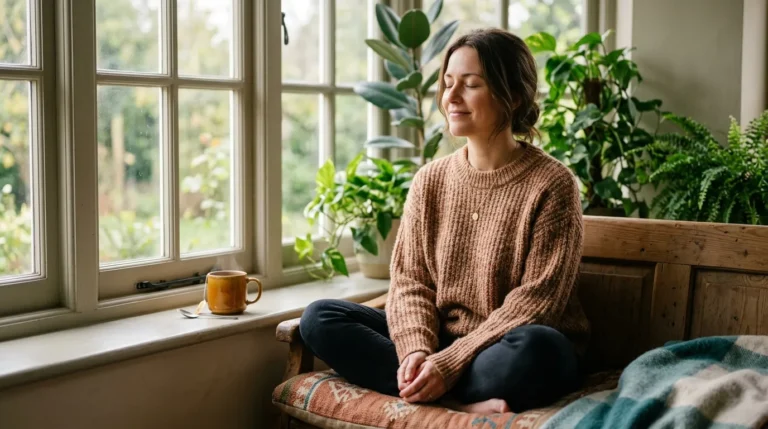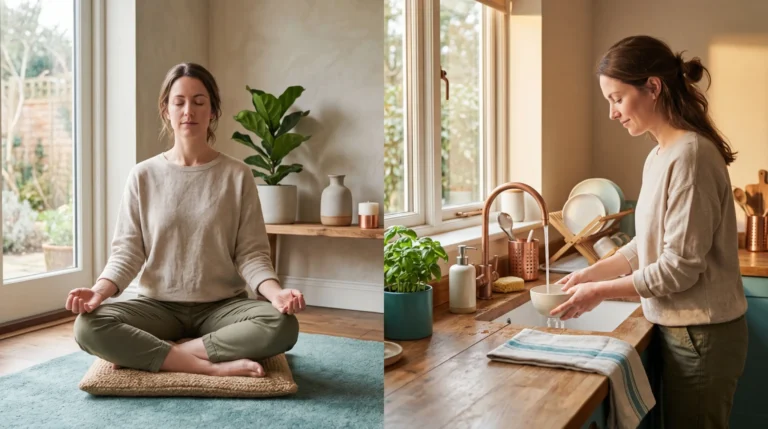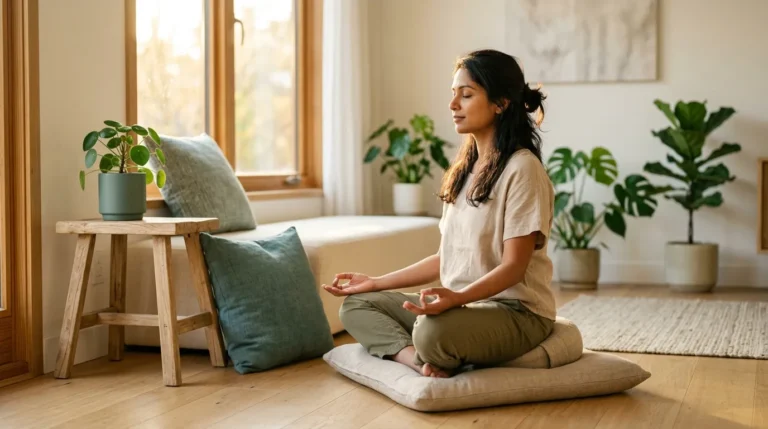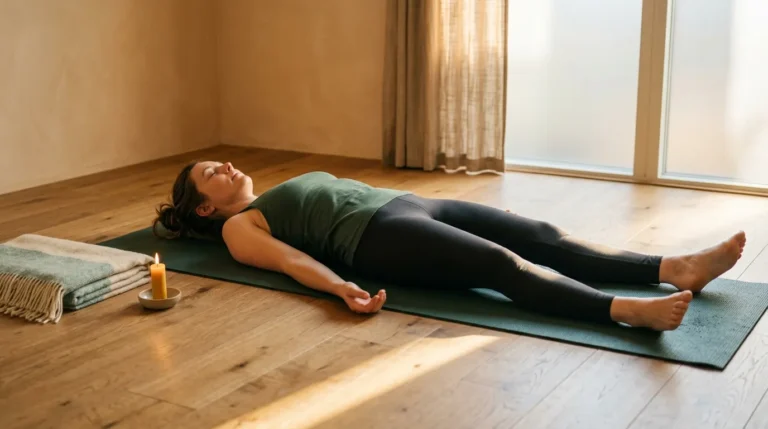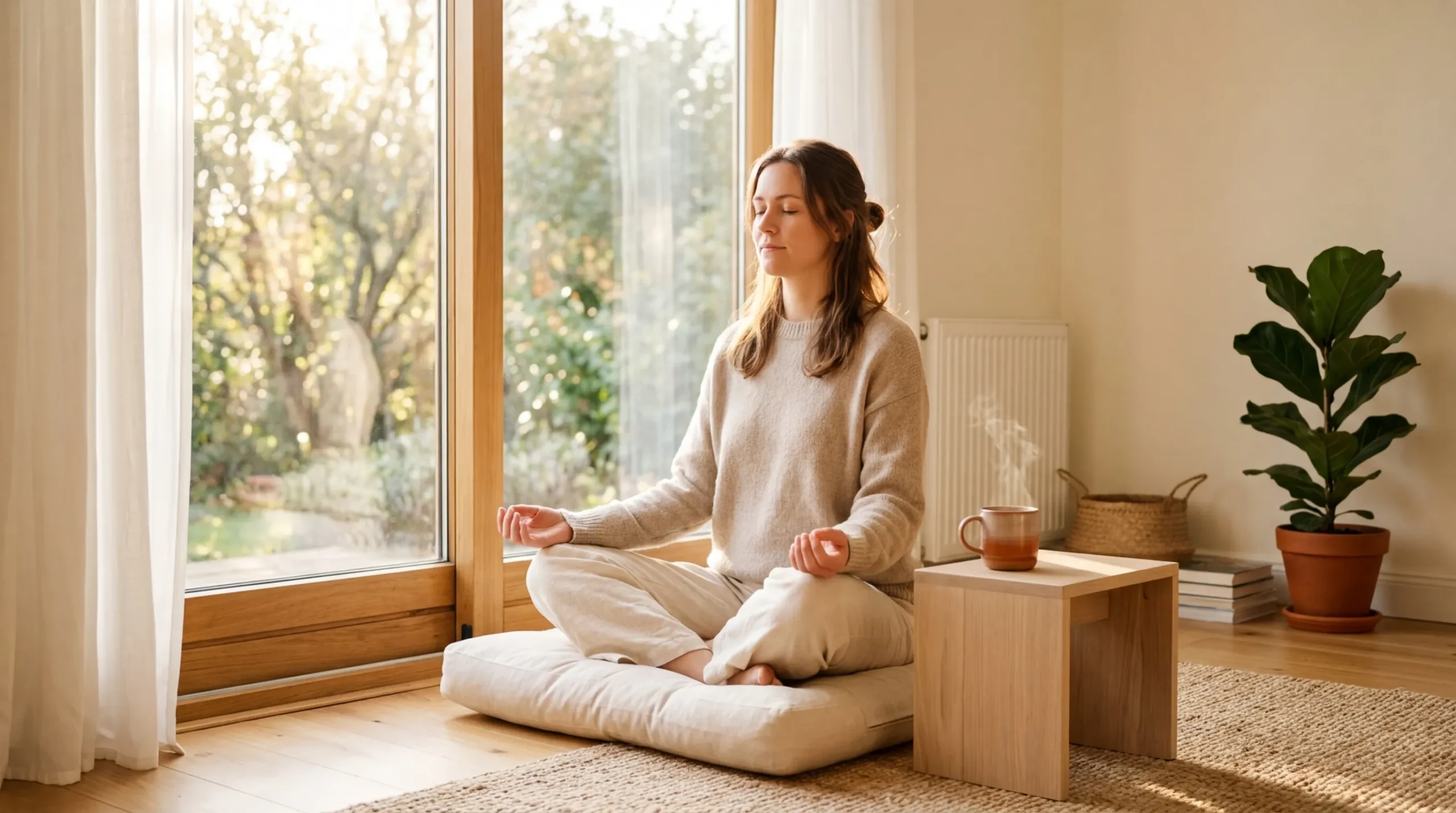
Your alarm goes off. Before your feet even touch the floor, your brain is already running through the day’s meetings, deadlines, and the email you forgot to answer last night. Sound familiar? Here’s what’s happening inside your body: cortisol surges 50-75% within 30 minutes of waking — a spike called the Cortisol Awakening Response (Endocrine Reviews). That’s your body’s built-in stress ignition. But a simple morning meditation can reshape how that cortisol surge plays out. A peer-reviewed study tracking 14,879 meditation app users found that morning meditators retained their practice 63.4% better over six months compared to those who practiced at other times of day (Journal of Medical Internet Research, 2023). Morning isn’t just convenient. It’s when meditation works best.
Key Takeaways
- Morning meditation intercepts your body’s natural cortisol spike, reducing stress before it builds.
- Just 10 minutes produces the same mindfulness benefits as 20 minutes (Scientific Reports, 2023).
- Consistency matters 2.5x more than session length for long-term wellbeing (Applied Psychology: Health and Well-Being, 2025).
- A structured morning routine takes less than 10 minutes and requires no equipment.
Why Does Morning Meditation Work Better Than Other Times?
A 2025 study of 44 healthcare workers found that morning meditation significantly increases positive affect throughout the entire workday (International Journal of Environmental Research and Public Health, 2025). Even more interesting: the mood boost was strongest on mornings after poor sleep. So the worse your night, the more a morning session helps.
Why morning specifically? Three reasons.
First, cortisol peaks in the morning. A 2024 meta-analysis in Psychoneuroendocrinology found that meditation and mindfulness are the most effective interventions for reducing cortisol — outperforming talk therapy by more than threefold (Hedges’ g = 0.345 vs 0.107). Studies measuring cortisol at awakening showed even larger effects (g = 0.644) (Psychoneuroendocrinology, 2024). Meditating when cortisol is highest gives you the biggest bang for your time.
A 2024 meta-analysis in Psychoneuroendocrinology found that meditation reduces cortisol with an overall effect size of g = 0.345, but studies measuring cortisol specifically at awakening showed nearly double the effect (g = 0.644) — making morning the optimal window for meditation’s stress-reducing benefits.
Second, willpower is finite. By evening, decision fatigue erodes your ability to sit down and practice. That’s why app-based data from nearly 15,000 users shows morning sessions stick better (Journal of Medical Internet Research, 2023). Every 10% increase in morning sessions translated to roughly 5.5 additional days of practice before someone quit.
Third, morning meditation sets your baseline. Instead of reacting to stress after it builds, you start the day with your nervous system in a calmer state. Think of it as putting on armor before the battle, not patching wounds after.
What Does Morning Meditation Do to Your Brain?
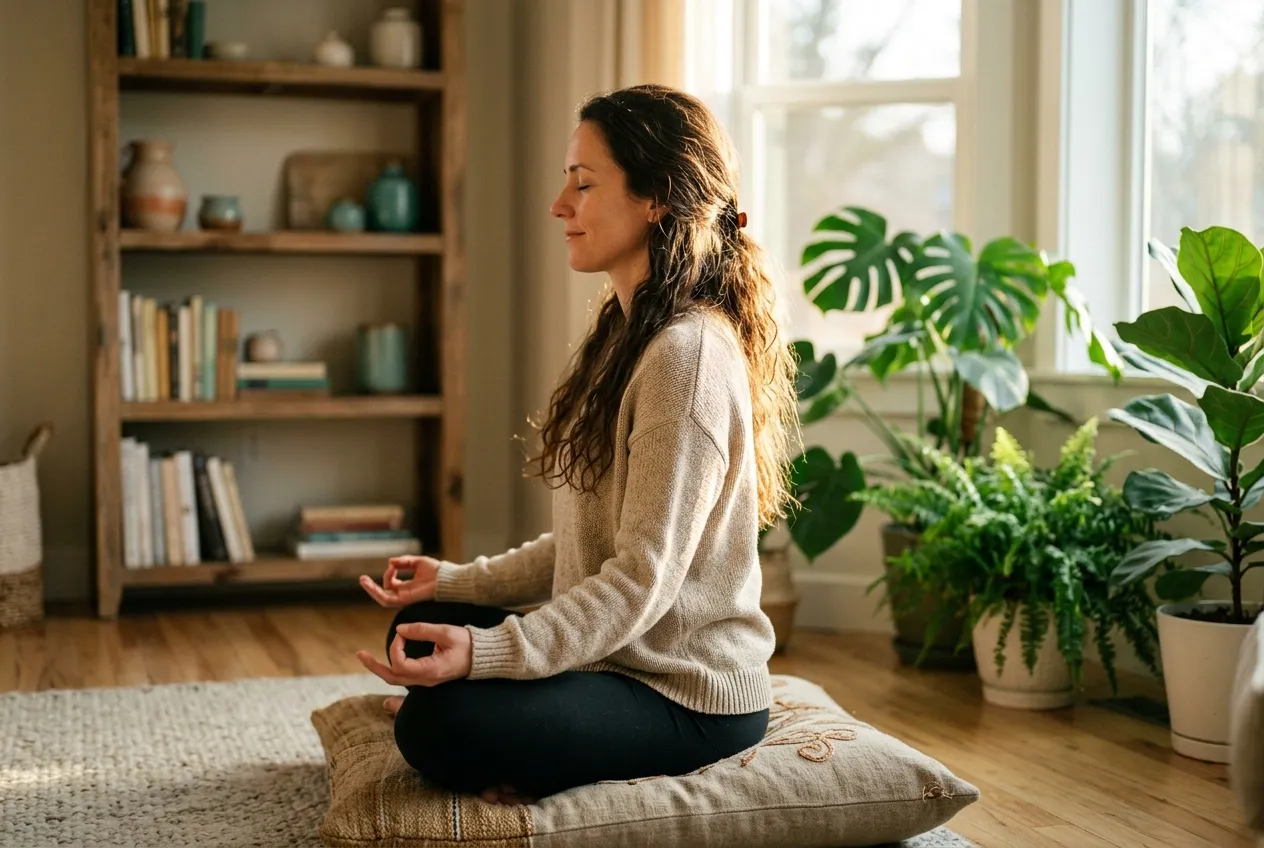
Meditation strengthens the connection between the prefrontal cortex and amygdala — your brain’s core emotion-regulation pathway (Social Cognitive and Affective Neuroscience, 2015). That matters because the prefrontal cortex is your rational decision-maker. The amygdala is your threat detector. When these two communicate well, you respond to stress instead of reacting to it.
How Morning Meditation Calms the Amygdala
An eight-week mindfulness training program reduced right amygdala activation in response to emotional stimuli — even when participants weren’t meditating (Desbordes et al., Frontiers in Human Neuroscience, 2012). The calming effect carried over into daily life. The largest population study to date (3,742 participants) confirmed that regular meditation practitioners have a measurably smaller right amygdala (Brain Imaging and Behavior, 2018). A less reactive amygdala means fewer false alarms throughout your day.
How Morning Meditation Sharpens Focus
A meta-analysis of 111 randomized controlled trials involving 9,538 participants found that mindfulness meditation improves executive attention (g = 0.301), working memory accuracy (g = 0.326), and inhibition control (g = 0.643) (Health Psychology Review, 2023). Those aren’t small numbers. An effect size of 0.643 for inhibition control — the ability to filter distractions — is particularly relevant if your mornings involve back-to-back meetings and constant notifications.
According to a 2023 meta-analysis in Health Psychology Review covering 111 randomized controlled trials and 9,538 participants, mindfulness meditation enhances inhibition accuracy with an effect size of g = 0.643, making it one of the most reliable non-pharmaceutical interventions for improving the ability to filter distractions and maintain focus. For a deeper dive into the focus connection, see my guide on meditation for focus.
What I noticed: After three weeks of morning meditation before checking my phone, my first hour of work became noticeably more productive. I wasn’t calmer because the work was easier — I was calmer because I stopped reacting to every Slack notification as urgent.
How Long Should Your Morning Meditation Be?
Here’s the good news: you don’t need an hour. A 2023 study published in Scientific Reports tested 372 participants in a randomized controlled trial and found no significant difference between 10-minute and 20-minute meditation sessions for state mindfulness (Schlechta Portella et al., Scientific Reports, 2023). Ten minutes is enough.
The 5-Minute Threshold for Stress Reduction
A 2025 JAMA Network Open trial involving 1,458 employees found that as little as 5 minutes of daily meditation produced measurable stress reduction (Cohen’s d = 0.85 for perceived stress). Employees who meditated 5-10 minutes daily showed greater stress improvement than those under 5 minutes (JAMA Network Open, 2025). Benefits held steady at the four-month follow-up.
A 2025 trial published in JAMA Network Open found that employees who meditated for just 5-10 minutes daily experienced significant stress reduction (Cohen’s d = 0.85) that persisted at four-month follow-up, establishing a concrete minimum effective dose for morning meditation practice.
Consistency Beats Duration
Perhaps the most practical finding: a 2025 longitudinal study following 1,053 meditators over two months (with a 2-4 year follow-up) found that practice frequency is approximately 2.5 times more important than session length for improving wellbeing (Applied Psychology: Health and Well-Being, 2025). In other words, 10 minutes every day beats 30 minutes twice a week. If you’re short on time, my 5-minute meditation guide offers techniques designed specifically for busy mornings.
How to Build a Morning Meditation Routine (Step-by-Step)

You don’t need an app, a meditation cushion, or a perfectly quiet room. Here’s a 10-minute morning meditation routine based on the most practiced technique: breath awareness, which 89.3% of experienced practitioners use according to the 2025 Meditation Practice Report (Mindful Leader, 2025).
Step 1: Set Your Alarm 15 Minutes Earlier
Don’t squeeze meditation into an already-rushed morning. Set your alarm just 15 minutes earlier than usual. Those extra minutes remove the pressure. Place your phone across the room so you have to physically get up — this prevents the scroll-before-you-sit trap.
Step 2: Sit Upright, Feet on the Floor
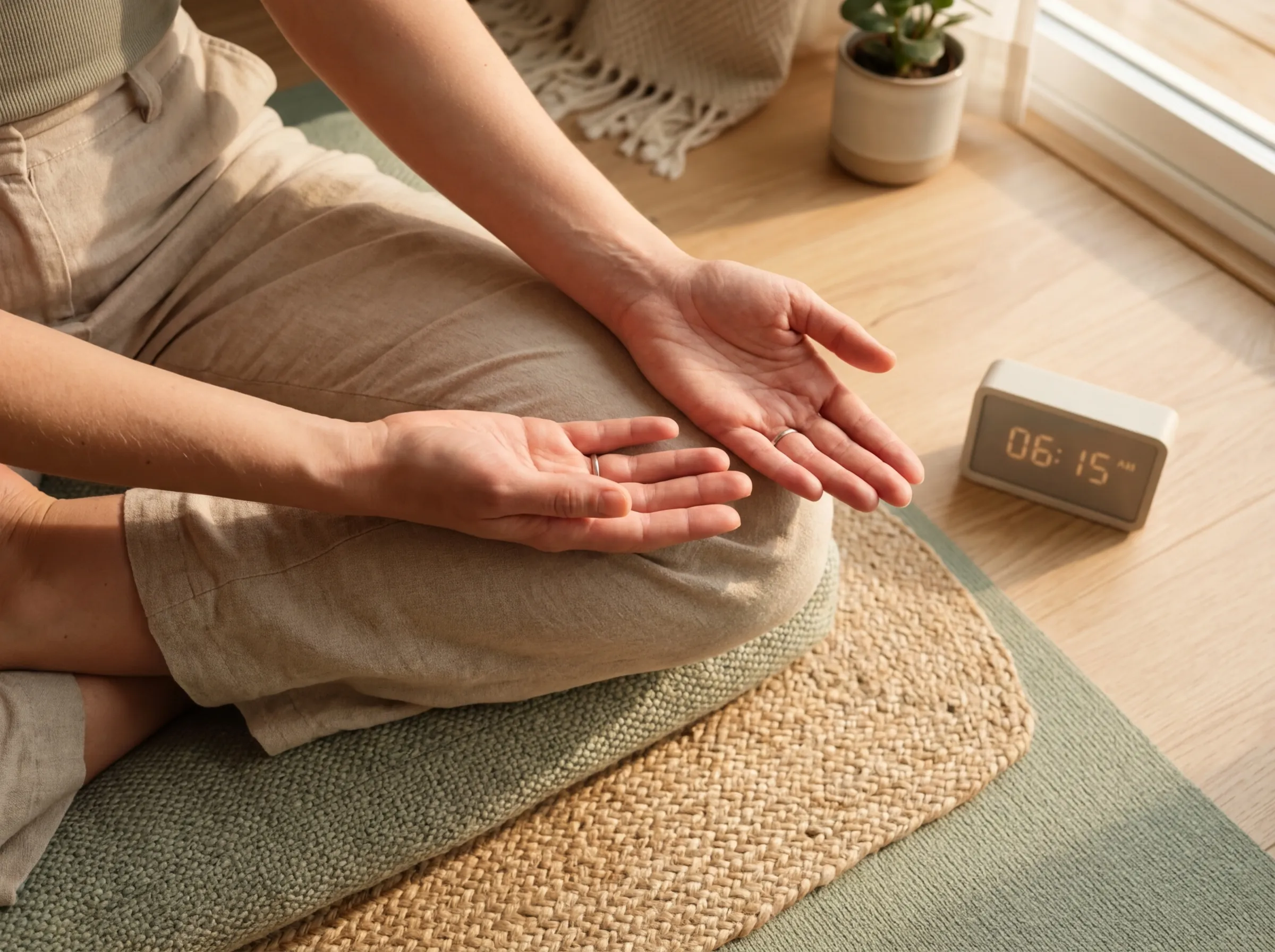
Find a chair, the edge of your bed, or a cushion on the floor. Sit with your spine straight but not rigid. Rest your hands on your thighs. Close your eyes or soften your gaze toward the ground. You don’t need a special posture. Comfort matters more than form.
Step 3: Take Three Deep Breaths
Before settling into the meditation, take three slow, deep breaths through your nose. Exhale fully through your mouth. This signals your nervous system to begin shifting from sympathetic (alert) to parasympathetic (calm) mode. If you want more structure for this opening, breathwork techniques covers several options.
Step 4: Focus on Your Natural Breath (8-10 Minutes)
Now let your breathing return to its natural rhythm. Don’t try to control it. Simply notice the sensation of air entering and leaving your nostrils. When your mind wanders — and it will — gently return attention to the breath. No judgment. Each redirect strengthens your attention circuits, similar to how a bicep curl strengthens your arm. That wandering isn’t failure; it’s the exercise itself.
Step 5: Close With Intention
In the last minute, broaden your awareness. Notice sounds in the room. Feel the weight of your body in the chair. Then set a simple intention for the day — not a goal, but a quality. Something like “patience” or “presence.” Open your eyes slowly. You’re ready.
What If Your Mind Won’t Stop Racing?
This is the single most common concern I hear, and the answer might surprise you: a racing mind is completely normal. Meditation isn’t about achieving a blank mind. Research shows that the act of noticing you’ve wandered and returning to the breath is what builds the neural pathways (Health Psychology Review, 2023).
Three Techniques for a Restless Morning Mind
Counting breaths. Count each exhale from 1 to 10, then start over. If you lose count, begin again at 1. This gives your mind just enough structure to reduce aimless wandering.
Body scan. Instead of focusing on breath, scan from the top of your head to your toes. Spend 30 seconds on each region. Notice tension without trying to fix it. This approach works particularly well if you carry physical stress in your shoulders or jaw. For a detailed walkthrough, see my body scan meditation guide.Anchor phrase. Silently repeat a short phrase on each exhale: “I am here” or simply “calm.” This occupies the verbal part of your brain and reduces intrusive thoughts.
If sitting still makes your anxiety worse on some mornings, that’s a signal to try something active instead. Walking meditation offers the same mindfulness benefits with gentle movement.
How to Make Your Morning Meditation Stick
The biggest barrier to a consistent morning meditation practice isn’t motivation — it’s friction. A 2025 Meditation Practice Report found that 26.2% of practitioners cite lack of time and 26.2% cite distractions as their top obstacles (Mindful Leader, 2025). Here’s how to reduce both.
Habit Stack It
Attach meditation to something you already do every morning. After brushing your teeth, before making coffee. This technique, called habit stacking, removes the decision about “when.” You don’t decide to brush your teeth every morning — you just do it. Your meditation should feel the same way.
Start With 5 Minutes, Not 10
The JAMA study confirms that five minutes is enough for measurable benefits (JAMA Network Open, 2025). Start there. A 2024 study of 1,247 participants across 91 countries found that just 10 minutes daily for 30 days reduced depression symptoms by 19.2% and anxiety by 12.6% (British Journal of Health Psychology, 2024). But you don’t need to start at 10. Build up gradually.
Track, Don’t Judge
Keep a simple tally — a checkmark on a calendar or a note in your phone. Research confirms that 56.6% of experienced meditators practice daily, and those who track their sessions show stronger habit retention (Mindful Leader, 2025). Don’t grade your sessions. Just mark “done.”
Frequently Asked Questions
Can you meditate in bed in the morning?
Yes, but sitting upright works better for most people. Lying down increases the chance of falling back asleep, especially if you’re sleep-deprived. If you do meditate in bed, prop yourself up with pillows so your back is at a 45-degree angle. The key is staying alert enough to maintain attention on your breath.
Is morning meditation better than evening meditation?
For habit formation, yes. Research tracking nearly 15,000 app users found morning meditators retained their practice 63.4% better over six months (Journal of Medical Internet Research, 2023). For stress reduction, morning meditation intercepts your cortisol peak. Evening meditation can improve sleep quality — if that’s your goal, see my better sleep guide.
How quickly will I notice results from morning meditation?
Most people report subtle shifts within one to two weeks of daily practice. A study of 1,247 participants found measurable improvements in depression, anxiety, and wellbeing after 30 days of 10-minute daily sessions (British Journal of Health Psychology, 2024). Brain-level changes in amygdala reactivity appear after approximately eight weeks of consistent practice.
Do I need an app for morning meditation?
No. A Carnegie Mellon review published in American Psychologist confirmed that meditation apps deliver measurable benefits with 10-21 minutes of use, three times per week (Creswell, American Psychologist, 2025). But the same review noted that 95% of users discontinue apps within 30 days. A timer on your phone and the breath-awareness technique above are all you need. Apps can help with guided sessions, but they aren’t necessary. If you do prefer guided structure, our review of the best meditation apps in 2026 covers options ranked specifically on retention — the metric that matters for actually building a morning habit.
What’s the best morning meditation for complete beginners?
Breath awareness — simply focusing on the sensation of breathing — is practiced by 89.3% of meditators and requires no instruction beyond what I’ve described in the step-by-step section above. Start with five minutes. If you want a broader overview of techniques including body scan, loving-kindness, and mindfulness, see my meditation for beginners guide.
Your Next Morning Starts Tonight
The simplest way to start a morning meditation practice is to prepare the night before. Set your alarm 15 minutes early. Choose your spot. Place a glass of water there. Tomorrow morning, skip the phone, sit down, and breathe for five minutes. That’s it.
You don’t need to be good at this. You don’t need to clear your mind. You just need to show up. Because the research is clear: frequency matters 2.5 times more than duration. Five minutes every morning will do more for your stress, focus, and emotional resilience than an occasional 30-minute session ever could.
If you’re new to meditation entirely, start with my meditation for beginners guide for a complete overview of techniques. Already comfortable with breathwork? Try pairing your morning meditation with 4-7-8 breathing for an even deeper calm.
References
- Cortisol Awakening Response. Endocrine Reviews, Endocrine Society. https://www.endocrine.org/journals/endocrine-reviews/the-cortisol-awakening-response
- Rodde, T. et al. (2023). Timing and Consistency of Meditation Practice. Journal of Medical Internet Research. https://pmc.ncbi.nlm.nih.gov/articles/PMC10131734/
- Akinola, I. et al. (2025). Morning Mindfulness in Healthcare Workers. International Journal of Environmental Research and Public Health. https://pmc.ncbi.nlm.nih.gov/articles/PMC12027109/
- Schlechta Portella, C. F. et al. (2023). 10 vs 20-Minute Meditation Sessions. Scientific Reports. https://www.nature.com/articles/s41598-023-46578-y
- Radin, A. et al. (2025). Digital Meditation for Employee Stress. JAMA Network Open. https://jamanetwork.com/journals/jamanetworkopen/fullarticle/2829186
- Bowles, D. & Van Dam, N. (2025). Meditation Frequency vs Duration. Applied Psychology: Health and Well-Being. https://pmc.ncbi.nlm.nih.gov/articles/PMC12336962/
- Psychotherapy and Cortisol Meta-Analysis (2024). Psychoneuroendocrinology. https://www.sciencedirect.com/science/article/pii/S0306453023003931
- Gill, L. N. et al. (2023). Mindfulness and Cognition Meta-Analysis. Health Psychology Review. https://pmc.ncbi.nlm.nih.gov/articles/PMC10902202/
- Desbordes, G. et al. (2012). Amygdala Reactivity and Mindfulness. Frontiers in Human Neuroscience. https://pmc.ncbi.nlm.nih.gov/articles/PMC3485650/
- Gotink, R. A. et al. (2018). Meditation and Amygdala Volume. Brain Imaging and Behavior. https://pmc.ncbi.nlm.nih.gov/articles/PMC6302143/
- Taren, A. A. et al. (2015). MBSR and Amygdala-PFC Connectivity. Social Cognitive and Affective Neuroscience. https://academic.oup.com/scan/article/10/12/1758/2502572
- Remskar, M. et al. (2024). 10-Minute Daily Mindfulness RCT. British Journal of Health Psychology. https://bpspsychub.onlinelibrary.wiley.com/doi/10.1111/bjhp.12745
- Creswell, J. D. (2025). Meditation Apps Review. American Psychologist / CMU. https://www.cmu.edu/news/stories/archives/2025/august/meditation-apps-deliver-real-health-benefits-research-finds
- 2025 Meditation Practice Report. Mindful Leader. https://www.mindfulleader.org/blog/106947-meditation-practice-report