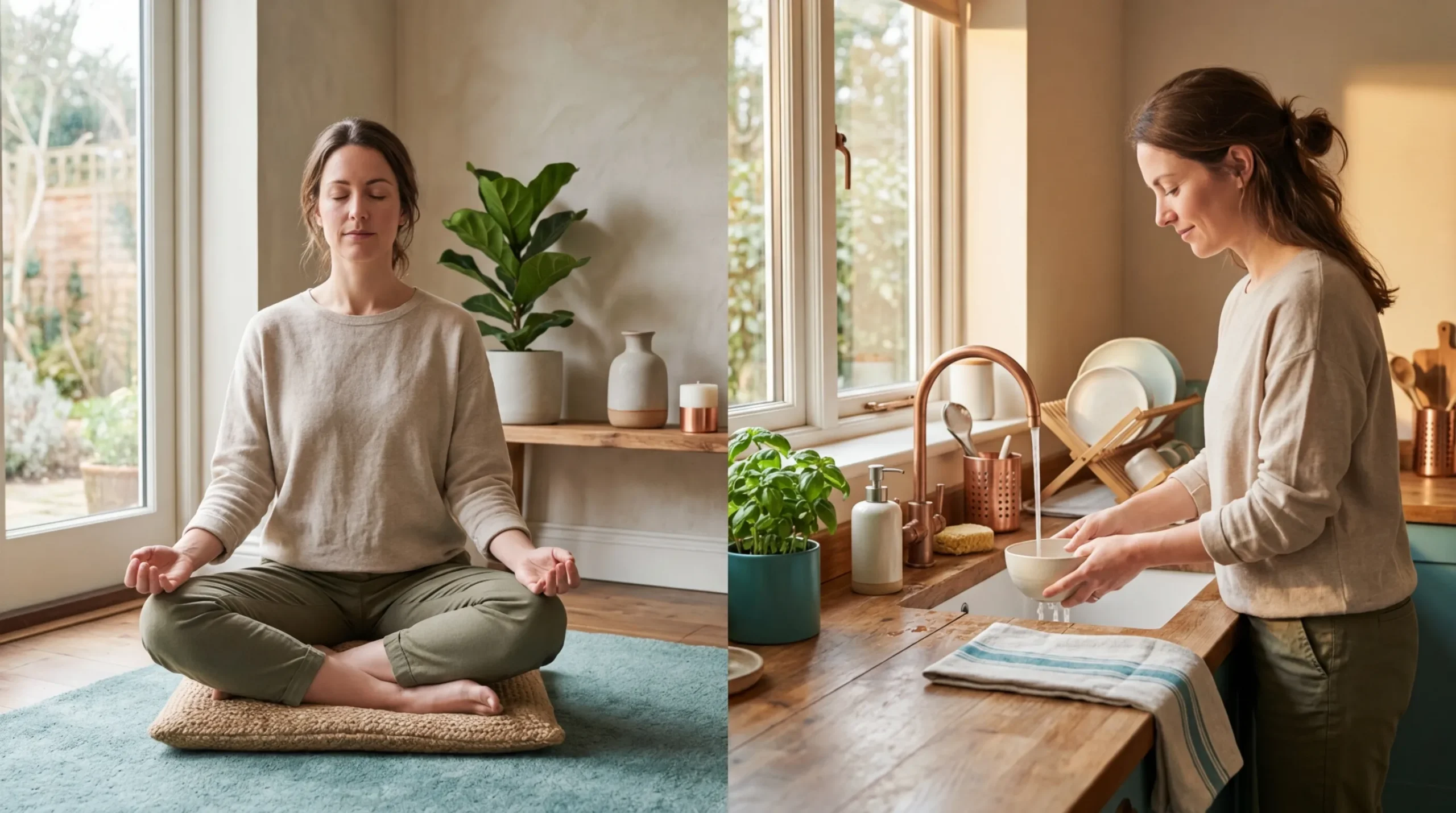
Someone tells you to “try meditation.” Someone else suggests “practicing mindfulness.” Are they saying the same thing? Not exactly — and the confusion matters. The American Psychological Association defines mindfulness as “awareness of one’s internal states and surroundings” (APA). Meditation, by contrast, is a structured practice you do for a set period. Here’s the simplest way I can put it: mindfulness is a skill. Meditation is the workout that builds it. But you can also practice mindfulness without ever sitting down to meditate — and that’s where things get interesting. Understanding the difference between mindfulness vs meditation helps you choose the right approach for your specific goals, whether that’s managing stress, improving focus, or just feeling less scattered during your day.
Key Takeaways
- Meditation is the broader practice; mindfulness is one specific type of meditation.
- Mindfulness improves emotional regulation and reduces rumination (Health Psychology Review, 2023).
- Both practices reduce stress, but through different mechanisms.
- Start with mindfulness meditation if you’re new — it’s the most researched and accessible form.

What Is Mindfulness, Exactly?
The APA’s two-component model describes mindfulness as: first, self-regulation of attention to maintain focus on immediate experience; and second, an orientation of curiosity, openness, and acceptance toward that experience (APA). In plain language, mindfulness means paying attention to what’s happening right now — without judging it as good or bad.
Mindfulness as a Trait vs. a State
Researchers distinguish between trait mindfulness (your natural tendency to be present) and state mindfulness (being present in a specific moment). A 2025 study in Scientific Reports found that meditation interventions increased state mindfulness among participants with lower trait mindfulness (Scientific Reports, 2025). In other words, if you’re naturally not very present, meditation helps the most. That’s encouraging — it means the people who need it most benefit the most.
A 2025 study in Scientific Reports found that meditation interventions increased state mindfulness specifically among participants with lower baseline trait mindfulness, suggesting that the distinction between mindfulness and meditation matters most for beginners — those who aren’t naturally present gain the most from structured practice.
Everyday Mindfulness in Action
You don’t need to close your eyes to be mindful. Eating lunch without scrolling your phone. Listening to a coworker without planning your response. Noticing the temperature of water on your hands while washing dishes. A 2025 workplace study in Frontiers in Psychology found that programs focused on informal mindfulness training during work activities produced significant improvements in self-compassion, communication, and wellbeing (Frontiers in Psychology, 2025).
What Is Meditation, and How Is It Different?
Meditation is a specific, deliberate practice — you set aside time, adopt a posture, and direct your attention in a particular way. The 111-RCT meta-analysis found that formal meditation practice improves executive attention (g = 0.301), working memory (g = 0.326), and inhibition control (g = 0.643) across 9,538 participants (Health Psychology Review, 2023). Those cognitive improvements come from the repeated, structured exercise of attention — something informal mindfulness alone doesn’t provide as efficiently.
Types of Meditation That Build Mindfulness
Not all meditation is mindfulness meditation. Here are the main categories:
Focused attention meditation. You concentrate on one object — usually your breath. When your mind wanders, you notice and return. This builds concentration and is the most common starting point. A 2025 study found it significantly improves sustained attention while also lowering perceived stress (PLOS ONE, 2025).Open monitoring meditation. Instead of narrowing focus, you observe everything arising in your awareness without reacting. This builds meta-awareness — the ability to watch your own thoughts. It reduces brain activity in regions tied to habitual thinking (Scientific Reports, 2018).Loving-kindness meditation. You direct feelings of warmth toward yourself and others. Less about attention, more about emotional regulation.
Body scan meditation. You systematically notice sensations from head to toe. Excellent for releasing physical tension and building interoceptive awareness — your brain’s ability to sense what’s happening inside your body.
For a deeper exploration of each type, my meditation for beginners guide walks through all of them with step-by-step instructions.
Mindfulness vs Meditation: How Each Changes Your Brain
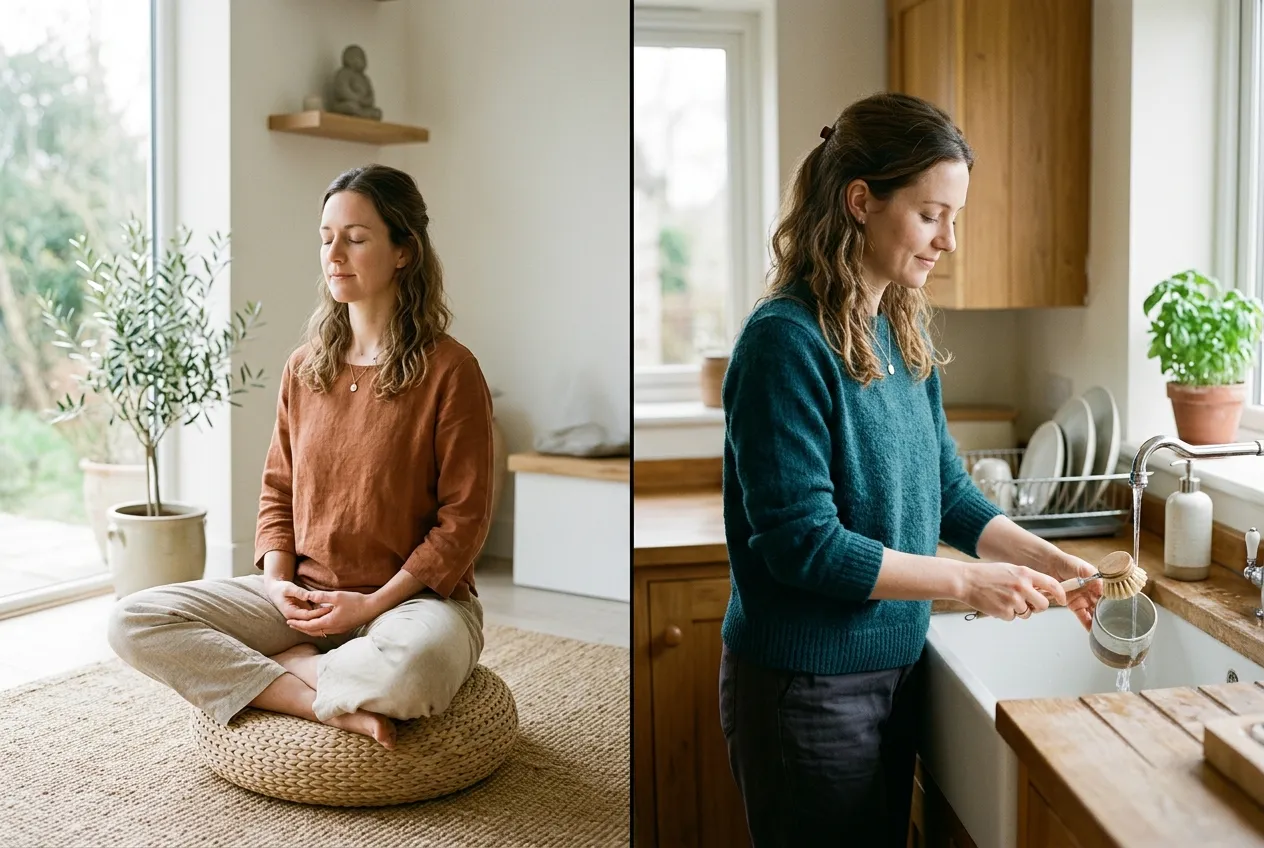
Both mindfulness and meditation produce measurable brain changes, but the mechanisms differ.
What Meditation Does to Your Brain
Regular meditation practice reduces activity in the default mode network — the brain region responsible for mind-wandering and rumination. A landmark PNAS study found experienced meditators showed significantly less default mode network activity during all types of meditation compared to novices (PNAS, 2011). Meditation also increases cortical thickness in the prefrontal cortex and reduces amygdala volume over time (Brain Imaging and Behavior, 2018). These are structural changes — your brain physically reorganizes.
Regular meditation practice reduces default mode network activity across all meditation types and increases cortical thickness in the prefrontal cortex, according to a PNAS study (Brewer et al., 2011). These structural brain changes from formal meditation practice are distinct from the behavioral changes produced by informal mindfulness — a key difference when comparing mindfulness vs meditation approaches.
What Mindfulness Does to Your Behavior
Mindfulness, practiced informally throughout the day, changes how you respond to situations rather than changing brain structure. A 2024 study of 1,247 participants found that just 10 minutes of daily mindfulness practice reduced depression by 19.2% and anxiety by 12.6% compared to controls, with improvements sustained at one-month follow-up (British Journal of Health Psychology, 2024). These behavioral changes happen faster than structural brain changes but may be less durable without ongoing practice.
The practical distinction: Meditation gives you a stronger engine. Mindfulness teaches you to drive better. You can improve your driving without building a stronger engine, and you can build a stronger engine without changing how you drive. But combining both? That’s where the real gains happen.
Which Is Better for Stress: Mindfulness or Meditation?
Both work, but a 2024 meta-analysis in Psychoneuroendocrinology found that structured meditation and mindfulness interventions are the most effective approaches for reducing cortisol — outperforming talk therapy by more than threefold (Psychoneuroendocrinology, 2024). The key word is “structured.” Informal mindfulness helps, but formal practice delivers stronger physiological results.
A 2024 meta-analysis in Psychoneuroendocrinology found that structured meditation and mindfulness interventions reduce cortisol with an effect size of g = 0.345, outperforming talk therapy by more than threefold (g = 0.107) — demonstrating that while both mindfulness and meditation reduce stress, formal practice produces measurably stronger physiological changes.
When Mindfulness Is Enough
If your stress comes from autopilot habits — eating too fast, scrolling instead of sleeping, half-listening in conversations — informal mindfulness can break those patterns without any formal practice. A workplace study found significant improvements in communication and self-compassion from just informal mindfulness during work activities (Frontiers in Psychology, 2025).
When You Need Meditation
If your stress is chronic, keeps you awake at night, or manifests physically (tension headaches, jaw clenching, racing heart), formal meditation provides stronger intervention. The JAMA study of 1,458 employees found that even five minutes of daily structured meditation produced measurable stress reduction with an effect size of 0.85 (JAMA Network Open, 2025). For a quick routine you can start tonight, my better sleep guide includes meditation techniques specifically for calming a wired nervous system.
How to Practice Both: A Simple Weekly Framework
You don’t have to choose between mindfulness and meditation. Here’s a practical framework that combines both.
Formal Meditation (3-5 Times Per Week)
Set aside 10 minutes for focused attention meditation. Sit, close your eyes, focus on your breath. The morning meditation routine I’ve described works well here — research shows morning sessions stick 63.4% better (Journal of Medical Internet Research, 2023). If you’re short on time, 5-minute meditation offers effective alternatives.
Informal Mindfulness (Daily, No Extra Time Needed)
Pick one daily activity and do it with full attention. Some ideas:
- Mindful coffee. Notice the warmth of the mug, the aroma, the first sip. No phone.
- Mindful commute. If walking, feel each footstep. If driving, notice your grip on the wheel.
- Mindful transition. Before entering a meeting, take three conscious breaths. Feel your feet on the floor.
What I noticed: I started with just mindful coffee — putting my phone in another room for the first five minutes of the morning. Within a week, those five minutes became the calmest part of my day. It wasn’t meditation. It was just paying attention. And it made me actually want to sit down and meditate afterward.
The Progression
Start with informal mindfulness. It’s easier, requires no time commitment, and builds the awareness muscle. Once mindfulness feels natural, add formal meditation sessions. Research suggests practicing focused attention meditation first, then expanding to open monitoring — the traditional sequence that builds skills most efficiently (PLOS ONE, 2025).
Frequently Asked Questions
Is mindfulness the same as meditation?
No. Mindfulness is a quality of present-moment awareness you can apply anytime — while eating, walking, or working. Meditation is a dedicated practice where you sit and train attention for a set period. The APA defines mindfulness as “awareness of one’s internal states and surroundings,” while meditation is the structured exercise that strengthens that awareness (APA).
Can you be mindful without meditating?
Yes. Informal mindfulness practice — paying full attention during everyday activities — produces measurable benefits. A 2025 workplace study found that informal mindfulness training improved wellbeing, self-compassion, and communication without formal meditation sessions (Frontiers in Psychology, 2025). However, combining informal mindfulness with formal meditation delivers stronger and more durable results.
Which should a beginner try first: mindfulness or meditation?
Start with informal mindfulness — it’s easier and requires no extra time. Pick one daily activity (coffee, commuting, dishes) and do it with full attention. Once that feels natural, add five minutes of formal seated meditation. For a complete walkthrough, see my meditation for beginners guide.
How long does mindfulness take to work?
A study of 1,247 participants found measurable improvements in depression, anxiety, and wellbeing after just 30 days of 10-minute daily mindfulness practice (British Journal of Health Psychology, 2024). Many people report feeling calmer within one to two weeks. Brain-level structural changes from formal meditation appear after approximately eight weeks.
Is mindfulness vs meditation a matter of effort?
Both require effort, but different kinds. Meditation demands scheduled time and sitting still — that’s why consistency is the biggest challenge. Mindfulness requires interrupting autopilot mode throughout your day, which can be just as difficult in a different way. Research confirms that frequency matters 2.5 times more than duration for long-term benefits (Applied Psychology: Health and Well-Being, 2025).
Start Where You Are
You don’t need to decide between mindfulness and meditation right now. Start with the lower-friction option: be fully present during one activity tomorrow. That’s mindfulness. When you’re ready for more, sit for five minutes and watch your breath. That’s meditation. Together, they’re the most effective non-pharmaceutical approach to managing stress, sharpening focus, and building emotional resilience that science has found.
Already interested in formal practice? My meditation for beginners guide covers everything from posture to technique. Want to strengthen your body’s calm response? Breathwork techniques pairs naturally with both mindfulness and meditation.
References
- Mindfulness. APA Dictionary of Psychology. https://dictionary.apa.org/mindfulness
- Gill, L. N. et al. (2023). Mindfulness and Cognitive Functioning Meta-Analysis. Health Psychology Review. https://pmc.ncbi.nlm.nih.gov/articles/PMC10902202/
- Brewer, J. A. et al. (2011). Default Mode Network and Meditation. PNAS. https://www.pnas.org/doi/10.1073/pnas.1112029108
- Gotink, R. A. et al. (2018). Meditation and Amygdala Volume. Brain Imaging and Behavior. https://pmc.ncbi.nlm.nih.gov/articles/PMC6302143/
- Sampaio, A. et al. (2025). Focused Attention and Open Monitoring Effects. PLOS ONE. https://journals.plos.org/plosone/article?id=10.1371/journal.pone.0322537
- Lardone, A. et al. (2018). Open Monitoring Meditation Brain Regions. Scientific Reports. https://www.nature.com/articles/s41598-018-28274-4
- Remskar, M. et al. (2024). 10-Minute Daily Mindfulness RCT. British Journal of Health Psychology. https://bpspsychub.onlinelibrary.wiley.com/doi/10.1111/bjhp.12745
- Ichikawa, K. et al. (2025). Informal Mindfulness in the Workplace. Frontiers in Psychology. https://www.frontiersin.org/journals/psychology/articles/10.3389/fpsyg.2025.1526275/full
- Intervention-induced State Mindfulness (2025). Scientific Reports. https://www.nature.com/articles/s41598-025-27697-0
- Psychotherapy and Cortisol Meta-Analysis (2024). Psychoneuroendocrinology. https://www.sciencedirect.com/science/article/pii/S0306453023003931
- Radin, A. et al. (2025). Digital Meditation for Employee Stress. JAMA Network Open. https://jamanetwork.com/journals/jamanetworkopen/fullarticle/2829186
- Rodde, T. et al. (2023). Timing and Consistency of Meditation Practice. Journal of Medical Internet Research. https://pmc.ncbi.nlm.nih.gov/articles/PMC10131734/
- Bowles, D. & Van Dam, N. (2025). Meditation Frequency vs Duration. Applied Psychology: Health and Well-Being. https://pmc.ncbi.nlm.nih.gov/articles/PMC12336962/